Showing posts with label bearish. Show all posts

Saturday, January 12, 2019

Simple Day Trades - Gap Windows and Price Spikes

IMPORTANT NOTE: Pre-market trades like these are posted in our morning update and video only. We don’t want to blanket all our longer term traders with day trades. So if you are an active trader be sure you read our morning update and watch the video with your morning coffee.

The morning gap has filled and our spike targets are being reached as well. Keep in mind, these are short term trade setup which will be implemented into our member’s area in the near future that auto update and post for those of you who want to take advantage of early day trades and be done by 11 am most trading sessions. Once we have things implemented there will be a detailed PDF on how trading these along with a video.


For you longer term traders we are also working on having our swing trade charts and signal post and update automatically in the member’s area as well. Each trading strategy, chart, and signals will run in a separate member’s area page and you will be able to follow and trade the strategies that fit your personality and trading style.

This is going to take us 30 - 60+ days to get things fully set up and running and it’s going to add a lot of value and opportunities for you – Subscribe Now!

Chris Vermeulen
Chief Investment Strategist


Stock & ETF Trading Signals


Stock & ETF Trading Signals

Saturday, December 30, 2017

2018 First Quarter Technical Analysis Price Forecast

As 2017 draws to a close, our analysis shows the first Quarter of 2018 should start off with a solid rally. Our researchers use our proprietary modeling and technical analysis systems to assist our members with detailed market analysis and timing triggers from expected intraday price action to a multi-month outlook.

These tools help us to keep our members informed of market trends, reversals, and big moves. Today, we are going to share some of our predictive modelings with you to show you why we believe the first three months of 2018 should continue higher.

One of our most impressive and predictive modeling systems is the Adaptive Dynamic Learning system. This system allows us to ask the market what will be the highest possible outcome of recent trading activity projected into the future. It accomplishes this by identifying Genetic Price/Pattern markers in the past and recording them into a Genome Map of price activity and probable outcomes.

This way, when we ask it to show us what it thinks will be the highest probable outcome for the future, it looks into this Genome Map, finds the closest relative Genetic Price/Pattern marker and then shows us what this Genome marker predicts as the more likely outcome.

This current Weekly chart of the SPY is showing us that the next few Weeks and Months of price activity should produce a minimum of a $5 – $7 rally. This means that we could see a continued 2~5% rally in US Equities early in 2018.


Additionally, the ES (S&P E-mini futures) is confirming this move in early 2018 with its own predictive analysis. The ADL modeling system is showing us that the ES is likely to move +100 pts from current levels before the end of the first Quarter 2018 equating to a +3.5% move (or higher). We can see from this analysis that a period of congestion or consolidation is expected near the end of January or early February 2018 – which would be a great entry opportunity.


The trends for both of these charts is strongly Bullish and the current ADL price predictions allow investors to understand the opportunities and expectations for the first three months of 2018. Imagine being able to know or understand that a predictive modeling system can assist you in making decisions regarding the next two to three months as well as assist you in planning and protecting your investments? How powerful would that technology be to you?

Our job at Technical Traders Ltd. is to assist our members in finding and executing profitable trades and to assist them in understanding market trends, reversals, and key movers. We offer a variety of analysis types within our service to support any level of a trader from novice to expert, and short term to long term investors.

Our specialized modeling systems allow us to provide one of a kind research and details that are not available anywhere else. Our team of researchers and traders are dedicated to helping us all find great success with our trading.

So, now that you know what to expect from the SPY and ES for the next few months, do you want to know what is going to happen in Gold, Silver, Bonds, FANGs, the US Dollar, Bitcoin, and more?

Join The Technical Traders Right Here to gain this insight and knowledge today.

Chris Vermeulen

Stock & ETF Trading Signals

Thursday, August 20, 2015

A Great Insight into Why Commodity Weakness Will Persist

By John Mauldin 

In today’s Outside the Box, good friend Gary Shilling gives us deeper insight into the global economic trends that have led to China’s headline making, market shaking devaluation of the renminbi. He reminds us that today’s currency moves and lagging growth are the (perhaps inevitable) outcome of China massive expansion of output for many products that started more than a decade ago. China was at the epicenter of a commodity bubble that got underway in 2002, soon after China joined the World Trade Organization.

As manufacturing shifted from North America and Europe to China –with China now consuming more than 40% of annual global output of copper, tin, lead, zinc and other nonferrous metal while stockpiling increased quantities of iron ore, petroleum and other commodities – many thought a permanent commodity boom was here.

Think again, Australia; not so fast, Brazil. Copper prices, for instance, have been cut nearly in half as world growth, and Chinese internal demand, have weakened. Coal is another commodity that is taking a huge hit: China’s imports of coking coal used in steel production are down almost 50% from a year ago, and of course coal is being hammered here in the US, too.

And the litany continues. Grain prices, sugar prices, and – the biggee – oil prices have all cratered in a world where the spectre of deflation has persistently loomed in the lingering shadow of the Great Recession. (They just released grain estimates for the US, and apparently we’re going to be inundated with corn and soybeans. The yield figures are almost staggeringly higher than the highest previous estimates. Very bearish for grain prices.)

Also, most major commodities are priced in dollars; and now, as the US dollar soars and the Fed prepares to turn off the spigot, says Gary, “raw materials are more expensive and therefore less desirable to overseas users as well as foreign investors.” As investors flee commodities in favor of the US dollar and treasuries, there is bound to be a profound shakeout among commodity producers and their markets.

See the conclusion of the article for a special offer to OTB readers for Gary Shilling’s INSIGHT. Gary’s letter really does provide exceptional value to his readers and clients. It’s packed with well-reasoned, outside-the-consensus analysis. He has consistently been one of the best investors and analysts out there.

There are times when you look at your travel schedule and realize that you just didn’t plan quite as well as you could have. On Monday morning I was in the Maine outback with my youngest son, Trey, and scheduled to return to Dallas and then leave the next morning to Vancouver and Whistler to spend a few days with Louis Gave. But I realized as Trey and I got on the plane that I no longer needed to hold his hand to escort him back from Maine. He’s a grown man now. I could’ve flown almost directly to Vancouver and cut out a lot of middlemen. By the time that became apparent, it was too late and too expensive to adjust.

Camp Kotok, as it has come to be called, was quite special this year. The fishing sucked, but the camaraderie was exceptional. I got to spend two hours one evening with former Philadelphia Fed president Charlie Plosser, as he went into full-on professor mode on one topic after another. I am in the midst of thinking about how my next book needs to be written and researched, and Charlie was interested in the topic, which is how the world will change in the next 20 years, what it means, and how to invest in it. Like a grad student proposing a thesis, I was forced by Charlie to apply outline and structure to what had been only rough thinking.

There may have been a dozen conversations like that one over the three days, some on the boat – momentarily interrupted by fish on the line – and some over dinner and well into the night. It is times like that when I realize my life is truly blessed. I get to talk with so many truly fascinating and brilliant people. And today I find myself with Louis Gave, one of the finest economic and investment thinkers in the world (as well as a first class gentleman and friend), whose research is sought after by institutions and traders everywhere. In addition to talking about family and other important stuff, we do drift into macroeconomic talk. Neither of us were surprised by the Chinese currency move and expect that this is the first of many
.
I did a few interviews while I was in Maine. Here is a short one from the Street.com. They wanted to talk about what I see happening in Europe. And below is a picture from the deck of Leen’s Lodge at sunset. Today I find myself in the splendor of the mountains of British Columbia. It’s been a good week and I hope you have a great one as well.


Oops, I’ve just been talked into going zip-trekking this afternoon with Louis and friends. Apparently they hang you on a rope and swing you over forests and canyons. Sounds interesting. Looks like we’ll do their latest and greatest, the Sasquatch. 2 km over a valley. Good gods.

Your keenly aware of what a blessing his life is analyst,
John Mauldin, Editor

Stay Ahead of the Latest Tech News and Investing Trends...

Each day, you get the three tech news stories with the biggest potential impact.

Commodity Weakness Persists

(Excerpted from the August 2015 edition of A. Gary Shilling’s INSIGHT)
The sluggish economic growth here and abroad has spawned three significant developments – falling commodity prices, looming deflation and near-universal currency devaluations against the dollar. With slowing to negative economic growth throughout the world, it’s no surprise that commodity prices have been falling since early 2011 (Chart 1). While demand growth for most commodities is muted, supply jumps as a result of a huge expansion of output for many products a decade ago. China was the focus of the commodity bubble that started in early 2002, soon after China joined the World Trade Organization at the end of 2001.


China, The Manufacturer


As manufacturing shifted from North America and Europe to China – with China now consuming more than 40% of annual global output of copper, tin, lead, zinc and other nonferrous metal while stockpiling increased quantities of iron ore, petroleum and other commodities – many thought a permanent commodity boom was here.

So much so that many commodity producers hyped their investments a decade ago to expand capacity that, in the case of minerals, often take five to 10 years to reach fruition. In classic commodity boom-bust fashion, these capacity expansions came on stream just as demand atrophied due to slowing growth in export-dependent China, driven by slow growth in developed country importers. Still, some miners maintain production because shutdowns and restarts are expensive, and debts incurred to expand still need to be serviced. Also, some mineral producers are increasing output since they believe their low costs will squeeze competitors out. Good luck, guys!

Copper, Our Favorite


Copper is our favorite industrial commodity because it's used in almost every manufactured product and because there are no cartels on the supply or demand side to offset basic economic forces. Also, copper is predominantly produced in developing economies that need the foreign exchange generated by copper exports to service their foreign debts. So the lower the price of copper, the more they must produce and export to get the same number of dollars to service their foreign debts. And the more they export, the more the downward pressure on copper prices, which forces them to produce and export even more in a self reinforcing downward spiral in copper prices. Copper prices have dropped 48% since their February 2011 peak, and recently hit a six year low as heavy inventories confront subdued demand (Chart 2).


Even in 2013, after two solid years of commodity price declines, major producers were in denial. That year, Glencore purchased Xtrata and Glencore CEO Ivan Glasenberg called it “a big play” on coal. “To really screw this up, the coal price has got to really tank,” he said at the time. Since then, it’s down 41%. But back in February 2012 when the merger was announced, coal was selling at around $100 per ton and Chinese coal demand was still robust.

Nevertheless, Chinese coal consumption fell in 2014 for the first time in 14 years and U.S. demand is down as power plants shift from coal to natural gas. Meanwhile, coal output is jumping in countries such as Australia, Colombia and Russia. China’s imports of coking coal used in steel production are down almost 50% from a year ago. Many coal miners lock in sales at fixed prices, but at current prices, over half of global coal is being mined at a loss. U.S. coal producers are also being hammered by environmentalists and natural gas producers who advocate renewable energy and natural gas vs. coal.

Losing Confidence?


Recently, major miners appear to be losing their confidence, or at least they seem to be facing reality. Anglo-American recently announced $4 billion in writedowns, largely on its Minas-Rio $8.8 billion iron ore project in Brazil, but also due to weakness in metallurgical coal prices. BHP took heavy writedowns on badly timed investments in U.S. shale gas assets. Rio Tinto’s $38 billion acquisition of aluminum producer Alcan right at the market top in 2007 has become the poster boy for problems with big writeoffs due to weak aluminum prices and cost overruns.

Glencore intends to spin off its 24% stake in Lonmin, the world’s third largest platinum producer. Iron ore-focused Vale is considering a separate entity in its base metals division to “unlock value.” Meanwhile, BHP is setting up a separate company, South 32, to house losing businesses including coal mines and aluminum refiners. That will halve its assets and number of continents in which it operates, leaving it oriented to iron ore, copper and oil.

Goldman Sachs coal mines suffered from falling prices and labor problems in Colombia. It is selling all its coal mines at a loss and has also unloaded power plants as well as aluminum warehouses. The firm’s commodity business revenues dropped from $3.4 billion in 2009 to $1.5 billion in 2013. JP Morgan Chase last year sold its physical commodity assets, including warehouses. Morgan Stanley has sold its oil shipping and pipeline businesses and wants to unload its oil trading and storage operations.

Jefferies, the investment bank piece of Leucadia National Corp., is selling its Bache commodities and financial derivatives business that it bought from Prudential Financial in 2011 for $430 million. But the buyer, Societe Generale, is only taking Bache’s top 300 clients by revenue while leaving thousands of small accounts, and paying only a nominal sum. Bache had operating losses for its four years under Jefferies ownership.

Grains and other agricultural products recently have gone through similar but shorter cycles than basic industrial commodities. Bad weather three years ago pushed up grain prices, which spawned supply increases as farmers increased plantings. Then followed, as the night the day, good weather, excess supply and price collapses. Pork and beef production and prices have similar but longer cycles due to the longer breeding cycles of animals.

Sugar prices have also nosedived in recent years (Chart 3). Cane sugar can be grown in a wide number of tropical and subtropical locations and supply can be expanded quickly. Like other Latin American countries, Brazil – the world's largest sugar producer – enjoyed the inflow of money generated from the Fed’s quantitative easing. But that ended last year and in combination with falling commodity prices, those countries’ currencies are plummeting (Chart 4). So Brazilian producers are pushing exports to make up for lower dollar revenues as prices fall, even though they receive more reals, the Brazilian currency that has fallen 33% vs. the buck in the last year since sugar is globally priced in dollars.


Oil Prices


Crude oil prices started to decline last summer, but most observers weren’t aware that petroleum and other commodity prices were falling until oil collapsed late in the year. With slow global economic growth and increasing conservation measures, energy demand growth has been weak. At the same time, output is climbing, especially due to U.S. hydraulic fracking and horizontal drilling. So the price of West Texas Intermediate crude was already down 31% from its peak, to $74 per barrel by late November.

Cartels are set up to keep prices above equilibrium. That encourages cheating as cartel members exceed their quotas and outsiders hype output. So the role of the cartel leader – in this case, the Saudis – is to accommodate the cheaters by cutting its own output to keep prices from falling. But the Saudis have seen their past cutbacks result in market share losses as other OPEC and non-OPEC producers increased their output. In the last decade, OPEC oil production has been essentially flat, with all the global growth going to non-OPEC producers, especially American frackers (Chart 5). As a result, OPEC now accounts for about a third of global production, down from 50% in 1979.


So the Saudis, backed by other Persian Gulf oil producers with sizable financial resources – Kuwait, Qatar and the United Arab Emirates – embarked on a game of chicken with the cheaters. On Nov. 27 of last year, while Americans were enjoying their Thanksgiving turkeys, OPEC announced that it would not cut output, and they have actually increased it since then. Oil prices went off the cliff and have dropped sharply before the rebound that appears to be temporary. On June 5, OPEC essentially reconfirmed its decision to let its members pump all the oil they like.

The Saudis figured they can stand low prices for longer than their financially-weaker competitors who will have to cut production first. That list includes non-friends of the Saudis such as Iran and Iraq, which they believe is controlled by Iran, as well as Russia, which opposes the Saudis in Syria. Low prices will also aid their friends, including Egypt and Pakistan, who can cut expensive domestic energy subsidies.

The Saudis and their Persian Gulf allies as well as Iraq also don’t plan to cut output if the West's agreement with Iran over its nuclear program lifts the embargo on Iranian oil. As much as another million barrels per day could then enter the market on top of the current excess supply of two million barrels a day.

The Chicken-Out Price


What is the price at which major producers chicken out and slash output? It isn’t the price needed to balance oil-producer budgets, which run from $47 per barrel in Kuwait to $215 per barrel in Libya (Chart 6). Furthermore, the chicken out price isn’t the “full cycle” or average cost of production, which for 80% of new U.S. shale oil production is around $69 per barrel.


Fracker EOG Resources believes that at $40 per barrel, it can still make a 10% profit in North Dakota as well as South and West Texas. Conoco Phillips estimates full cycle fracking costs at $40 per barrel. Long run costs in the Middle East are about $10 per barrel or less (Chart 7).


In a price war, the chicken out point is the marginal cost of production – the additional costs after the wells are drilled and the pipelines laid – it’s the price at which the cash flow for an additional barrel falls to zero. Wood Mackenzie’s survey of 2,222 oil fields globally found that at $40 per barrel, only 1.6% had negative cash flow. Saudi oil minister Ali al-Naimi said even $20 per barrel is “irrelevant.”

We understand the marginal cost for efficient U.S. shale oil producers is about $10 to $20 per barrel in the Permian Basin in Texas and about the same on average for oil produced in the Persian Gulf. Furthermore, financially troubled countries like Russia that desperately need the revenue from oil exports to service foreign debts and fund imports may well produce and export oil at prices below marginal costs – the same as we explained earlier for copper producers. And, as with copper, the lower the price, the more physical oil they need to produce and export to earn the same number of dollars.

Falling Costs


Elsewhere, oil output will no doubt rise in the next several years, adding to downward pressure on prices. U.S. crude oil output is estimated to rise over the next year from the current 9.6 million level. Sure, the drilling rig count fell until recently, but it’s the inefficient rigs – not the new horizontal rigs that are the backbone of fracking – that are being sidelined. Furthermore, the efficiency of drilling continues to leap. Texas Eagle Ford Shale now yields 719 barrels a day per well compared to 215 barrels daily in 2011. Also, Iraq’s recent deal with the Kurds means that 550,000 more barrels per day are entering the market. OPEC sees non-OPEC output rising by 3.4 million barrels a day by 2020.

Even if we’re wrong in predicting further big drops in oil prices, the upside potential is small. With all the leaping efficiency in fracking, the full-cycle cost of new wells continues to drop. Costs have already dropped 30% and are expected to fall another 20% in the next five years. Some new wells are being drilled but hydraulic fracturing is curtailed due to current prices. In effect, oil is being stored underground that can be recovered quickly later on if prices rise Closely regulated banks worry about sour energy loans, but private equity firms and other shadow banks are pouring money into energy development in hopes of higher prices later. Private equity outfits are likely to invest a record $21 billion in oil and gas start ups this year.

Earlier this year, many investors figured that the drop in oil prices to about $45 per barrel for West Texas Intermediate was the end of the selloff so they piled into new equity offerings (Chart 8), especially as oil prices rebounded to around $60. But with the subsequent price decline, the $15.87 billion investors paid for 47 follow-on offerings by U.S. and Canadian exploration and production companies this year were worth $1.41 billion less as of mid-July.


Dollar Effects


Commodity prices are dropping not only because of excess global supply but also because most major commodities are priced in dollars. So as the greenback leaps, raw materials are more expensive and therefore less desirable to overseas users as well as foreign investors. Investors worldwide rushed into commodities a decade ago as prices rose and many thought the Fed’s outpouring of QE and other money insured soaring inflation and leaping commodity prices as the classic hedge against it.

Many pension funds and other institutional investors came to view them as an investment class with prices destined to rise forever. In contrast, we continually said that commodities aren’t an investment class but a speculation, even though we continue to use them in the aggressive portfolios we manage.

We’ve written repeatedly that anyone who thinks that owning commodities is a great investment in the long run should study Chart 9, which traces the CRB broad commodity index in real terms since 1774. Notice that since the mid-1800s, it’s been steadily declining with temporary spikes caused by the Civil War, World Wars I and II and the 1970s oil crises that were soon retraced. The decline in the late 1800s is noteworthy in the face of huge commodity-consuming development then: In the U.S., the Industrial Revolution and railroad building were in full flower while forced industrialization was paramount in Japan.


At present, however, investors are fleeing commodities in favor of the dollar, Treasury bonds and other more profitable investments. Gold is among the shunned investments, and hedge funds are on balance negative on the yellow metal for the first time, according to records going back to 2006. Meanwhile, individual investors have yanked $3 billion out of precious metals funds.

Commodity Price Outlook

Commodity prices are under pressure from a number of forces that seem likely to persist for some time.

1. Sluggish global demand due to continuing slow economic growth.
2. Huge supplies of minerals and other commodities due to robust investment a decade ago.
3. Chicken games being played by major producers in the hope that pushing prices down with increasing supply will force weaker producers to scale back. This is true of the Saudis in oil and hard rock miners in iron ore.
4. Developing country commodity exporters’ needs for foreign exchange to service foreign debt. So the lower the prices, the more physical commodities they export to achieve the same dollars in revenue. This further depresses prices, leading to increased exports, etc. Copper is a prime example.
5. Increased production to offset the effects on revenues from lower prices, which further depresses prices, etc. This is the case with Brazilian sugar producers.
6. The robust dollar, which pushes up prices in foreign currency terms for the many commodities priced in dollar terms. That reduces demand, further depressing prices.

It’s obviously next to impossible to quantify the effects of all these negative effects on commodity prices. The aggregate CRB index is already down 57% from its July 2008 pinnacle and 45% since the more recent decline commenced in April 2011. To reach the February 1998 low of the last two decades, it would need to drop 43% from the late July level, but there’s nothing sacred about that 1998 number.

In any event, ongoing declines in global commodity prices will probably renew the deflation evidence and fears that were prevalent throughout the world early this year. And they might prove sufficient to deter the Fed from its plans to raise interest rates before the end of the year.

Like Outside the Box? Sign up here today and get each new issue delivered free to your inbox.
It's your opportunity to get the news John Mauldin thinks matters most to your finances.

The article Outside the Box: Commodity Weakness Persists was originally published at mauldineconomics.com.


Get our latest FREE eBook "Understanding Options"....Just Click Here!

Monday, July 7, 2014

Gold Option Trade – Will Gold Continue to Consolidate?

Until recently, the world has forgotten about gold and gold futures prices it would seem. A few years ago, all we heard about was gold and silver futures making new highs on the back of the Federal Reserve’s constant money printing schemes.

However, after a dramatic sell off the world of precious metals it became very quiet.


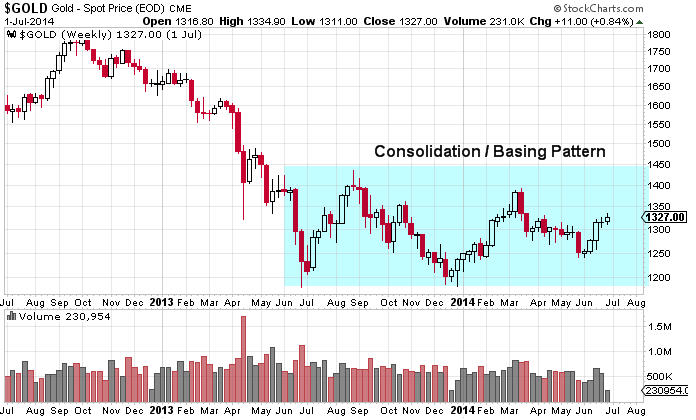
Gold prices have been in a giant basing or consolidation pattern for more than one year. As can clearly be seen below, gold futures prices have traded in a range between roughly 1,175 and 1,430 since June of 2013.


Chart1


The past few weeks we have heard more about gold prices as we have seen a five week rally since late May. I would also draw your attention to the fact that gold futures also made a slightly higher low which is typically a bullish signal.


At this point in time, it appears quite likely that a possible test of the upper end of the channel is possible in the next few weeks / months. If price can push above 1,430 on the spot gold futures price a breakout could transpire that could see $150 or more added to the spot gold price.


Clearly there are a variety of ways that a trader could consider higher prices in gold futures. However, a basic option strategy can pay handsome rewards that will profit from a continued consolidation. The trade strategy is profitable as long as price stays within a range for a specified period of time. Ultimately this type of trade strategy involves the use of options and capitalizes on the passage of time.


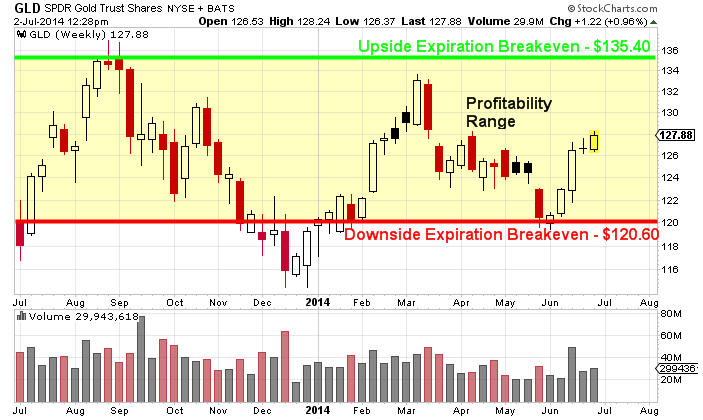
The strategy is called an Iron Condor Strategy, however in order to make this trade worth while we would consider widening out the strikes to increase our profitability while simultaneously increasing our overall risk per spread. Consider the chart of GLD below which has highlighted the price range that would be profitable to the August monthly option expiration on August 15th.


Chart2


As long as price stays in the range shown above, the GLD August Iron Condor Spread would be profitable. Clearly this strategy involves patience and the expectation that gold prices will continue to consolidate. This trade has the profit potential of $37 per spread, or a total potential return based on maximum possible risk of 13.62%. The probability based on today's implied volatility in GLD options for this spread to be profitable at expiration (August 15) is roughly 80%.


Our new option service specializes in identifying these types of consolidation setups and helps investors capitalize on consolidating chart patterns, volatility collapse, and profiting from the passage of time. And if you Advanced options trades are not your thing, we also provide Simple options where we buy either a call or put option based on the SP500 and VIX. The nice thing about buying calls and puts is that you can trade with an account as little as $2,500.


If You Want Daily Options Trades, Join the Technical Traders Options Alerts

See you in the markets!

Chris Vermeulen

Sign up for our next free trading webinar "Low VIX and What It Means to Your Trading"


Saturday, April 19, 2014

Gold Forecast – This Is Going To Be Exciting

Gold Forecast: During the past year there has been very little talk about gold, silver or gold stocks in the media. Yet the year before it was all the media could talk about and they even had the price of gold streaming live all day in the corner of the TV monitor.

I am always amazed how the masses and media can be so off in their timing of the stock market and commodities in general. For example when Greece was having issues in 2012 and everyone was avoiding investments in that country like it was the plague. Looking back now, Greece is up huge and only recently investors are confident enough to put money into the Greek stock market again.

But the truth is that big move has already happend, and the US and global markets are in rotation (changing trends). Money is slowly shifting from what has been hot during the past year or two, to new investments which have a lot more room to rise in value. And this is leads us back to my gold forecast.

If you are at all familiar with Stan Weinstein’s work, then you understand the four market stages. If not, you can learn these four stages on my Stan Weinstein page. Through stage analysis we can predict the type of price action we should expected and have a rough idea just how long a move (new trend) is likely to last. It is important to know that Stan Weinstein’s stage analysis works on any time frame from a one minute chart to a monthly chart. If you do not know this then you are trading almost blind without a doubt.

Current stage analysis looks as though the US stock market may be starting to form a stage three top. There are several indicators and market behaviors which are screaming, telling us to trade with caution to the long side. But the masses do not see this or hear what is unfolding in front of their very own eyes, and that I fine. It actually reminds me of a funny old movie called “hear no evil, see no evil”.

In short, the market is showing some signs of distribution selling in stocks, and the once market leaders are now getting completely crushed with heavy selling volume like the biotech stocks, social media stocks and other momentum stocks and this is bad.

Gold on the other had has been forming a stage one basing pattern. This provides a very bullish long term gold forecast that investors could ride for several years.

-----------------------

Q: Where Will Investment Capital Go During The Next Bear Market In stocks?


A: One of the places will be precious metals. Click here for my gold forecast which shows the main reason why

-----------------------
 

Gold Forecast Coles Notes:


1. The U.S. dollar index has setup a massive stage 3 topping pattern on the weekly chart. A falling dollar will send the price of gold higher naturally.

2. Bullish gold forecasts by the media have dropped substantially, meaning everyone is bearish on gold.

3. Gold stocks are already showing signs of massive accumulation. I always use the price and volume action of gold stocks to help create and time my gold forecasts which it starting to look bullish.

Gold Forecast Conclusion:


Gold market traders should understand that precious metals in general are still months away from breaking out to the upside and starting a new bull market. Do not be in a rush to buy gold or gold stocks yet. There will be plenty of time folks.

See you in the markets!
Chris Vermeulen 

Get My Daily Video Gold Forecast & Gold Trading Alerts at The Gold & Oil Guy


Sign up for one of our Free Trading Webinars....Just Click Here!


Sunday, January 12, 2014

23 Reasons to Be Bullish on Gold

By Laurynas Vegys, Research Analyst

It's been one of the worst years for gold in a generation. A flood of outflows from gold ETFs, endless tax increases on gold imports in India, and the mirage (albeit a convincing one in the eyes of many) of a supposedly improving economy in the US have all contributed to the constant hammering gold took in 2013.

Perhaps worse has been the onslaught of negative press our favorite metal has suffered. It's felt overwhelming at times and has pushed even some die-hard goldbugs to question their beliefs… not a bad thing, by the way.

To me, a lot of it felt like piling on, especially as the negative rhetoric ratcheted up. Last year's winner was probably Goldman Sachs, calling gold a "slam dunk sale" for 2014 (this, of course, after it's already fallen by nearly a third over a period of more than two and a half years, how daring they are).

This is why it's important to balance the one sided message typically heard in the mainstream media with other views. Here are some of those contrarian voices, all of which have put their money where their mouth is…..
  • Marc Faber is quick to stand up to the gold bears. "We have a lot of bearish sentiment, [and] a lot of bearish commentaries about gold, but the fact is that some countries are actually accumulating gold, notably China. They will buy this year at a rate of something like 2,600 tons, which is more than the annual production of gold. So I think that prices are probably in the process of bottoming out here, and that we will see again higher prices in the future."
  • Brent Johnson, CEO of Santiago Capital, told CNBC viewers to "buy gold if they believe in math… Longer term, I think gold goes to $5,000 over a number of years. If they continue to print money at the current rate, I think it could be multiples of that. I see a slow steady rise punctuated with some sharp upward moves."
  • Jim Rogers, billionaire and cofounder of the Soros Quantum Fund, publicly stated in November that he has never sold any gold and can't imagine ever selling gold in his life because he sees it as an insurance policy. "With all this staggering amount of currency debasement, gold has got to be a good place to be down the road once we get through this correction."
  • George Soros seems to be getting back into the gold miners: he recently acquired a substantial stake in the large cap Market Vectors Gold Miners ETF (GDX) and kept his calls on Barrick Gold (ABX).
  • Don Coxe, a highly respected global commodities strategist, says we can expect gold to rise with an improving economy, the opposite of what many in the mainstream expect. "You need gold for insurance, but this time the payoff will come when the economy improves. In the past when everything was falling all around you, commodity prices were soaring out of sight. We had three recessions in the 1970s and gold went from $35 an ounce to $850. But this time, gold is going to appreciate when we start getting 3% GDP growth."
  • Jeffrey Gundlach, bond guru and not historically known for being a big fan of gold, came out with a candid endorsement of the yellow metal: "Now, I kind of like gold. It's definitely very non correlated to other assets you may have in your portfolio, and it does seem sort of cheap. I also like the GDX."
  • Steve Forbes, publishing magnate and chief executive officer of Forbes magazine, publicly predicted an impending return to the gold standard in a speech in Las Vegas. "A new gold standard is crucial. The disasters that the Federal Reserve and other central banks are inflicting on us with their funny-money policies are enormous and underappreciated."
  • Rob McEwen, CEO of McEwen Mining and founder of Goldcorp, reiterated his bullish call for gold to someday top $5,000. "We now have governments willing to seize their citizens' assets. We now have currency controls on the table, which we haven't seen since the late 1960s/early '70s. We have continued debasement of currencies. And the economies of the Western world remain stagnant despite enormous monetary stimulation. All these facts to me are bullish for gold and make me believe the price will bounce back relatively soon."
  • Doug Casey says that while gold is not the giveaway it was at $250 back in 2001, it is nonetheless a bargain at current prices. "I've been buying gold for years and I continue to buy it because it is the way you save. I'm very happy to be able to buy gold at this price. All the so called quantitative easing, money printing, by governments around the world has created a glut of freshly printed money. This glut has yet to work its way through the global economic system. As it does, it will create a bubble in gold and a super bubble in gold stocks."
And then there's the people who should know most about how sound the world's various types of paper money are: central banks. As a group, they have added tonnes of bullion to their reserves last year….
  • Turkey added 13 tonnes (417,959 troy ounces) of gold in November 2013. Overall, it has added 143.6 tonnes (4,616,847 troy ounces) so far this year, up 22.5% from a year ago, in part thanks to the adoption of a new policy to accept gold in its reserve requirements from commercial banks.
  • Russia bought 19.1 tonnes (614,079 troy ounces) in July and August alone. With the year to date addition of 57.37 tonnes [second only to Turkey] Russia's gold reserves now total 1,015 tonnes. It now holds the eighth-largest national stash in the world.
  • South Korea added a whopping 20 tonnes (643,014 troy ounces) of gold in February, and now carries 23.7% more gold on its balance sheet than at the end of 2012."Gold is a real safe asset that can help (us) respond to tail risks from global financial situations effectively and boosts the reliability of our foreign reserves holdings," said central bank officials.
  • Kazakhstan has been buying gold every month, at an average of 2.4 tonnes (77,161 troy ounces) through October. As a result, the country's reserves have seen a 21% increase to 139.5 tonnes from a year ago.
  • Azerbaijan has taken advantage of a slump in gold prices and has gone from having virtually no gold to 16 tonnes (514,411 ounces).
  • Sri Lanka and Ukraine added 5.5 (176,829 troy ounces) and 6.22 tonnes (199,977 troy ounces) respectively over the past year.
  • China, of course, is the 800 pound gorilla that mainstream analysts seem determined to ignore. Though nothing official has been announced by China's central bank, the chart below provides some perspective into the country's consumer buying habits.
China ended 2013 officially as the largest gold consumer in the world. Chinese sentiment towards gold is well echoed in a statement made by Liu Zhongbo of the Agricultural Bank of China: "Because gold has capabilities to absorb external economic shocks, growth of its use in the international monetary system will be imminent."

And those commercial banks that have been verbally slamming gold, it turns out many are not as negative as it might seem…
  • Goldman Sachs proved itself to be one of the biggest hypocrites: while advising clients to sell gold and buy Treasuries in Q2 2013, it bought a stunning (and record) 3.7 million shares of GLD. And when Venezuela decided to raise cash by pawning its gold, guess who jumped in to handle the transaction? Yes, they claim the price will fall this year, but with such a slippery track record, it's important to watch what they do and not what they say.
  • Société Générale Strategist Albert Edwards says gold will top $10,000 per ounce (with the S&P 500 Index tumbling to 450 and Treasuries yielding less than 1%).
  • JPMorgan Chase went on record in August recommending clients "position for a short term bounce in gold." Gold's price resistance to Paulson & Co. cutting its gold exposure, along with growing physical gold demand in Asia, were cited among the main reasons.
  • ScotiaMocatta's Sunil Kashyap said that despite the selloff, there's still significant physical demand for gold, especially from India and China, which "supports prices."
  • Commerzbank calls for the gold price to enter a boom period this year. Based on investment demand from Asian countries, China and India in particular, the bank predicted the yellow metal will rise to $1,400 by the end of 2014.
  • Bank of America Merrill Lynch, in spite of lower price forecasts for gold this year, reiterated they remain "longer-term bulls."
  • Citibank's top technical analyst Tom Fitzpatrick stated gold could head to $3,500. "We believe we are back into that track where gold is the hard currency of choice, and we expect for this trend to accelerate going forward."
None of these parties thinks the gold bull market is over. What they care about is safety in this uncertain environment, as well as what they see as enormous potential upside.

In the end, the much ridiculed goldbugs will have had the last laugh.

We can speculate about when the next uptrend in gold will set in, but the action for today is to take advantage of price weakness. Learn about the best gold producers to invest in, now at bargain basement prices.

Try BIG GOLD for 3 months, risk-free, with 100% money back guarantee. Click here to get started.


If you ever plan on retiring, get our “Merit Paycheck System”, watch the video explaining the methods right now!


Tuesday, August 6, 2013

Are Your Bullish Calls Plagued with Divergences?

By now everyone has a prediction about where the S&P 500 Index (SPX) is going to be heading in the future. Most of the sell side and their ilk are all rolling out the green bullish carpet and predicting that a major bull run is right around the corner.

If you are a contrarian investor by nature and tend to sell when others are buying this will be of great interest to you. When retail investors are buying and the professional sell side is quickly reducing their long equity exposure we get increasingly more bearish.

This recent report was accompanied by some eye opening charts...... 

View report and charts courtesy of Bank of America Merrill Lynch


Get our FREE Trading Webinars Today!


Sunday, May 5, 2013

Stocks Preparing for Pullback, Buy Bad News, Sell the Good

The SP500 remains in a strong uptrend, but the index has posted a sizable gains for 2013 thus far so it’s only logical that a pullback within this bull market takes place sooner than later.

With May now upon us and historically prices fall more times than not we feel a 3-4 weeks correction is on the verge of starting. This Friday we just had very strong economic numbers confirming the economy is recovering. This news has sent stocks sharply higher as shorts cover their positions and investors who are not yet long get into position to profit from higher prices. But the herd psychology and their trades are typically incorrect as they invest based on fear and greed. The old saying is buy on negative news and sell on positive news will typically get you on the correct side of the market more times than not if used with price, volume and cycles.

The Technical Traders – SP500 Index Weekly Chart

If we look at the price of the SP500 we need it to breakdown below the recent pivot low before we become bearish. Volume which is not shown on this chart is below average as price moves higher and this is a bearish sign also.

Looking at a basic cycle using the stochastics indicator we can see that the current cycle is starting to turn down. Cycles tend to lead price during an uptrend so we could still have stocks move higher for another week or so but be aware that when price starts to drop its likely a market top. But until then you must respect the uptrend. Stocks can remain overbought and toppy looking for months… so done be gambling and trying to pick a top until we see breakdown start.

spy2

SP500 Stocks Trading Above 200 Moving Average – The Technical Traders View

Stocks trading above the 200 day moving average is a great indicator for helping spot broad market underlying strength/weakness. It does lag the market but is still very powerful. The chart below shows this info and my thinking of what is likely to unfold sooner than later though price may still rise for several days yet.

We also use a similar chart for timing swing trades and market tops which are based on stocks trading above the 20 day moving average. This chart is not shown here but is now trading at a level which generally triggers selling/market top.

spy1

Stock Market and SP500 Trading and Investing Conclusion:

In short, we are still bullish on the market as we focus on trading with the trend. We do not pick market tops and we do not pick market bottoms. Knowing that stocks make their biggest moves at the end of their uptrend and at the end of a down trend it’s only common sense that risk is extremely high if you are betting against the current trend.

The best thing to do is wait for a technical breakdown and reversal which puts the odds more in your favor with much less risk and typically a clear line in the sand to exit the position if you are incorrect.

The last major stock market top which formed in September of last year had a series of strong news and strong price action persuading the herd to buy stocks. Instead it was the last impulse wave up just before a strong correction took place. That is much like what we see now with the economic news.

Join our free newsletter and stay on right side of the market while reducing your trading/investing stress. My simple yet effective analysis walks you through the market each week without bias. Remember Price and Volume is what makes you money trading NOT news or forecasts.

Join our FREE Newsletter Today!


Check out our current specials for full subscription members.

Wednesday, July 25, 2012

How To Position Yourself for a 10 Year Pattern Breakout

As mentioned last Friday just before things took a dive on the weekend, a look at the major market indices did not look promising. If we take an even longer term look and examine the monthly charts we can see that The S&P 500 as well as the Dow Jones have been approaching multi decade rising channel resistance lines. Further, they also appear to be forming bearish rising wedge patterns.

Monthly Long Term Chart Analysis & Thoughts....

As many of my longer term subscribers can attest to, I always preach that technical analysis is one part art and one part science: you can never be completely certain on what the outcome of a pattern is going to be. However, we can use historical analysis to make better investments. The great American Novelist Mark Twain probably said it best in that “history does not repeat itself, but it rhymes”. Regarding a rising wedge pattern, we know that roughly two thirds of the time they will break to the downside. This also means that one third of the time they break to the upside.

In accomplishing our goal of capital growth we must do a number of things. We must make returns on our investments, we must protect our investments, and we must limit our losses. While all three aspects work in tandem with each other, there are times when focus must be allocated to one specific approach.

Regarding the current technical setup, I’m not so focused on the 67% chance that these wedges will break to the downside, but more so the impact of each outcome on the average Joe’s portfolio and mom and pop businesses. The S&P 500 and the Dow are approaching long term resistance lines that have been in place for decades. If we do break to the downside, which I suspect we will, there could be a very significant sell off with consequences that no one can predict at this point though I mention some things in the chart above. Alternatively, there is significant overhead resistance in the various indices, and I don’t believe an upside break would be too monumental.

That being said, I always like to keep an open outlook and wait for the right opportunity. I’m trying to think of scenarios that would prelude further upside action and I really am not coming up with much. As evidenced by the completion of the recent 5 wave uptrend on the S&P that coincided nicely with the various quantitative easing policies, Ben Bernanke and the fed have had less and less impact. I truly can’t see many fiscal developments that would prompt any significant bullish action.

The only scenario I really think that could pump up equities is a series of positive earnings announcements. A lot of expectations, earnings numbers, guidance, etc… have been revised downwards over the last couple of quarters, so there is the opportunity for some positive surprises that could lead to some bullish price action. In absence of such a scenario, I really can’t think of much else that would prompt a run up.

Look at these charts of positive and negative earnings surprises… and the dates and remember what happened following this negative data....

Positive Earnings Surprise


Negative Earnings Surprise


That being said, I am recommending two courses of action. For those steadfast bulls, lock in some profits and/or buy some protection. Missing out on some of the upside is a lot better than losing some of the gains you have fought so hard for over the past couple of years. For the more aggressive traders and investors, start following my updates a little more regularly as I foresee many shorting opportunities coming up in the future. As many of you know, sell offs are often quick and abrupt, and timing is extremely important when playing the downside.

Further, trading could get very volatile in the near future. Historically, and even more so looking forward as August and September have been very costly for the average investor. Our focus will be in taking the highest probability trades that offer the best risk to reward scenarios. There will be times when we miss trades, and times when they’re not timed perfectly. But, as those who have been with me for a while can attest to, patience pays off in the long run....

Join my Free Market Analysis & Trade Idea Newsletter > Now at The Gold & Oil Guy

Chris Vermeulen

Get our Free Trading Videos, Lessons and eBook today!

Thursday, June 21, 2012

Gold and Silver on the Verge of Something Spectacular

Gold and silver have taken more of a back seat over the past 12 months because of their lack of performance after topping out in 2011. Since then prices have been trading sideways/lower with declining volume. The price action is actually very bullish from a technical standpoint. My chart analysis and forward looking forecasts show $3,000 ish for gold and $90 ish for silver in the next 18-24 months.

Now don’t get too excited yet as there is another point of view to ponder....

My non technical outlook is more of a contrarian thought and worth thinking about as it may unfold and catch many gold bugs and investors off guard costing them a good chunk of their life savings. While I could write a detailed report with my thinking, analysis and possible outcomes I decided to keep it simple and to the point for you.

Bullish Case: Euro land starts to crumble, stocks fall sharply sending money into gold and silver which are trading at these major support levels which in the past triggered multi month rallies.

Bearish Case: Greece, Spain and Italy worth through their issues over the next few months while metals bounce around or drift higher because of uncertainty. But once things have been sorted out and financial stability (of some sort) has been created and the END OF THE FINANCIAL COLLAPSE has been avoided money will no longer want to be in precious metals but rather move into risk on.

Take a look at the gold and silver charts below for an idea of what may happen and where support levels are if we do see money start to rotate out of metals in the next 3-6 months.

Gold Forecast
Silver Forecast
Over the next few months things will slowly start to unfold and shed some light on what the next big move is likely going to happen to gold and silver.

The price movements we have seen for both gold and silver indicate were are just warming up for something really big to happen. It could be a massive parabolic rally to ridiculous new highs in 2012/2013 or it could be a huge unwinding of the safe havens as countries sort out their issues and the big money starts moving out of metals and into currencies and stocks.

Only time will tell and that is why I analyze the market multiple times per week to stay on top of both long term and short term trends.

To keep up with Chris Vermeulen and his thoughts on current trends and trades for gold, silver, oil, bonds and the stocks market checkout The Traders Video Playbook


Get our Free Trading Videos, Lessons and eBook today!

Monday, May 28, 2012

SP 500 Update.... U.S. Markets wear the Heavy Crown

Get our Free Trading Videos, Lessons and eBook today!

The US market is one of very few trying to maintain a long term uptrend Bull cycle around the world.  Most major world indices are in decline, only Germany and London are also trying to hang in of the major indices.

Will the rest of European problems continue to spillover and weigh down our markets in finally cause a flush?  Or… will the US stay strong and lead higher amidst the turmoil?

The threat of debt repudiation resonates throughout Europe and has major headwinds for the Banking industries and otherwise… and it may be hard for the US market to gain much traction until we find out if there are any resolutions near term.

The Technical picture is mixed.  The drop to 1292 from 1422 highs created a 38% fibonacci retracement of the October lows at 1074 and the March highs of 1422.  This is typical for a 4th wave correction after 3 waves of rally.  In addition, we had Mclellan Oscillators at extreme lows coming into this past week, investor sentiment running at multi month lows not seen since last summer, and many other oversold indicators.

This led to a 36 point bounce early in the week from 1292 to 1328, but it had trouble holding into the end of the week. I was looking for a strong close over 1322 to help confirm the downtrends lows were in place at 1292, but we did not get that just yet.  Near term we have to see a very strong bounce this coming week over 1330 on a closing basis or the market will be at risk of a rising bearish wedge and then another large downleg to new lows since the 1422 highs.  Therefore, Tuesday and Wednesday in my opinion will likely immediately tell us which way this market is about to go.

We have a few outlooks that are valid.  One is that we had an ABC correction from 1422-1292 and we are in the early stages of a Major Wave 5 up bullish pattern.  The  other is we had 3 waves down, this is a 4th wave bounce, and a 5th wave to new lows on the move is next.  Again, early in the week will be key in my opinion.

Here are two charts. One shows the Weekly SP 500 pattern and prior pivot points where downtrends halted and reversed. In each case the candlestick pattern for the week was inside and above the prior weeks lows and closed higher (White Candlesticks).  This also happened this past week, but I again would like to see higher closing levels early in the week to confirm.

The other chart is a daily chart showing the 1330 barrier we would like to see crossed to avoid a rising bearish wedge pattern.

Join us at Market Trend Forecast and sign up for free weekly updates. Alternatively, you can use our 33% discount on that page to subscribe and receive 4-5 updates per week on US Markets, Gold, and Silver!


David Banister

Check out our latest Video, Market Analysis and Forecast for the Dollar, Crude Oil, Gold, Silver, and the SP500

Thursday, October 20, 2011

Crude Oil Analysis & How To Trade Oil Report


How to trade oil is not an easy thing to do in today’s headline driven market. Even the best oil analysis which may have been correct will still be wrong at times. This is due to the fact that oil has many factors which play into its price. Things likes like extreme weather conditions, geopolitical events, currency fluctuations, economic conditions and supply and demand.

During any time of the day oil traders and their oil analysis stand a good chance of having one of these factors directly affect the price of crude oil messing up their charts.

But, I am a firm believer that these factors (news events) generally fall in line with the overall larger trend of oil. So understanding how to spot trends in oil is a vital part of the equation.

Another important aspect of trading crude oil along with stocks and commodities is for you to understanding how to trade price and volume at an intraday time frame. If you don’t understand candle sticks, chart patterns and volume will get your head handed to you more times than not.

Let’s take a look at some charts which cover everything you need to know in great detail…...

How to Trade Oil Daily Chart Analysis:
Below you can see clearly how the overall trend is down for oil. You can also see the repeated bearish patterns and key resistance levels. In my oil analysis I focus on finding and trading the trend. You will not find me trying to pick a major top or bottom with my strategy; rather I focus on low risk high probability continuation patterns within a trend.

Once the trend stops and reverses there will likely be one or two losing trades as the investment shakes things up and sentiment slowly comes around and shifts to support the new trend in oil.

How To Trade Oil

Intraday Crude Oil Analysis:
This is a chart of Oct 19th using a 5 minute interval. The annotations on the chart explain clearly what I saw and was hoping to see for an oil etf trade setup this week.

How To Trade Oil Analysis

How To Trade Oil Conclusion:
In short, I have been waiting for this setup to unfold for a few days now. This report goes to show that if you have the patients to site back, watch and wait you will trade with much less risk. By doing this you reduce risk on your overall position because you can time your entry 1-3 days before oil moves in your favour getting you the best possible price. Also the less time you have to keep your money in a trade the better because of the factors (news events) I told you about earlier. Cash is king! Get my bi-weekly reports and videos by joining my free oil newsletter here at The Gold and Oil Guy.Com

Chris Vermeulen

Wednesday, September 14, 2011

Adam Hewison: Can You Handle The Truth?

Like a lot of folks, I love good movies. One of my favorite movies is, “A Few Good Men” starring Jack Nicholson and Tom Cruise. I was thinking this morning about Jack Nicholson’s famous line from the movie, which goes like this: “You can’t handle the truth!”

Now here is the reality… A politician can spin the truth about his or her record, WHY? To get reelected, of course. A CEO of a company can spin sales projections to pump his stock up, WHY? So he can receive a bigger year end bonus. The pundits who appear on CNBC and Fox business news can spin markets any way they want, WHY? To benefit their own vested interests in a market.

WANT TO KNOW THE TRUTH?

This is what I really like about the marketplace: It tells you the truth! It literally is a no spin zone. When you examine the recent downturn in the equity markets, the market was telling you that it did not believe in the policies of this current administration. Similarly, when Ken Lay and Jeff Schilling at Enron were telling everybody how good business was, the market exposed the truth on that bunch of crooks by sending their stock into bankruptcy.

So can you, as a trader, handle the truth? Does your political bias or a particular view of a market get in the way of your trading?

When you use a non-biased, objective approach like MarketClub’s Trade Triangles as your trading foundation, you will find you can sweep aside all of the spin and BS. All you have to do as a trader is listen to the real truth, and that is which direction is the trend in the market.

Now, let’s take a look at where the SP 500 is headed.....

The battle continues between the Bulls and the Bears as we have entered into a very tight trading range between 1140 on the downside and 1200 on the upside. Our views are based on our Trade Triangle technology and they continue to point to lower levels. The two important lows that were established on August 26th and again on September 6th at the 1140 area are important support for this market. Long term traders should continue to be short or be out of the market completely, and in a cash position. Intermediate term traders should be on the sidelines waiting for either a buy or sell signal based on our Trade Triangle technology.

Monthly Trade Triangles for Long Term Trends = Negative
Weekly Trade Triangles for Intermediate Term Trends = Positive
Daily Trade Triangles for Short Term Trends = Negative
Combined Strength of Trend Score = – 75

The S&P 500 index closed higher on Wednesday as it extends the short covering rally off August's uptrend line crossing near 1148.10. The high range close sets the stage for a steady to higher opening when Thursday's night session begins trading. Stochastics and the RSI are still neutral to bearish signaling that sideways to lower prices are possible near term.

Closes below the aforementioned uptrend line would confirm an end to the corrective rally off August's low while opening the door for a possible test of August's low crossing at 1093.50 later this fall. Closes above last Thursday's high crossing at 1197.70 would temper the near term bearish outlook.

First resistance is last Thursday's high crossing at 1197.70. Second resistance is the late August high crossing at 1223.00. First support is Monday's low crossing at 1123.90. Second support is the reaction low crossing at 1113.20.

Tuesday, April 19, 2011

Equities Don’t Follow the Dollar Index So Hold On!

So far in 2011 the equities market has made some sizable whip saw type moves that even veteran traders have had difficulty being on the right side of the price action. The year started out with equities being very overbought and extended making is virtually impossible for a low risk trader to buy on pullbacks. This was primarily due to the fact that there were no real pullbacks other than for a day or two which was immediately followed by prices continuing to grind higher.

In March, we finally had the pullback everyone was waiting for which we caught 4% of the sell off using an inverse ETF. Then we saw the bottom a few days later and caught a 3% gain from near the lows during a rally higher. So as you can see there have been three trends in the SP500 so far this year and we are about to see another sizable move unfold in the coming week.

In the past 8 sessions we have seen the market pullback slightly and the big question everyone is asking is do we get long or do we short here? Below are my thoughts and analysis….
US Dollar Index – Daily Chart
The dollar is still in a very strong down trend. As long as it continues to fall we should see higher stock and commodity prices. I do feel as though there is more downside for the dollar but its nearing an end. Stepping back and looking at the longer term chart of the dollar is very clear that it is getting oversold and sizable bounce should take place. If we see the dollar breakout of this falling wedge and start to rally you will want to be short stocks and commodities.
SPY ETF (SP500 Index Fund) Daily Chart
When comparing the Dow Jones Industrial Average and the Russell 2K indexes it is rather obvious that both have performed well this year and have broken above the February highs. The DOW was strong because it has it is exposed to energy stocks and with oil rocketing higher, it has helped those energy based stocks lift the index higher. The Russell 2K consists of small cap stocks and with the general public still being so bullish on the equity markets and investors are buying volatile, high risk small cap stocks to help boost their gains.

Now, looking at the SP500 it has yet to break the February high and this is because it holds several large tech stocks and financial stocks which have been lagging the overall market so far this year. Tech stocks and financials tend to lead the market and the fact that they are not is of great concern to me.
So going back to the US Dollar, I feel as though it has a little more downward motion left which will help get the SP500 to a new yearly high. Once the dollar rally starts, it will crush stock and commodity prices for several months.

Weekend Trend Conclusion:
In short, I favor the long side for both stocks and commodities, but that can change on a dime once the dollar starts to rally. There are many negative factors coming together that give me a negative outlook on stocks and commodities for the next 2-4 months and they are:

1. Quantitative Easing is now done = rising dollar
2. Investor sentiment is at an extreme bullish level = typically a bearish sign for stocks
3. The Sell In May and Go Away is almost here…
4. Earning season is here and that is typically a time when stocks get sold into = lower stock prices
My final thought is to keep positions small and be ready to flip positions from long to short and vise versa depending on what you trade…

To Get Chris Vermeulens Free Trading Rule Guide Weekly Newsletter visit The Gold and Oil Guy .Com


Share