Showing posts with label futures. Show all posts

Tuesday, May 22, 2018

How to Predict the Maximum Profit on Each Trade - Free Webinar

Every trader discovers this cold hard truth. Your profit isn’t made when you get in a trade, but when you get out. In fact, we constantly receive questions from our readers about how to avoid leaving money on the table in trades.

Sometimes people get out of a trade too early just to watch it take off and turn into a huge winner without them. Other times you watch your profits disappear because you hung onto your position too long. The key to winning trades is managing your position and timing your exit. Easier said than done, right?

That’s why we reached out to our friend John Carter at Simpler Trading. If you’re not familiar with John, he’s a 25 year trading veteran with a track record for spotting big moves and timing trades in the market for maximum profit. He’s also the author of the best selling book for traders, Mastering the Trade.

John is putting on a special free webinar for our readers this Wednesday May 23rd to show us how we can know exactly when to exit a trade for maximum gains.

Claim My Seat Now

John’s been working on something really special, and he’s sharing it with our readers. Plus, he’s going to explain in detail....

   ●   How to Catch the Biggest Turning Points in Real Time

   ●   Why ‘One Size Fits All’ Systems Can Burn Your Account

   ●   How to Get in Earlier on Explosive Moves with Confidence

   ●   The Simple Exit Rule that Can Generate ‘Easy Money’

   ●   How to Rapidly Grow a Smaller Account Part Time

   ●   How to Get Rid of Guesswork from Entries and Exits

   ●   How to Finally Treat Your Trading like a Business

        And a whole lot more....

These strategies work whether you’re trading Options, Futures, or any other derivatives. The key is understanding when the market is telling you to get out. You’ll see exactly what I mean on the free webinar.

Claim My Seat Now

See you in the markets!
Ray's Stock World

P.S. This is going to be one of the most popular webinars we’ve ever had, so make sure you register as early as possible to Secure Your Spot Right Here


Saturday, October 15, 2016

Carley Garner's "Higher Probability Commodity Trading"

Carley Garner's new book "Higher Probability Commodity Trading" takes readers on an unprecedented journey through the treacherous commodity markets; shedding light on topics rarely discussed in trading literature from a unique perspective, with the intention of increasing the odds of success for market participants.

In its quest to guide traders through the process of commodity market analysis, strategy development, and risk management, Higher Probability Commodity Trading discusses several alternative market concepts and unconventional views such as option selling tactics, hedging futures positions with options, and combining the practice of fundamental, technical, seasonal, and sentiment analysis to gauge market price changes.

Carley, is a frequent contributor of commodity market analysis to CNBC's Mad Money TV show hosted by Jim Cramer. She has also been a futures and options broker, where for over a decade she has had a front row seat to the victories and defeats the commodity markets deal to traders.

Garner has a knack for portraying complex commodity trading concepts, in an easy-to-read and entertaining format. Readers of Higher Probability Commodity Trading are sure to walk away with a better understanding of the futures and options market, but more importantly with the benefit of years of market lessons learned without the expensive lessons.

Get Higher Probability Commodity Trading on Amazon....Get it Here!

Sunday, March 20, 2016

Four Trading Strategies That Work

If you have been following us this year you already know that our trading partner Chris Vermeulen has been spot on in 2016 and has helped our readers make profitable trade after profitable trade this year. We have followed and worked with many traders over the years so we know what trading information is useful and what is just junk information.

Chris' connects with most readers through his complimentary stock trading and education newsletter which includes simple trading strategies to use with stocks, options, futures or forex.

Get Chris' newsletter "The Four Trading Strategies That Work" right HERE!

We hope you enjoy the free content and learning from some new tips and tricks for your own trading toolbox. To further add value Chris has put together a way for you to learn some of his trading strategies which cover stocks, options, futures and forex.

Bookmark this link since you can only select one free trading strategy at a time when you optin to the form on this special webpage below. But I should note, if you want a second or third strategy you just need to revisit the optin page, optin, and select another strategy.

These strategies are only available for a couple days then Chris takes them down so click the link below and optin to be presented with the four trading strategies.

Click here to get the free "Four Trading Strategies That Work"


See you in the markets.
Ray's Stock World


Stock & ETF Trading Signals

Sunday, March 1, 2015

Are you a Brain Dead Trader or Just Lucky?

Were you one of the lucky ones? Were you one of 8,909 traders that registered for this weeks fantastic free webinar from John Carter? If not, not to worry. John has made the webinar available as a replay and of course it's still free to watch. This was another game changer as John found a way to make trading options on premium decay understandable by anyone no matter their trading skill level.

Watch the Free Webinar Replay Here

Why did so many traders fight for a spot at this webinar? I think it has a lot to do with the video primer John send us earlier in the week giving us just a taste of what John would show us in more detail at the webinar.

Watch that Free Video Here

In this video John shows us a simple and effective strategy for using premium decay, but he also shows us his strategy to make money on a stock if it's going up or down.

In this webinar John will discuss....

  *  Why trading options are perfect for newbies, retirees, part time traders, and full time traders

  *  Why options are safer than trading stocks, futures or forex while holding on for bigger winners

  *  One strategy he uses for consistent trading results that you can use the next trading day

  *  The brain dead rules to follow so you can know exactly how to trade this one set up for consistency

  *  How traders get sucked into buying the wrong stocks at the wrong price so you never get suckered into a trade again

       And much more….

And John doesn't stop there.....

Get his latest FREE eBook "Understanding Options"....Just Click Here!

Nobody did more in 2014 to change the way traders, investors and fund managers looks at trading options than John did with this one eBook. Get yours right now while it's still available.

See you in the markets!
Ray's Stock World


Wednesday, January 14, 2015

Three Simple Techniques to Improve Your Trading

Hey traders, Ray here with Ray's Stock World. Today I wanted to share with you a short training video that combines the experience of thousands of live trades and nearly 19 years of active trading experience.

The folks over at NetPicks have put together a short training video that lays out three simple techniques you should be following to instantly improve your trading today.

You can view the video by Just Clicking Here and there are no email or other obligations required.

In just over 10 minutes they detail for you what a trader should be doing right now in 2015. Things have changed dramatically since options, futures and forex trading became popular as you'll see. Find out what matters in 2015 and add more winning trades to your account today.

 Watch "Three Simple Techniques to Improve Your Trading"

See you in the markets!
Ray's Stocks World


Get out latest FREE eBooK "Understanding Options"......Just Click Here


Tuesday, January 13, 2015

EFPs and The Unanticipated Consequences of Purposive Social Action

By Jared Dillian


Pretend you are a corn trader. As such, you have two choices: have a position in corn futures or own physical corn. It may seem silly to even consider owning physical corn, because corn futures are easy to trade—just click a button on your screen. But assume you have a grain elevator, and whether you own futures or physical corn is all the same to you. How do you decide which you prefer?

If one is mispriced relative to the other.

If you consider owning physical corn, you have to take into account the cost of storage and any transportation costs you may incur getting the corn to the delivery point. You also have to think of the cost of carrying that physical corn position, or the opportunity loss you incur by not investing the money in the risk-free alternative.

The thing is, there’s nothing keeping the spot and futures markets on parallel tracks, aside from the basis traders who spend their time watching when the futures get out of whack from the physical. That basis exists in just about every futures market, even in financial futures that are cash settled. In fact, that was pretty much my life when I was doing index arbitrage—trading S&P 500 futures against the underlying stocks. I was basically a fancy version of the basis trader in corn.

With stock index futures (like the S&P 500, or the NDX, or the Dow), the basis is slightly more complicated. Not only do you have to calculate the cost of carry—which is usually determined by risk free interest rates and the stock loan market for the underlying securities—but you also have to take into account the dividends that the underlying stocks pay out. Remember, futures don’t pay dividends, but stocks do. At Lehman Brothers, we had a guy whose sole job was to construct and maintain a dividend prediction model for the S&P 500.

So far, so good. However, one of the first things I learned about on the index arbitrage desk was EFP, which stands for Exchange for Physical—a corner of the market almost nobody knows about.

Basically, we could take a futures position and exchange it for a stock position at an agreed-upon basis with another bank or broker. Interdealer brokers helped arrange these EFP trades. The reason so few people know about them is probably because, historically, the EFP market has been very sleepy. The most it would usually move in a day was 15 or 20 cents in the index, or in interest rate terms, a few basis points.

Now it is moving several dollars at a time.

A Basis Gone Berserk


Back when I was doing this about ten-plus years ago, we had a balance sheet of about $8 billion, which is to say that we carried a hedged position of stocks versus S&P 500 futures (also Russell 2000 futures, NASDAQ futures, etc.).

We did this for a few reasons. One, it was profitable to do so—the basis often traded rich so that by selling futures and buying stock and holding the position until expiration, we would make money. Also, by carrying this long stock inventory, we were able to offset short positions elsewhere in the firm and reduce the firm’s cost of funds. At Lehman and most other Wall Street firms, index arbitrage was a joint venture with equity finance.

During the tech bubble in 1999, the basis got very, very rich because money was plowing into mutual funds and managers were being forced to hold futures for a period of time until they were able to pick individual stocks.

During the bear market in 2008, the basis traded very cheap, up until very recently, because inflows into equity mutual funds were weak, and index arbitrage desks were willing to accept less profit on their balance sheet positions.

But now, the basis has gone nuts.

It always goes a little nuts toward year-end because banks try to take down positions to improve the optics of their accounting ratios. If you have fewer assets, your return on assets looks better. So when banks try to get rid of stock inventory into year-end, they buy futures and sell stock, pushing up the basis.

But now it has skyrocketed, and the cause seems to be the effects of regulation.

We’ve talked about this before, in reference to corporate bonds. Banks aren’t keeping a lot of inventory anymore, because there’s no money in it. The culprits here are a combination of Dodd-Frank and Basel III. There are all kinds of unintended consequences, and the EFP market going nuts is probably the least of it.

But even that is a big one. Basically, it has introduced significant costs (about 1.5% annually) to the holder of a long futures position, which includes everyone from indexers all the way down to retail investors. These are the sorts of things that don’t get talked about in congressional hearings. Did XYZ law work? Sure it worked. But now it costs you 1.5% a year to hold S&P 500 futures and roll them, and you can’t get a bid for more than $2 million in a liquid corporate bond issue.

It’s All About Liquidity


The liquidity issue is the biggest one, and the one I harp on all the time. Pre Dodd-Frank, the major investment banks were giant pools of liquidity. You wanted to do a block trade of 20 million shares? No problem. You wanted to trade $250 million of double-old tens? It could be done.

Not anymore. Liquidity has diminished in just about every asset class, from FX to equities to rates to corporates, because compliance costs have gone up and it’s expensive to hold more capital against these positions. Someday, someone might take up the slack, like second-tier brokers or even hedge funds.
But here’s the biggest consequence of the equity finance market blowing up: High-frequency trading (HFT) firms that aren’t self-clearing now find it difficult to trade profitably and stay in business. With fewer of them around, we will finally get an answer to the question whether they add to liquidity or not.

So if you talk to an index arbitrage trader about what is going on with the EFP market, he can tell you precisely why it is screwed up. It’s an open secret on Wall Street. Introduce a regulation over here, an unintended consequence pops up over there. Then there are more regulations to deal with the unintended consequences. Regulations have added 100 times the volatility to one of the most liquid and ordinary derivatives in the world—the plain vanilla EFP.

Less liquidity, more volatility—welcome to 2015.
Jared Dillian
Jared Dillian


Get our latest FREE eBook "Understanding Options"....Just Click Here!


Monday, January 12, 2015

What's the One Thing Standing in the Way of Your Success?

Our trading partners at Netpicks have just sent over their new system they are going to use in 2015 and this looks good. What if you could get your hands on one simple indicator that literally has doubled and in some cases tripled the profitability of a forex trading system? What if it came without any out of pocket to you?

No changes - the exact same trading system but adding this one simple indicator literally wiped out numerous losing trades and ensured a much higher winning percentage.

That has done wonders for the bottom line of this system and literally it could have the same impact on any trading system you are working with now or have considered.

You really need to pick this up today. You can get the full scoop....Just Click Here

Double or Even Triple Your Profits
Simply look at your chart and know instantly when to trade and when to pass on any trade, any trading system

Decrease Trading, Work Less, Keep More
By learning to eliminate trades you'll spend less in commissions, have more free time and prevent those costly mistakes

Works with Ease on Any Trading System
You'll be able to implement the Dynamic Profit Detector with ease on your chart and easily determine the best trades...and those to avoid. Forex? Futures? Stocks? ETFs? YES!

There are zero obligations or costs. That's right, it's free. It simply takes a few minutes to download and install and you'll see the markets completely differently than you have before.

Who wouldn't want to have a shot at doubling or tripling success? I already grabbed mine, so take advantage while it's available.

Download the "Dynamic Swing Trader" now

See you in the markets,
Ray's Stock World


Get our latest FREE eBooK "Understanding Options"....Just Click Here

Monday, November 17, 2014

Free Webinar: Why you Should Trade Options on ETFs

Our trading partner John Carter of Simpler Options is back with another one of his wildly popular free trading webinars. His focus this time is "Why you should trade Options on ETFs". John took the time to give us idea what he'll be walking us through step by step in this weeks webinar by producing this great video [just click here to watch]  that included how we can play the next big move in the dollar. A move that John predicts most traders will miss.

Just Click Here to get your Reserved Seat for the Webinar

This weeks webinar is Tuesday evening November 18th at 8 p.m. est

In this free webinar John Carter will discuss....

  *  Why trading options on ETFs are perfect for newbies, retirees, part time traders, and full time traders

  *  Why options on ETFs are safer than trading futures or forex while allowing you to hold on for bigger
       moves

  *  What ETFs should you trade options on and which ones should you avoid so you’re choosing the most
       consistent ETFs to trade

  *  The 5 reasons why you should learn how to trade options on ETFs and stabilize your trading account

  *  Why options on ETFs are ideal for small account traders who want to either safely grow their account
       or try for a home run trade

And much more….

Just click here to get your reserved space asap, John's classes always fill up and turn people away so sign up now and make sure you log in 10 minutes early so you don't lose your spot.

See you Tuesday evening!

Ray's Stock World


Here's a great primer for the webinar, watch John's FREE video he released this week....Just Click Here!


Friday, November 7, 2014

Mark Twain: History Doesn't Repeat Itself....But it Does Rhyme. Gold, Vanderbilt and More

By John Mauldin


“The significant problems that we have created cannot be solved at the level of thinking we were at when we created them.”– Albert Einstein

“Generals are notorious for their tendency to ‘fight the last war’ – by using the strategies and tactics of the past to achieve victory in the present. Indeed, we all do this to some extent. Life's lessons are hard won, and we like to apply them – even when they don't apply. Sadly enough, fighting the last war is often a losing proposition. Conditions change. Objectives change. Strategies change. And you must change. If you don't, you lose.”– Dr. G. Terry Madonna and Dr. Michael Young

“Markets are perpetuating a serious error by acting on the belief that central bankers actually know what they are doing. They do not. Not because they are ill-intentioned but because they are human and subject to the limitations that apply to all human endeavors. If you want proof of their fallibility, simply look at their economic forecasts. Despite their efforts to do so, central banks can’t repeal the business cycle (though they can distort it). While the 2008 financial crisis should have taught them that lesson, it appears to have led them to precisely the opposite conclusion.

“There are limits to knowledge in every field, including the hard sciences, and economics is not a hard science; it is a social science whose knowledge is imprecise, and practitioners’ ability to predict the future is extremely limited. Fed officials are attempting to guide an extremely complex economy with tools of questionable utility, and markets are ignoring their warnings that their ability to manage a positive outcome is highly uncertain. Markets are confusing what they want to happen with what is likely to happen, a common psychological phenomenon. Investors who prosper in the long run will be those who acknowledge the severe limits of economic knowledge and the compelling evidence that trillions of dollars of QE and years of zero interest rates may have saved the system from immediate collapse five years ago but failed to produce sustained economic growth or long-term price stability.”– Michael Lewitt, The Credit Strategist, Nov. 1, 2014

As I predicted months ago in this letter and last year in Code Red, the Japanese have launched another missile in their ongoing currency war, somewhat fittingly on Halloween. Rather than being spooked, the markets saw it as just another round of feel good quantitative easing and climbed to all-time highs on the Dow and S&P 500. The Nikkei soared even more (for good reason). As we will see later in this letter, this is not your father’s quantitative easing. The Japanese, for reasons of their own, will intervene not only in their own equity markets but in foreign equity markets as well, and do so in a size and manner that will be significant. This gambit is going to have ramifications far beyond merely weakening the yen. In this week’s letter we are going to take an in depth look at what the Japanese have done.

It is something of a cliché to quote Mark Twain’s “History doesn’t repeat itself, but it does rhyme.” But it is an appropriate way to kick things off, since we are going to look at the “ancient” history of Mark Twain’s era, and specifically the Panic of 1873. That October saw the beginning of 65 months of recession (certainly longer than our generation’s own Great Recession), which inflicted massive pain on the country. The initial cause was government monetary intervention, but the crisis was deepened by soaring debt and deflation.
As we seek to understand what happened 141 years ago, we’ll revisit the phenomenon of October as a month of negative market surprises. It actually has its roots in the interplay between farming and banking.

The Panic of 1873

Shortly after the Civil War, which saw the enactment of federal fiat money (the “greenback” of that era, issued to finance the war), there was a federal law passed that required rural and agricultural banks to keep 25% of their deposits with certain certified national banks, which were based mainly in New York. The national banks were required to pay interest on those deposits, so they had to put the money out for loans. But because those deposits were “callable” at any time, there was a limit to the types of loans they could do, as long-term loans mismatched assets and liabilities.

The brokers of the New York Stock Exchange were considered an excellent target for such loans. They could use the proceeds of the loans as margin to buy stocks, either for their own trading or on behalf of their clients. As long as the stocks went up – or at the very least as long as the ultimate clients were liquid – there wasn’t a problem for the national banks. Money could be repatriated; or, if necessary, margins could be called in a day. But this was before the era of a central bank, so actual physical dollars (and other physical instruments) were involved as reserves, as was gold. Greenbacks could be used to buy gold, but at a rate that floated. The price of gold could fluctuate significantly from year to year, depending upon the availability of gold and the supply of greenbacks (and of course, market sentiment – which certainly rhymes with our own time).

The driver for October volatility was an annual cycle, an ebb and flow of dollars to and from these rural banks. In the fall when the harvest was ready, the country banks would recall their margin loans in order to pay farmers or loan to merchants to buy crops from farmers and ship them via the railroads. Money would then become tight on Wall Street as the national banks called their loans back in.

This cycle often caused extra volatility, depending on the shortness of loan capital. Margin rates could rise to as much as 1% per day! Of course, this would force speculators to sell their stocks or cover their shorts, but in general it could drive down prices and make margin calls more likely. This monetary tightening often sent stocks into a downward spiral – not unlike the downward pressure that present-day Fed tightening actions have exerted, but in a compressed period of time.

If there was enough leverage in the system, a cascade could result, with stocks dropping 20% very quickly. Since much of Wall Street was involved in railroads, and railroads were nothing if not leveraged loans and capital, falling asset prices would reduce the ability of investors in railroads to find the necessary capital for expansion and maintenance of operations.

This historical pattern no longer explains the present-day vulnerability of markets in October. Perhaps the phenomenon persists simply due to market lore and investor psychology. Like an amputee feeling a twinge in his lost limb, do we still sense the ghosts of crashes past?

(And once more with Mark Twain: “October. This is one of the peculiarly dangerous months to speculate in stocks. The others are July, January, September, April, November, May, March, June, December, August, and February.”)

It was in this fall environment that a young Jay Gould decided to manipulate the gold market in the autumn of 1873, creating a further squeeze on the dollar. Not only would he profit off a play in gold, but he thought the move would help him in his quest to take control of the Erie Railroad. Historian Charles R. Morris explains, in a fascinating book called The Tycoons

Gould’s mind ran in labyrinthine channels, and he turned to the gold markets as part of a strategy to improve Erie’s freights. Grain was America’s largest export in 1869. Merchants purchased grain from farmers on credit, shipped it overseas, and paid off the farmers when they received their remittances from abroad. Their debt to the farmers was in greenbacks, but their receipts from abroad came in gold, for the greenback was not legal tender overseas. It could take weeks, or even months, to complete a transaction, so the merchant was exposed to changes in the gold/greenback exchange rate during that time. If gold fell (or the greenback rose), the merchant’s gold proceeds might not cover his greenback debts.

The New York Gold Exchange was created to help merchants protect against that risk. Using the Exchange, a merchant could borrow gold when he made his contract, convert it to greenbacks, and pay off his suppliers right away. Then he would pay off the gold loan when his gold payment came in some weeks later; since it was gold for gold, exchange rates didn’t matter. To protect against default, the Exchange required full cash collateral to borrow gold. But that was an opening for speculations by clever traders like Gould. If a trader bought gold and then immediately lent it, he could finance his purchase with the cash collateral and thereby acquire large positions while using very little of his own cash.

[Note from JM: In the fall there was plenty of demand for gold and a shortage of greenbacks. It was the perfect time if you wanted to create a “corner” on gold.]

Gould reasoned that if he could force up the price of gold, he might improve the Erie’s freight revenues. If gold bought more greenbacks, greenback-priced wheat would look cheaper to overseas buyers, so exports, and freights, would rise. And because of the fledgling status of the new Gold Exchange, gold prices looked eminently manipulable, since only about $20 million in gold was usually available in New York. [Some of his partners in the conspiracy were skeptical because…] The Grant administration, which had just taken office in March, was sitting on $100 million in gold reserves. If gold started suddenly rising, it would hurt merchant importers, who could be expected to clamor for government gold sales.

So Gould went to President Grant’s brother-in-law, Abel Corbin, who liked to brag about his family influence. He set up a meeting with President Grant, at which Gould learned that Grant was cautious about any significant movements in either the gold or the greenback, noting the “fictitiousness about the prosperity of the country and that the bubble might be tapped in one way as well as another.” That was discouraging: popping a bubble meant tighter money and lower gold.

But Gould plunged ahead with his gold buying, including rather sizable amounts for Corbin’s wife (Grant’s wife’s sister), such that each one-dollar rise in gold would generate $11,000 in profits. Corbin arranged further meetings with Grant and discouraged him from selling gold all throughout September.

Gould and his partners initiated a “corner” in the gold market. This was actually legal at the time, and the NY gold market was relatively small compared to the amount of capital it was possible for a large, well-organized cabal to command. True corners were devastating to bears, as they generally borrowed shares or gold to sell short, betting on the fall in price. Just as today, if the price falls too much, then the short seller can buy the stock back and take his losses. But if there is no stock to buy back, if someone has cornered the market, then losses can be severe. Which of course is what today we call a short squeeze.

The short position grew to some $200 million, most of it owed to Gould and his friends. But there was only $20 million worth of gold available to cover the short sales. That gold stock had been borrowed and borrowed and borrowed again. The price of gold rose as Gould’s cabal kept pressing their bet.

But Grant got wind of the move. His wife wrote her sister, demanding to know if the rumor of their involvement was true. Corbin panicked and told Gould he wanted out, with his $100,000+ of profits, of course. Gould promised him his profits if he would just keep quiet.

Then Gould began to unload all his gold positions, even as some of his partners kept right on buying. You have to keep up pretenses, of course. Gould was telling his partners to push the price up to 160, while he was selling through another set of partners.

It is a small irony that Gould also had a contact in the government in Washington (a Mr. Butterfield) who assured him that there was no move to sell gold from DC, even as that contact was personally selling all his gold as fast as he could. Whatever bad you could say about Gould (and there were lots of bad things you could say), his trading instincts were good. He sensed his contact was lying and doubled down on getting out of the trade. In the end, Gould didn’t make any money to speak of and in fact damaged his intention of getting control of the Erie Railroad that fall.

The attempted gold corner didn’t do much harm to the country in and of itself. But when President Grant decided to step in and sell gold, there was massive buying, which sucked a significant quantity of physical dollars out of the market and into the US Treasury at a time when dollars were short. This move was a clumsy precursor to the open-market operations of the Federal Reserve of today, except that those dollars were needed as margin collateral by brokerage companies. No less than 14 New York Stock Exchange brokerages went bankrupt within a few days, not including brokerages that dealt just in gold.

All this happened in the fall, when there were fewer physical dollars to be had.

The price of gold collapsed. Cornelius Vanderbilt, who was often at odds with Jay Gould, had to step into the market (literally – that is, physically, which was rare for him) in order to quell the panic and provide capital, a precursor to J.P. Morgan’s doing the same during the Panic of 1907.

While many today believe the Fed should never have been created, we have not lived through those periods of panics and crashes. And while I think the Fed now acts in ways that are inappropriate (how can 12 FOMC board members purport to fine-tune an economic cycle, let alone solve employment problems?), the one true and proper role of the Fed is to provide liquidity in time of a crisis.

“People Who Live Too Much on Credit”

At the end of the day, it was too much debt that was the problem in 1873. Cornelius Vanderbilt was quoted in the epic book The First Tycoon as saying (emphasis mine)

I’ll tell you what’s the matter – people undertake to do about four times as much business as they can legitimately undertake.… There are a great many worthless railroads started in this country without any means to carry them through. Respectable banking houses in New York, so called, make themselves agents for sale of the bonds of the railroads in question and give a kind of moral guarantee of their genuineness. The bonds soon reach Europe, and the markets of their commercial centres, from the character of the endorsers, are soon flooded with them.… When I have some money I buy railroad stock or something else, but I don’t buy on credit. I pay for what I get. People who live too much on credit generally get brought up with a round turn in the long run. The Wall Street averages ruin many a man there, and is like faro.”

In the wake of Gould’s shenanigans, President Grant came to New York to assess the damage; and eventually his Secretary of the Treasury decided to buy $30 million of bonds in a less clumsy precursor to Federal Reserve open market operations, trying to inject some liquidity back into the markets. This was done largely as a consequence of a conversation with Vanderbilt, who offered to put up $10 million of his own, a vast sum at the time.

But the damage was done. The problem of liquidity was created by too much debt, as Vanderbilt noted. That debt inflated assets, and when those assets fell in price, so did the net worth of the borrowers. Far too much debt had to be worked off, and the asset price crash precipitated a rather deep depression, leaving in its wake far greater devastation than the recent Great Recession did. It took many years for the deleveraging process to work out. Sound familiar?

To continue reading this article from Thoughts from the Frontline – a free weekly publication by John Mauldin, renowned financial expert, best-selling author, and Chairman of Mauldin Economics – please click here.

Important Disclosures

The article Thoughts from the Frontline: Rhyme and Reason was originally published at mauldin economics


Get our latest FREE eBook "Understanding Options"....Just Click Here!

Monday, July 7, 2014

Gold Option Trade – Will Gold Continue to Consolidate?

Until recently, the world has forgotten about gold and gold futures prices it would seem. A few years ago, all we heard about was gold and silver futures making new highs on the back of the Federal Reserve’s constant money printing schemes.

However, after a dramatic sell off the world of precious metals it became very quiet.


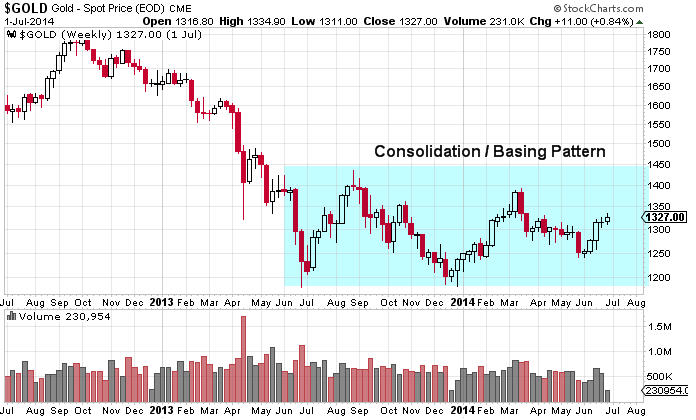
Gold prices have been in a giant basing or consolidation pattern for more than one year. As can clearly be seen below, gold futures prices have traded in a range between roughly 1,175 and 1,430 since June of 2013.


Chart1


The past few weeks we have heard more about gold prices as we have seen a five week rally since late May. I would also draw your attention to the fact that gold futures also made a slightly higher low which is typically a bullish signal.


At this point in time, it appears quite likely that a possible test of the upper end of the channel is possible in the next few weeks / months. If price can push above 1,430 on the spot gold futures price a breakout could transpire that could see $150 or more added to the spot gold price.


Clearly there are a variety of ways that a trader could consider higher prices in gold futures. However, a basic option strategy can pay handsome rewards that will profit from a continued consolidation. The trade strategy is profitable as long as price stays within a range for a specified period of time. Ultimately this type of trade strategy involves the use of options and capitalizes on the passage of time.


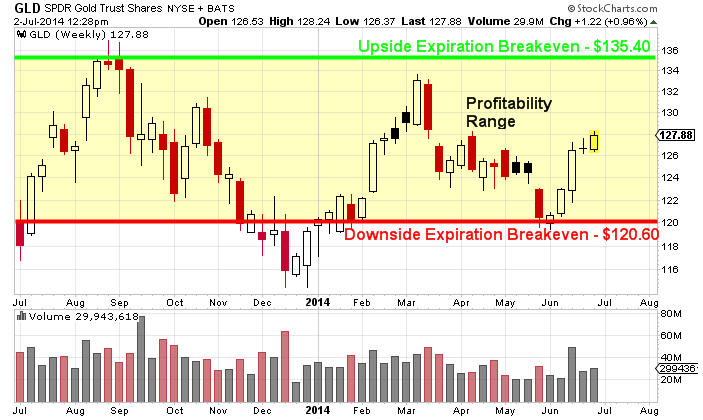
The strategy is called an Iron Condor Strategy, however in order to make this trade worth while we would consider widening out the strikes to increase our profitability while simultaneously increasing our overall risk per spread. Consider the chart of GLD below which has highlighted the price range that would be profitable to the August monthly option expiration on August 15th.


Chart2


As long as price stays in the range shown above, the GLD August Iron Condor Spread would be profitable. Clearly this strategy involves patience and the expectation that gold prices will continue to consolidate. This trade has the profit potential of $37 per spread, or a total potential return based on maximum possible risk of 13.62%. The probability based on today's implied volatility in GLD options for this spread to be profitable at expiration (August 15) is roughly 80%.


Our new option service specializes in identifying these types of consolidation setups and helps investors capitalize on consolidating chart patterns, volatility collapse, and profiting from the passage of time. And if you Advanced options trades are not your thing, we also provide Simple options where we buy either a call or put option based on the SP500 and VIX. The nice thing about buying calls and puts is that you can trade with an account as little as $2,500.


If You Want Daily Options Trades, Join the Technical Traders Options Alerts

See you in the markets!

Chris Vermeulen

Sign up for our next free trading webinar "Low VIX and What It Means to Your Trading"


Monday, May 26, 2014

Free trading webinar: The Insiders Guide to Growing a Small Account into a Big Account

Growing your account is not as hard as you think. And it won't take you decades to grow it if you do it the RIGHT (and safe) way. Let John Carter show you how he does it and how you can do it too.

Just click here to grab a seat to Tuesdays [June 3rd] FREE webinar

He's pulling back the cloak on how he personally grows his accounts with super low risk, and max gains and control. He'll show you........

   *   His favorite low risk strategy to grow his account

   *  What stops to use and WHEN

   *  How to control risk without being timid

   *  How to secure your financial future.

   *  And a lot more...plus he'll be taking question

Seats are limited for this 'Insider Meeting', so get your name on the list TODAY:

Just Click Here to Reserve Your Seat to John's Meeting 

See you Tuesday!
Ray's Stock World


Monday, April 28, 2014

What High Frequency Trading Firms Don't Want You to Know

If you haven't heard about High Frequency Trading (HFT), now's the time to learn. HFT almost guarantees you'll lose as a day/short term trading individual, but John Carter shows you how you can beat the high frequency traders at their own game.

Mark your calendars for this Tuesday. It's in your best interest (if you're serious about your trading) to attend the webinar John's putting on THIS TUESDAY…

What HFT Firms Don't Want You to Know

You have two times to attend, and it's only happening TUESDAY. You'll learn....

   *   How to protect against High Frequency Traders
   *   How to take advantage of what HFT's are doing
   *   How to get in front of HFT's
   *   What is HFT's agenda?!
   *   Why HTF's impacts all traders (stock, options, futures, etc)

And of course a lot more.....Just click here to get you seat NOW

John Carter and The staff at Ray's Stock World


John's new video > HFT vs. John Carter: The Rise of the Machines


Friday, February 14, 2014

Paper Gold Ain’t as Good as the Real Thing

By Doug French, Contributing Editor

For the first time ever, the majority of Americans are scared of their own federal government. A Pew Research poll found that 53% of Americans think the government threatens their personal rights and freedoms.


Americans aren't wild about the government's currency either. Instead of holding dollars and other financial assets, investors are storing wealth in art, wine, and antique cars. The Economist reported in November, "This buying binge… is growing distrust of financial assets."

But while the big money is setting art market records and pumping up high end real estate prices, the distrust in government script has not pushed the suspicious into the barbarous relic. The lowly dollar has soared versus gold since September 2011.

Every central banker on earth has sworn an oath to Keynesian money creation, yet the yellow metal has retraced nearly $700 from its $1,895 high. The only limits to fiat money creation are the imagination of central bankers and the willingness of commercial bankers to lend. That being the case, the main culprit for gold's lackluster performance over the past two years is something else, Tocqueville Asset Management Portfolio Manager and Senior Managing Director John Hathaway explained in his brilliant report "Let's Get Physical.

Hathaway points out that the wind is clearly in the face of gold production. It currently costs as much or more to produce an ounce than you can sell it for. Mining gold is expensive; gone are the days of fishing large nuggets from California or Alaska streams. Millions of tonnes of ore must be moved and processed for just tiny bits of metal, and few large deposits have been found in recent years.

"Production post 2015 seems set to decline and perhaps sharply," says Hathaway.

Satoshi Nakamoto created a kind of digital gold in 2009 that, too, is limited in supply. No more than 21 million bitcoins will be "mined," and there are currently fewer than 12 million in existence. Satoshi made the cyber version of gold easy to mine in the early going. But like the gold mining business, mining bitcoins becomes ever more difficult. Today, you need a souped-up supercomputer to solve the equations that verify bitcoin transactions—which is the process that creates the cyber currency.

The value of this cyber dollar alternative has exploded versus the government's currency, rising from less than $25 per bitcoin in May 2011 to nearly $1,000 recently. One reason is surely its portability. Business is conducted globally today, in contrast to the ancient world where most everyone lived their lives inside a 25 mile radius. Thus, carrying bitcoins weightlessly in your phone is preferable to hauling around Krugerrands.

No Paper Bitcoins


But while being the portable new kid on the currency block may account for some of Bitcoin's popularity, it doesn't explain why Bitcoin has soared while gold has declined at the same time.

Hathaway puts his finger on the difference between the price action of the ancient versus the modern. "The Bitcoin gold incongruity is explained by the fact that financial engineers have not yet discovered a way to collateralize bitcoins for leveraged trades," he writes. "There is (as yet) no Bitcoin futures exchange, no Bitcoin derivatives, no Bitcoin hypothecation or rehypothecation."

So, anyone wanting to speculate in Bitcoin has to actually buy some of the very limited supply of the cyber currency, which pushes up its price.

In contrast, the shinier but less-than-cyber currency, gold, has a mature and extensive financial infrastructure that inflates its supply—on paper—exponentially. The man from Tocqueville quotes gold expert Jeff Christian of the CPM Group who wrote in 2000 that "an ounce of gold is now involved in half a dozen transactions." And while "the physical volume has not changed, the turnover has multiplied."

The general process begins when a gold producer mines and processes the gold. Then the refiners sell it to bullion banks, primarily in London. Some is sold to jewelers and mints.

"The physical gold that remains in London as unallocated bars is the foundation for leveraged paper gold trades. This chain of events is perfectly ordinary and in keeping with time-honored custom," explains Hathaway.

He estimates the equivalent of 9,000 metric tons of gold is traded daily, while only 2,800 metric tons is mined annually.

Gold is loaned, leased, hypothecated, and rehypothecated, over and over. That's the reason, for instance, why it will take so much time for the Germans to repatriate their 700 tonnes of gold currently stored in New York and Paris. While a couple of planes could haul the entire stash to Germany in no time, only 37 tonnes have been delivered a year after the request. The 700 tonnes are scheduled to be delivered by 2020.

However, it appears there is not enough free and unencumbered physical gold to meet even that generous schedule. The Germans have been told they can come look at their gold, they just can't have it yet.

Leveraging Up in London


The City of London provides a loose regulatory environment for the mega banks to leverage up. Jon Corzine used London rules to rehypothecate customer deposits for MF Global to make a $6.2 billion Eurozone repo bet. MF's customer agreements allowed for such a thing.

After MF's collapse, Christopher Elias wrote in Thomson Reuters, "Like Wall Street cocaine, leveraging amplifies the ups and downs of an investment; increasing the returns but also amplifying the costs. With MF Global's leverage reaching 40 to 1 by the time of its collapse, it didn't need a Eurozone default to trigger its downfall—all it needed was for these amplified costs to outstrip its asset base."

Hathaway's work makes a solid case that the gold market is every bit as leveraged as MF Global, that it's a mountain of paper transactions teetering on a comparatively tiny bit of physical gold.

"Unlike the physical gold market," writes Hathaway, "which is not amenable to absorbing large capital flows, the paper market, through nearly infinite rehypothecation, is ideal for hyperactive trading activity, especially in conjunction with related bets on FX, equity indices, and interest rates."

This hyper leveraging is reminiscent of America's housing debt boom of the last decade. Wall Street securitization cleared the way for mortgages to be bought, sold, and transferred electronically. As long as home prices were rising and homeowners were making payments, everything was copasetic. However, once buyers quit paying, the scramble to determine which lenders encumbered which homes led to market chaos. In many states, the backlog of foreclosures still has not cleared.

The failure of a handful of counterparties in the paper-gold market would be many times worse. In many cases, five to ten or more lenders claim ownership of the same physical gold. Gold markets would seize up for months, if not years, during bankruptcy proceedings, effectively removing millions of ounces from the market. It would take the mining industry decades to replace that supply.

Further, Hathaway believes that increased regulation "could lead, among other things, to tighter standards for collateral, rules on rehypothecation, etc. This could well lead to a scramble for physical." And if regulators don't tighten up these arrangements, the ETFs, LBMA, and Comex may do it themselves for the sake of customer trust.

What Hathaway calls the "murky pool" of unallocated London gold has supported paper-gold trading way beyond the amount of physical gold available. This pool is drying up and is setting up the mother of all short squeezes.

In that scenario, people with gold ETFs and other paper claims to gold will be devastated, warns Hathaway. They'll receive "polite and apologetic letters from intermediaries offering to settle in cash at prices well below the physical market."

It won't be inflation that drives up the gold price but the unwinding of massive amounts of leverage.
Americans are right to fear their government, but they should fear their financial system as well. Governments have always rendered their paper currencies worthless. Paper entitling you to gold may give you more comfort than fiat dollars.

However, in a panic, paper gold won't cut it. You'll want to hold the real thing.

There's one form of paper gold, though, you should take a closer look at right now: junior mining stocks. These are the small cap companies exploring for new gold deposits, and the ones that make great discoveries are historically being richly rewarded… as are their shareholders.

However, even the best junior mining companies—those with top managements, proven world class gold deposits, and cash in the bank—have been dragged down with the overall gold market and are now on sale at cheaper than dirt prices.

Watch eight investment gurus and resource pros tell you how to become an "Upturn Millionaire" taking advantage of this anomaly in the market—click here.


Watch "The 80/20 Trading Rule, Lessons from a Millionaire Trader


Monday, February 10, 2014

Barbers and Taxi Cab Drivers are Talking Coffee...Is that the Top? JO JVA

One of the oldest trading cliches in the book. "When the TV pundits are talking about it, and the barbers and taxi cab drivers are talking about it...the top is in". But not in coffee this year. We think we are just getting started. And when we talk coffee we always check in with our favorite coffee trader Mike Seery. Here's what Mike is saying....

Coffee futures have been the big story in recent weeks due to the fact of a huge rally in the last 2 weeks caused by hot & dry conditions in central Brazil which is causing prices to move much higher as we have not seen a drought since 1989 and there are no rains forecast in the next 7 days which could push prices up even higher.

Coffee is trading above its 20 and 100 day moving average settling at 137.85 a pound in the May contract up about 1000 points this week with extreme volatility as Brazil's crop is estimated between 54 – 55 million bags and that could be lowered if this drought continues in the month of February and as I talked about in previous blogs the volatility is extremely high.

So I would look at bull call option spreads for the month of July limiting your risk to what the premium costs also allowing you to stay in the market without getting stopped out because there are days like Thursday when prices were down 700 points which is around $3,000 a futures contract as the volatility is here to stay and I do think higher prices are coming.

The 50% retracement from the recent high to the low is right around 130 so if you’re looking to get into a futures contract I would look to buy that level placing my stop at the 10 day low which currently is at 115 risking around $5,500 per contract.

Coffee is a very large contract and if you're right it will pay you off tremendously as I've gone through similar events in this market especially in 1994 when prices went from $.75 to 2.70 in a matter of months due to a frost and if this drought does continue expect coffee possibly getting up to the $2 a pound level as prices could really explode just like what happened in the grain market in 2012.

Current coffee trend: HIGHER
Current chart structure: TERRIBLE

Get a free trend analysis for coffee ETF ticker "JO" in your inbox.


Monday, January 13, 2014

Don't Let Scalping Scare You....Use our Free Trading System Download

For many of our readers at Ray's Stock World active trading is terrifying. The crazy spreads and crushing risk while you're "super glued" to your chair is not a very appealing way to spend your trading day. But done right, it can be insanely lucrative.

A couple of times a year our friends and trading partners at The Premier Trader University bring us [and our readers] a free download of their popular "Trend Jumper Trading Program".

Check out this FREE System Now

This high frequency system is a "genetically modified" active trading method that cuts your risk while boosting your results. Believe it or not, it's a jaw dropping, easy to learn strategy that's actually fun to trade.

This system regularly sells for $997.00 to the public. In the last release in April, literally hundreds of traders ran to pay full retail price for this system. Price to all of our readers today? ZERO. That's right, FREE!

But we have managed to convince the developers to let our readers have their best, most lucrative indicators without the triple digit price tag. Right now, you're going to get the two most profitable Trend Jumper trade plans free for life.

Click here to get your FREE Trend Jumper Indicators

Seriously, these two indicators are all you need. No need to upgrade, no need to spend a nickel. Folks are paying hundreds of dollars for the full version. But you'll get the best indicators and they can be used for trading stocks, commodities, Forex, futures and more....all for free.

We'll see you next in the markets. And we'll be using Trend Jumper, will you?

Ray's Stock World


Get this Free Scalping System Now


Friday, December 6, 2013

Is it Too Late to Get into this Monster UNG Trade?

Natural gas looks to be breaking out and it has John's attention. With monthly and weekly charts breaking out he is looking at futures contracts having the possibility of easily moving up to the 4.48 level which means there is a lot of options open for us options traders. And if you have been following us this week you know John is on a roll.

John has put together a detailed free video to show us just exactly how to play UNG and natural gas while limiting our risk, just click here to watch "Is it Too Late to Get into this Monster UNG Trade?"


And if you haven't had a chance to see it yet take a few minutes to watch John's wildly popular webinar replay....."Nine Reasons Why You Should Trade Options on ETFs"

See you in the markets, the natural gas markets!

Ray's Stock World


Thursday, December 5, 2013

Are You Trading Gold? Two Compelling Reasons To Consid

Here's a great trading quote you may not have heard:

"It is better to trade two complementary strategies that make less, than one strategy that makes more"

Yes, it is almost always true. Traders can make more profits (over the long term) by trading two conservative, complementary strategies that have lower, combined profit potential than trading one aggressive strategy that has a higher profit potential.

The reason is not obvious and frequently over-looked until it is too late: The single, higher profit strategy will often endure larger, deeper draw downs (periods of losing trades and unprofitability in which account equity is reduced) in order to achieve the greater returns. Deep draw downs are stressful and cause the trader to second guess his strategy, skip trades, reduce position size, cut winners short and so on, all of which are detrimental to the long term profit potential of the strategy. Dreams of riches often end in a nightmare of losses.

To minimize these self-destructive behaviors and maximize the odds of long term, consistent profitability, it is better to diversify and trade strategies and / or markets that are not related or similar. The goal is to achieve no or low correlation, so that when strategy A is struggling, strategy B is performing and vice versa.

Join us this Thursday for a free one hour educational event where we will discuss not only the power of diversification, but also why trading with historical data is so important.

Diversify, use history, trade Gold!

Applying your favorite strategy to just about any new market will certainly provide many of the benefits of diversification. But to maximize the power of diversifying, it is best to trade a market that "moves to its own beat." Meaning, one that does not move up and down in sync with the equity markets or instrument that you might trade. This is called low correlation.

A great uncorrelated market is Gold. It can be traded using stocks, ETF, options or futures. Furthermore, it moves a lot on a daily basis - much more than the major U.S. indices such as the Dow and S&P.

Want to learn about trading Gold using various instruments, tips for getting started, a simple strategy, etc.?

Check out our free training event next Thursday
 

Diversify, use history, trade Gold!


See you in the market, the gold market!
Ray's Stock World


Here's our Introduction into Trading the Gold Market


Thursday, September 12, 2013

Trading the Trend....Is Your Strategy Working?

This week our trading partner Todd Mitchell is sharing his unique trading strategies and we are finding they aren't for everyone. And, especially not for those people who like to use complicated software or get handcuffed to some "black box" trading system.

But it's a great insight into how professional E-Mini traders place winning trades everyday. You have to watch Todd's free presentation "The Simple Truth About Trends"

Todd proves that the key to pulling money of the markets - whether you're trading stocks, Forex, E-Mini futures or Options - is to trade with the prevailing trend. Yet, most people doing it all wrong. They're missing critical clues in price, getting in too late and not exiting their trade before the trend turns.

However, after watching this free video you'll have more knowledge about the trend than 90% of other traders.

Inside this presentation you'll discover:

- 3 Critical Bullish Patterns in Price
- 3 Important Bearish Patterns in Price
- 3 Little-Known Truths in Trend That Apply in all Markets in all Timeframes
- How to Spot Reversals Before They Happen
- How to Determine the Strength of the Market


There's over 1,000 comments of people raving about this content and I'm certain you'll agree it's one of the best presentations you've watched all year.

Watch "The Simple Truth About Trends" now!

Ray's Stock World


Wednesday, July 10, 2013

Register here for a Live PTU Trend Jumper Webinar System Demonstration

Join our friends at Premier Trader University as they demonstrate to you the powerful day and swing trading system that actively trades a number of your favorite markets. Forex? Futures? Options? Stocks? Yes to all of these.

Just some of the markets we’ll be showing you live include:

  *    Russell e-Mini Futures
  *   Crude Oil Futures
  *   EURJPY, CADJPY and EURUSD forex day trading
  *   EURAUD, GBPCAD, AUDJPY, EURUSD, GBPPY and many other forex pairs for swing trading * Unleaded Gas Futures
  *   Dax Futures
  *   European markets as well


Plus More – and we do it all LIVE in the markets during these webinars. You’ll learn actionable trading advice, and we answer all your questions live.

Our Next Webinars:

Thursday, July 11th at 12:00pm EST/9:00am PST/5:00pm GMT

Thursday, July 11th at 6:00pm EST/3:00pm PST/11:00pm GMT

You can register by clicking the date above – be sure to reserve your spot and attend – the live in the market demo has limited availability

Tuesday, May 14, 2013

Gold still has downward pressure to look forward to.....right?

Outside of a late week Currencies surge, there were very few fireworks to report in last week’s business. This week however, may be a different story.

Thursday and Friday of last week provided some decent movement in the Dollar and Euro, but it appeared things began in the Japanese Yen, then spilled over. Throughout the last several weeks, there have been multiple attempts to push the Yen to new lows for the year, but it always seemed that somehow the plan was foiled. After the selling pressure triggered stop-orders below support, all other Currencies had to react. There was a firm rebound in the US Dollar and an inverse move in the Euro Currency. Surprisingly, the swings in the Currencies had very little impact on outside markets. In fact, most other sectors of the markets were rather stale and choppy. A Treasury Bond auction had some impact on the 30 year bonds and 10 year Notes, but there was little else in the week that provided any excitement. The same goes for the Gold Futures. Normally, traders would use the direction the Dollar or the Stock Indexes as a guide for what to expect in the Metals, but those former relationships are no longer in play on a day to day basis.

This week, there are a few decent reports in the US and Europe that should provide some decent movement. In the United States, Retail Sales, CPI, PPI, Empire State Manufacturing, and Philly Fed reports will be worth watching. In Europe, traders will be following economic data out of Germany along with European GDP figures to provide sustained market direction in at least the Currency sector, but I am unsure whether or not it will carry over into the Metals.

The Weekly Chart of June Gold shows the Futures prices consolidating around $1425. I still believe that Gold Futures may have some further pressure ahead while the US stock indexes remain stable and strong. One thing that will be interesting to watch would be if the Gold Futures ever return to being a “flight to safety” vehicle if the stock market corrects. I will keep a tight watch on that former relationship as the stock market continues its questionable rally into uncharted territory.


Posted courtesy of our trading partner Adam Hewsion at INO.Com


Get our Free Trading Videos, Lessons and eBook today!