Showing posts with label stock. Show all posts

Monday, September 7, 2015

Buy the Dip? Hell No.....Sell the Rip Instead

By Tony Sagami

Are you worried about the stock market? You should be; at least according to your local Starbucks barista.
Starbucks CEO Howard Schultz told his 190,000 employees in his daily “Message from Howard” email communication: “Today’s financial market volatility, combined with great political uncertainty both at home and abroad, will undoubtedly have an effect on consumer confidence and … our customers are likely to experience an increased level of anxiety and concern. Let’s be very sensitive to the pressures our customers may be feeling.”

You can’t make this stuff up!

Hey, maybe I shouldn’t be too harsh on Mr. Schultz, because the stock market is in a lot of trouble… and not for the reasons the mass media and Wall Street experts are telling you. The know it alls on CNBC are pointing their fingers at the Chinese stock market meltdown as the reason for our stock market turmoil, but that is just the catalyst… not the root problem.

The source of the meltdown is deeper, more problematic, and more painful. What I’m talking about is that the Federal Reserve—from Greenspan to Bernanke, to Yellen—thought they possessed Wizard of Oz powers to fix whatever ails the economy with their menu of monetary tools.

In 2000, the Fed thought it could solve the bursting of the dot-com bubble with massive interest rate cuts and repeated that playbook again for the 2008-09 Financial Crisis. And when they ran out of room by cutting interest rates to zero, they trotted out Operation Twist and QE 1, 2, and 3.


Those three rounds of QE added about $3.7 trillion to the Federal Reserve’s balance sheet since 2008, which now totals a mind boggling $4.5 trillion. The problem is not China; the problem is Janet Yellen and her Federal Reserve buddies.


The Fed—beginning with the original monetary Mr. Magoo of Alan Greenspan—created a bubble, then rolled out more of the same to deal with the bursting of the bubble, and like the shampoo bottle says: Rinse, Lather, Repeat. Zero interest rates plus QE1, QE2, and QE3 created a massive misallocation of capital that has affected everything from home supply, ocean-going freighters, the US dollar, and wages, and pushed stock prices to a bigger than ever bubble.


The recent weakness is the painful process of deflating that bubble, but the Federal Reserve refuses to learn from its mistakes. It won’t be long until we hear about QE4 and/or a delay to the overpromised interest rate liftoff. Former US Treasury Secretary Larry Summers had this to say yesterday: “A reasonable assessment of current conditions suggests that raising rates in the near future would be a serious error that would threaten all three of the Fed’s major objectives; price stability, full employment and financial stability.”

Honestly, I don’t know what the Federal Reserve will do next. Heck, I bet they don’t know what to do either… but they will do something. Central bankers are arrogant know-it-alls who think they can fix the world’s financial problems with a couple of pulls of a monetary lever.

So pull they will.

And so the stock market damage will continue, albeit with some powerful up moves along the way.
Bulls, whether in a Spanish bull-fighting arena or roaming the floor of the NYSE, are a tough animal to kill. They won’t surrender until they make a few more desperate attempts to push the market higher.
Look at what happened last Tuesday after the 588-point Monday meltdown. The Dow Jones Industrial Average shot up by as much as 441 points before ending the day with a 204-point loss.


My point is that you’re going to see a lot of powerful up moves in the coming months… but I’m telling you, these are nothing more than bear market traps to lure you into buying at the wrong time. The stock market is falling into a bear market, and that means big swings both up and down, similar to 2000–2003.


The Federal Reserve, along with the rest of the world’s central bankers, has puffed stock valuations into an epic bubble, and the stock market has a long, long ways yet to fall…..just not in a straight line. That’s heart attack material for both buy-hold-and-pray and buy the dip investors, but it is a goldmine if you adapt your strategy.


Instead of buying the dip, the right strategy going forward is SELL THE RIP.

When the stock market gives you a big rally, the right move will be to sell into strength.

And if you have some risk capital, that will be the time to load up on inverse ETFs and put options, like my Rational Bear subscribers did in July.

The biggest short-selling opportunity of our lifetimes is knocking on your door.
Tony Sagami
Tony Sagami

30 year market expert Tony Sagami leads the Yield Shark and Rational Bear advisories at Mauldin Economics. To learn more about Yield Shark and how it helps you maximize dividend income, click here.

To learn more about Rational Bear and how you can use it to benefit from falling stocks and sectors, click here.


Get our latest FREE eBook "Understanding Options"....Just Click Here!


Monday, January 26, 2015

The Single Most Important Economic Statistic that the White House Never Talks About

By Tony Sagami


For the first time in 35 years, American business deaths now outnumber business births. —Jim Clifton, CEO, Gallup Polls

I’ve been self employed since 1998, and let me tell you, the life of a business owner isn’t easy. It’s filled with long hours, a relentless amount of paperwork, and uncertainty of where your next paycheck will come from.

If you’ve ever owned a business, you know exactly what I’m talking about.

Difficult or not, self employment is extremely rewarding, and I wouldn’t have it any other way. Nor would the other 6 million business owners in the United States. Of those 6 million businesses, the vast majority are small “Mom and Pop” businesses. Here are more statistics on businesses in the U.S. :
  • 3.8 million have four or fewer employees. That’s me!
     
  • 1 million with 5-9 employees;
     
  • 600,000 with 10-19 employees;
     
  • 500,000 with 20-99 employees;
     
  • 90,000 with 100-499 employees;
     
  • 18,000 with 500 employees or more; and
     
  • 1,000 companies with 10,000 employees or more.
Those small businesses are the backbone of our economy and responsible for employing roughly half of all Americans. Moreover, while estimates vary, small business create roughly two thirds of all new jobs in our country.

Get our latest FREE eBook "Understanding Options"....Just Click Here!

For those reasons, the health (or lack thereof) of small business is the single most important long term indicator of America’s economic health. Warning: new data suggest that small businesses are in deep trouble.
For the first time in 35 years, the number of business deaths outnumbers the number of business births.


The US Census Bureau reported that the birth and death rates of American businesses crossed for the first time ever! 400,000 new businesses were born last year, but 470,000 died.

Yup, business deaths now outnumber business births.


Pay attention, because this part is important.

The problem isn’t so much that businesses are failing, but that American entrepreneurs are simply not starting as many new businesses as they used to. We like to think of America has the hotbed of capitalism, but the US actually is number 12 among developed nations for new business startups.

Number 12!

You know what countries are ahead of us? Hungary, Denmark, Finland, New Zealand, Sweden, Israel, and even financially troubled Italy are creating new businesses faster than us!


The reasons for the capitalist pessimism are many, but my guess is that the root of the problem comes down to three issues: (1) difficulty of accessing capital (loans); (2) excessive and burdensome government regulations; and (3) an overall malaise about our economic future.

Business owners are permanently smitten with an entrepreneurial bug, and the only thing that prevents them from seeking business success is the expectation that they’ll lose money.

Sadly, the lack of new business start ups is confirmation that American’s free enterprise system is broken.

"There is nobody in this country who got rich on their own. Nobody. You built a factory out there—good for you. But I want to be clear. You moved your goods to market on roads the rest of us paid for. You hired workers the rest of us paid to educate. You were safe in your factory because of police forces and fire forces that the rest of us paid for. You didn't have to worry that marauding bands would come and seize everything at your factory... Now look. You built a factory and it turned into something terrific or a great idea—God bless! Keep a hunk of it. But part of the underlying social contract is you take a hunk of that and pay forward for the next kid who comes along."

Elizabeth Warren

“When small and medium-sized businesses are dying faster than they’re being born, so is free enterprise. And when free enterprise dies, America dies with it,” warns Gallup CEO Jim Clifton.

I don’t believe for a second that America’s free-enterprise system is permanently broken. The pendulum will eventually swing the other way, but our economy will not enjoy boom times until the birth/death trends are reversed.

That won’t happen next week or next month. It will take serious, fundamental changes in tax, regulatory, and judicial rules, and I sadly fear that it will take several years for that to happen. Until then, our economy is going to struggle and will pull our high flying stock market down with it. Are you prepared?

If you’re not familiar with inverse ETFs, you’re ignoring one of your best defenses against tough times. An inverse ETF is an exchange traded fund that’s designed to perform as the inverse of whatever index or benchmark it’s designed to track.

By providing performance opposite to their benchmark, inverse ETFs prosper when stock prices are falling. An inverse S&P 500 ETF, for example, seeks a daily percentage movement opposite that of the S&P. If the S&P 500 rises by 1%, the inverse ETF is designed to fall by 1%; and if the S&P falls by 1%, the inverse ETF should rise by 1%.

There are inverse ETFs for most major indices and even sectors and commodities (like oil and gold), as well as specialty ETFs for things like the VIX Volatility Index.

I’m not suggesting that you rush out and buy a bunch of inverse ETFs tomorrow morning. As always, timing is critical, so I recommend that you wait for my buy signals in my Rational Bear service.

But make no mistake, the birth/death ratio is signaling serious trouble ahead. Any investor who doesn’t prepare for it is going to get run over and flattened like a pancake.

Tony Sagami
Tony Sagami

30 year market expert Tony Sagami leads the Yield Shark and Rational Bear advisories at Mauldin Economics. To learn more about Yield Shark and how it helps you maximize dividend income, click here.

To learn more about Rational Bear and how you can use it to benefit from falling stocks and sectors, click here.


New Video: 6 Simple Criteria that Guarantee Trading Success.....Just Click Here!


Monday, January 12, 2015

Beyond Tesla: The Huge Profit Potential of Lithium

By Tony Sagami

One of the stocks that I get the most questions about is Tesla. I’m not sure whether investor interest is due to the gorgeous lines of the Tesla Model S, its amazing high performance engine, the high flying stock, or the energy saving nature of all electric vehicles….. but Tesla is a very popular subject.


Tesla cars don’t just look fast; they are fast! The Tesla Model S can go from 0 to 60 mph in a stunning 5.9 seconds and travel up to an impressive 319 miles on a single charge.

The Tesla Model S is shockingly modestly priced by luxury car standards. The basic model has a MSRP of $69,900, but the price tag can quickly escalate to $100,000 with optional add ons. Of course, a cheapskate like me would never pay that much for a car—even an electric car—but lots of status-conscious consumers have.


And you won’t see me buying Tesla stock either. Even though it’s well off of its 52 week high, it’s still trading for almost 80 times earnings and 29 times book value.

However, a lot of technology is incorporated into electric vehicles. The most profitable way to invest in electric vehicles is not through Tesla stock, but instead from the industry that makes batteries possible.
I’m talking about lithium, one of the most valuable natural resources of the new electronic world thanks to its unique and extremely valuable characteristics:

  • Lithium has such a low density that it floats on water and can be cut with a butter knife. And when mixed with aluminum and magnesium, it can form lightweight alloys that produce some the highest strength to weight ratios of all metals.
     
  • Lithium tolerates heat better than any other solid element, melting at 357°F.
  • Lithium batteries offer the best weight-to-energy ratio, making lithium batteries ideal for any application where weight is an issue, such as portable electronics.
     
  • That same high energy density and low weight characteristic makes lithium batteries the best choice for electric/hybrid vehicles due to car gas mileage. A car’s biggest enemy is weight.
     
  • Lithium has a very high electrochemical potential, meaning that it has excellent energy storage capacity.
Lithium is a key mineral of the future, but there are limited ways to invest in it because unlike other commodities, there is no vehicle to invest in the physical metal.

On top of that, few options exist to invest in it because the market is dominated by only a handful of producers: Chemical & Mining Company of Chile (SQM); FMC Corp. (FMC); Rockwood Holdings (ROC); and privately held Talison Lithium.

The Chemical & Mining Company of Chile is primarily a potash fertilizer company; FMC Corp. is a diversified chemical producer with a less than 15% of its revenues from lithium; and Talison is a privately held Chinese company.

That leaves Rockwood Holdings as the purest play on lithium by a wide margin, with close to a 50% share of the global lithium market. It’s the OPEC of lithium. It’s also trading around $80 a share right now… a lot cheaper than Tesla—the car and the stock!

Of course, timing is everything, so I’m not suggesting that you rush out and invest in lithium or any of the above stocks tomorrow morning. Instead, wait for my buy signal in Just One Trade.
Tony Sagami
Tony Sagami

30 year market expert Tony Sagami leads the Yield Shark and Rational Bear advisories at Mauldin Economics. To learn more about Yield Shark and how it helps you maximize dividend income, click here.

To learn more about Rational Bear and how you can use it to benefit from falling stocks and sectors, click here.


Get our latest FREE eBook "Understanding Options"....Just Click Here!


Monday, December 1, 2014

Using Stock Buybacks to Mask Deep Business Problems

By Tony Sagami


Stock buybacks are always a good thing… right? That’s what the mass media has trained investors to believe, but there are times when stock buybacks are a horrible strategy.

Let’s take a look at Herbalife, which has had very visible news items as billionaires like Carl Icahn, George Soros, Daniel Loeb, and Bill Ackman publicly debate the future of the company.


Herbalife shares have lost more than half their value in 2014 because of a Federal Trade Commission investigation and a big drop in profits. 50% is a huge haircut, but I believe Herbalife is poised for even more pain.

Rapidly Disappearing Profits


Herbalife recently reported its third-quarter results and they were just awful. Herbalife earned $0.13 per share in Q3, but that was a whopping 92% decline from the $1.32 it earned last year.

That’s awful, but Herbalife says business will be even worse going forward. The Wall Street crowd expected Herbalife to grow revenues by 7% in 2015, but the company said that its revenues will fall by -1% to -2% instead.

Part of that lower guidance is from the impact of the strong US dollar. Guidance for Q4 includes an unfavorable impact of $0.31 from currency conversions. If you remember, I previously wrote that the strong dollar was going to kill the 2015 profits of companies that do lots of business overseas.

I have to admit, I am skeptical of all the multilevel marketing businesses, but Herbalife is reinforcing that preconceived notion.

FTC and FBI Investigation


The Federal Trade Commission is investigating Herbalife for what could ultimately result in charges that Herbalife is operating an illegal pyramid scheme.

In March, the FTC sent Herbalife a civil investigative demand (CID), which is a subpoena on steroids because all the evidence produced by a CID can be used by other agencies in other investigations, such as the FBI, which is also investigating Herbalife.

The FTC outcome is unknown. Heck, Herbalife could eventually be declared innocent and pure… but I wouldn’t bet on it.

Board Members Gone Bad!


When your company is in the middle of FTC and FBI investigations, the last thing you want is for your company officers to get in trouble with the law. A current Herbalife board member, Pedro Cardoso, has been charged with illegal money laundering by Brazilian prosecutors. Time will tell if the charges are true… but it looks very bad.


That’s not the only problem with the Herbalife board of directors. Longtime Herbalife Board Member Leroy Barnes announced that he is leaving. Board members leave for legitimate reasons all the time, but Barnes is the fourth Herbalife board member to leave in 2014. Talk about rats jumping the ship!

The Smoke and Mirrors of Stock Buybacks


The above issues are all serious and enough to stay away from Herbalife, but the biggest red flag I see is the abusive financial engineering that Herbalife is using to prop up its stock.

Example: In Q2, Herbalife spent over $500 million to buy back its own stock for the purpose of propping up its earnings-per-share ratio. Fewer shares translates into higher earnings per share.


The root of the problem is that Herbalife is using up all its cash AND borrowing money like mad to finance the stock buyback.


In the last year, Herbalife’s debt has exploded by over $1 billion. Herbalife is using every penny of operating cash flow and taking on new debt just to buy back its stock.


Moreover, since Herbalife’s stock has plunged by 50% this year, Herbalife wasted hundreds of millions of dollar of shareholder money by buying stock at much higher prices.

And now that revenue, profits, and free cash flow generated by operations are shrinking, Herbalife is on a collision course with insolvency.


Carl Icahn, who is certainly a much better investor than I will ever be, is a big Herbalife fan and even went as far as to call the shares undervalued. “I would tell you I do believe Herbalife is quite undervalued and it is still a good business model.”

Ahhhh… Carl… sorry, but I think you couldn’t be more wrong.

George Soros, by the way, appears to agree with me because he reduced his Herbalife holdings by 60% after the company reported those disastrous third quarter results a few weeks ago. I’m not suggesting that you rush out and buy put options on Herbalife tomorrow morning. As always, timing is everything, but I have very little doubt that Herbalife’s stock will be significantly lower a year from now.

Moreover, the real point isn’t whether Herbalife is headed higher or lower, but that good, old fashioned fundamental research can help you make money in any type of market environment.

Even during bear markets.

30-year market expert Tony Sagami leads the Yield Shark and Rational Bear advisories at Mauldin Economics. To learn more about Yield Shark and how it helps you maximize dividend income, click here.

To learn more about Rational Bear and how you can use it to benefit from falling stocks and sectors, click here.


Get our latest FREE eBook "Understanding Options"....Just Click Here!

Thursday, September 25, 2014

Top Dividend Plays – Profit in a Bull Market, Protect Yourself in a Bear Market and Collect Dividends Along the Way!

When your babysitter knows that the market is on a roll, there is no question it’s a bull market! It may also be time to keep an eye out for a correction. No one knows when a correction will take place and you don’t want to miss gains in a bull market.

So what do you do?

Easy! Continue buying good companies with outstanding fundamentals, but look for “defensive” sectors and throw in some outstanding dividend payouts for good measure.

In this complimentary INO.com special report they reveal an ETF that’s loaded with the best and most consistent dividend paying companies. And here’s the best part: all of the companies listed in this ETF have to boast a record of increasing dividends for at least 20 consecutive years (not a typo).

As an added bonus, you’ll also receive their favorite dividend stock. This stock boasts a mind blowing dividend record backed by some of the strongest fundamentals around.

Don’t miss out, just click here to view this complimentary report today!

See you in the markets!
Ray's Stock World

Wednesday, July 2, 2014

5 Simple Rules to Evolve Past the Hot Stock List

By Andrey Dashkov

If you’re a typical small time investor, chances are you prefer to let a team of analysts fuss about such irksome things as correlation and beta. Maybe you’ve bought a stock because your brother in law gave you a hot tip, maybe you heard something about it on a financial news show, or maybe you just loved the company’s product.


Friends often ask me for “hot stock tips”—which is like walking up to someone at the craps table and asking what number to bet on. An accomplished craps player will have position limits, stop losses, income targets, and an overall strategy that does not hinge on one roll of the dice. You need an overall strategy long before you put money down.

So, what do I tell those friends asking for hot stock tips? Well, that they can retire rich with a 50-20-30 portfolio:
  • Stocks. 50% in solid, diversified stocks providing healthy dividends and appreciation.
  • High Yield. 20% in high yield, dividend paying investments coupled with appropriate safety measures. These holdings are bought for yield; any appreciation is a nice bonus.
  • Stable Income. 30% in conservative, stable income vehicles.
Unless you’re starting entirely from scratch, you should review your current portfolio allocations, identify where you’re over or underallocated, and then look for investments to fill those holes. In our portfolio here at Miller's Money Forever, we separate our recommendations into StocksHigh Yield, and Stable Income to help you do just that.

The Art of the Pick


By the time an investment lands in our portfolio, we’ve already run it through our Five Point Balancing Test. When your boasting brother in law tempts you with a “can’t-miss opportunity” or some pundit touts a hot tech company on television, you can come back to these five points, again and again.
  1. Is it a solid company or investment vehicle? Investing your retirement money safely is a must. How do you know if a company is solid? Take the time to validate essential company information, particularly when the recommendation comes from a source with questionable motivation.
  2. Does it provide good income? A good stock combines a robust dividend and appreciation potential.
  3. Is there a good chance for appreciation? There are two types of appreciating stocks: those that rise because of general market conditions and those that rise further because of the way management runs the business. We want both.
  4. Does it protect against inflation? High inflation is one of the biggest enemies of a retirement portfolio.
  5. Is it easily reversible? Ask yourself, “Can I quickly and easily reverse this investment if something unexpected occurs?” The ability to liquidate inexpensively is critical to correcting errors.

Marking the Bull’s Eye So You Can Hit It


It’s worthwhile to write down your goal—including an income target and the price at which you’ll sell if things head south—with every investment. After all, if you can’t see the bull’s eye, how will you know if you’ve hit it? Buying any investment because a trusted adviser, newsletter, or pundit recommended it is not a good enough reason. Buying because your portfolio has a hole, you understand the company, the investment vehicle, the risks, and the potential is.

Remember, retiring rich means having enough money to enjoy your lifestyle without money worries. Do your homework on every investment and you’ll make that pleasant thought your life’s reality. Every week, the Miller’s Money team provides no nonsense, practical advice about the best ways to invest for your retirement in  Miller’s Money Weekly Sign up here to receive it every Thursday.

The article 5 Simple Rules to Evolve Past the Hot-Stock List was originally published at Millers Money


Get your seat for our next free webinar "Low VIX and What It Means to Your Trading"....Just Click Here!


Sunday, May 4, 2014

World Money Analyst: Europe....Cliff Ahead?

By Dirk Steinhoff
When Kevin Brekke, managing editor [of World Money Analyst], contacted me last week, I knew it was time again to survey the investment landscape. This month, I will focus on Europe and its decoupled financial and real economy markets.

Globally, the last two years were marked by booming stock exchanges of developed markets, disappointing bond markets, and devastation across the precious metals markets.

Since June 2012, the EURO STOXX 50 Index, Europe’s leading blue chip index for the Eurozone, has advanced by approximately 50% and outperformed even the S&P 500 and the MSCI World indices.


Over the last six months, European stock exchanges have seen a surprising change of leadership: The major stock market indices of the “weaker” countries, like Portugal, Spain, and Italy, have outperformed those considered stronger, like Germany. One of the top performers was a country that was and still remains in “bankruptcy” mode: Greece.


The question at this point is: Can these outstanding European stock market performances continue?

In our search for an answer, let’s start with a closer look at the economic conditions within the European Union (EU), where approximately 2/3 of total “exports” (internal and external) of the EU-28 are traded. And then let’s have a look at the economic setting of some major trading partners, such as the US and BRIC countries, which account for roughly 17% and 21%, respectively, of the external exports of the EU-28.
Although the EURO STOXX 50 Index has soared since June 2012, certain key measures of the underlying real economies paint a different picture.

To start, the GDP of the EU-28 is not really growing. In 2012, it contracted by 0.4% and grew by the smallest fraction of 0.1% in 2013. The GDP growth numbers for the countries in the euro area are even worse: -0.7% in 2012 and -0.4% in 2013. Whereas Germany’s GDP was up in 2013 by 0.5%, economic growth was down in Spain, Italy, and Greece by -1.2%, -1.8%, and -3.6%, respectively.

Real GDP Growth Rates 2002-2012
2002
2003
2004
2005
2006
2007
2008
2009
2010
2011
2012
EU
1.3
1.5
2.6
2.2
3.4
3.2
0.4
-4.5
2.0
1.6
-0.4
Germany
0.0
-0.4
1.2
0.7
3.7
3.3
1.1
-5.1
4.0
3.3
0.7
Spain
2.7
3.1
3.3
3.6
4.1
3.5
0.9
-3.8
-0.2
0.1
-1.6
France
0.9
0.9
2.5
1.8
2.5
2.3
-0.1
-3.1
1.7
2.0
0.0
Italy
0.5
0.0
1.7
0.9
2.2
1.7
-1.2
-5.5
1.7
0.5
-2.5
Portugal
0.8
-0.9
1.6
0.8
1.4
2.4
0.0
-2.9
1.9
-1.3
-3.2


The EU unemployment rate stood at 10.2% at the beginning of 2012 and stands at 12.1% today. That the European Union is anything but a homogenous body that moves in unison can be seen in the following chart:


Where Germany has a current unemployment rate of 5.2% and a youth (under 25) unemployment rate of 7.5%, the numbers for other countries are worrisome: Current unemployment in Spain is 26.7%, and 12.7% in Italy, with youth unemployment in Spain at an incredible 57.7%, and 41.6% in Italy. And don’t forget Greece, which is mired in a historically unparalleled economic depression where unemployment is 28% and youth unemployment is a shocking 61.4%. Keep in mind that all of these numbers are those officially released by bureaucratic agencies. The real numbers, as we know, would likely be even worse.

Recent EU industrial production numbers have shown some slight improvement. Nevertheless, industrial production has only managed to recover to its 2004 level, and remains way below its 2007 heights (see next graph).

Source: Eurostat

So let’s see: a shrinking GDP, high and rising unemployment, and stagnant production significantly below 2007 levels. Those are not the rosy ingredients of a booming economy (as indicated by the stock exchanges) but of one that is struggling.

Europe is not in growth mode.

This verdict is further supported by the export numbers for trade between EU countries, known as internal trade. In 2001, internal trade accounted for 67.9% of EU exports. Today, this share is down to 62.7%. In an attempt to compensate for sluggish European growth, EU companies had to develop other export markets, such as the US or the emerging markets.

Will these markets help rescue European companies?

Time to Taper Expectations

With regards to the U.S., two important developments are worth mentioning. The first key development, which will have severe consequences for the global economy, was brought to my attention by my friend Felix Zulauf, an internationally well-known investor and regular member of the Barron’s Roundtable for more than 20 years. Running ever-increasing deficits in its trade and current accounts for almost 30 years, the US thus provided an enormous amount of stimulus for foreign exporters. Since 2006, however, the US trade deficit has shrunk, with deteriorating trade data for many nations as a consequence.


The second key development is that the newly appointed head of the US Federal Reserve system, Janet Yellen, seems determined to continue the taper of its bond buying program. This fundamental shift in monetary policy could be questioned if the economic numbers for the US begin to show significant weakness. But in the meantime, the reduction of economic stimulus in the US should lead to a reduced appetite for European export goods.

The emerging markets had been seen, not too long ago, as the investment opportunity and alternative to the fiscal and debt crisis-stricken countries of the developed world. Today, on a nearly daily basis, you hear bad news about the situation and developments in the emerging countries: swaying stock markets, plunging currencies, company bankruptcies, corruption scandals, and even riots.

The emerging markets are dealing with the unintended consequences of the Quantitative Easing (including liquidity easing and credit easing) programs in the West. The increased liquidity spilled over into the emerging markets in the hunt for yield. This flow of capital into the emerging markets lowered capital costs, inflated asset prices like stocks and real estate, and boosted commodity prices. All that, and more, sparked the emerging markets boom.

Now, this process has reversed. The natural conclusion to exaggerated credit-driven growth, the tapering of QE programs, the shrinking US trade deficit, and lower commodity prices has been an outflow of capital from emerging markets, triggering lower asset prices and exchange rates. The attempt of some countries to defend their currencies by raising interest rates will only exert further pressure on their economies.

With weaker emerging market economies and currencies, there will be no big added demand for European exports. Revenues and profits for EU companies (measured in euros) will fall.

When Trends Collide

So, over the last two years we had opposing trends—booming European stock markets and weak underlying real economies. This conflicting mix was mainly fostered by easy money that drove down interest rates to historic low levels. Plowing money into stocks, despite the poor fundamentals, was the only solution for most investors.

At their current elevated levels European stock markets appear vulnerable, and it seems reasonable to doubt that we will see a continuation of booming stock markets. Of course, such a decoupling can continue for some time, but the longer it continues, the closer we will get to a correction of this anomaly. Either the real economy catches up to meet runaway stock prices, or stock prices come down to meet the poor economic reality. Or some combination of the two.

Because of the economic facts that I discussed above, in my view, we may be seeing just the beginning of a stronger correction in stock prices.

Dirk Steinhoff is chief investment officer of portfolio management (international clients) at the BFI Capital Group. Prior to joining BFI in 2007, Mr Steinhoff acted as an independent asset manager for over 15 years. He successfully founded and built two companies in the realm of infrastructure and real estate management. Mr Steinhoff holds a bachelor’s and master’s degree in civil engineering and business administration, magna cum laude, from the University of Technology in Berlin, Germany. 


Want to read more World Money Analyst articles like this? Subscribe to World Money Analyst today and learn how to look abroad for truly diverse opportunities that insulate you from domestic risk.
The article World Money Analyst: Europe: Cliff Ahead? was originally published at Mauldin Economics


Sign up for one of our Free Trading Webinars....Just Click Here!


Sunday, March 30, 2014

Why Gold Is Falling and a Gold Forecast You May Not Like

The bitter truth about what may happen to gold is not all that exciting and likely don’t want to know, but you need to understand what is unfolding as we speak…..

Long story short, the prices of bonds look as though they are about to rally once again. Mounting fears of a stock market correction has money flowing into bonds which in turn will drive interest yields lower yet gain.

But the BIG PICTURE of what he FED said the other week about how they plan to raise rates in 2015 and cut QE down to $55 billion per month hurts the long term outlook for gold.

This news may not sound that important, it actually is and undermines the price of miners, silver and gold in a big way. Find out why gold is falling and the threat that could trigger a much larger meltdown in the long run with my gold forecast video.


Chris Vermeulen
Subscribe to my > ETF Trading Newsletter


Sign up for one of our Free Trading Webinars....Just Click Here!


Thursday, March 6, 2014

How Much Will a 15% Hair Cut Cost Your Investment Capital?

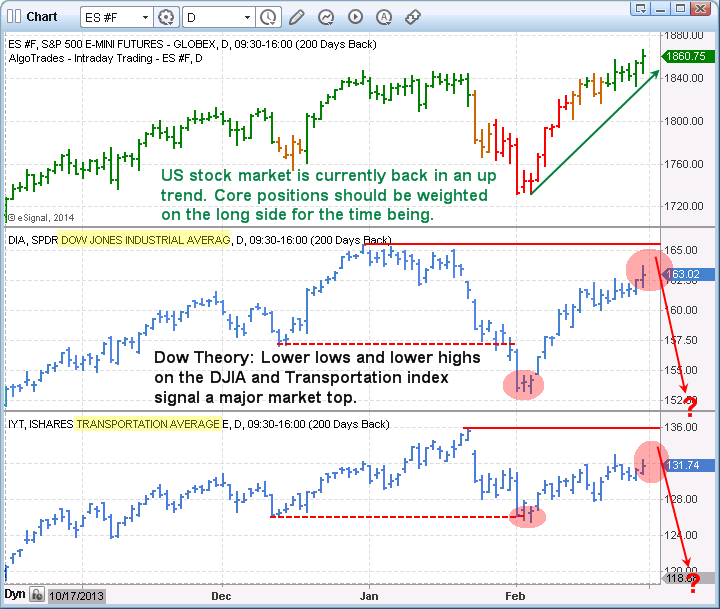
Over the past few weeks I have been watching the DOW and Transportation index closely because it looks and feels like the Dow Theory may play out this year and the stock market could take a 15% haircut.

But what if you skipped on the haircut and opted for a 40% refund?  What? Keep reading to find out how.

Keeping this post short and sweet, I think the U.S. stock market is setting up for a sharp selloff. And it will look a lot like the July 2011 correction. If my calculations are correct this will happen in the next 3-9 weeks and we will see a 15% drop from our current levels. Only time will tell, but I have a way to hedge against this with very little downside risk to you ETF portfolio.

The Dow Theory Live Example for ETF Portfolio

The daily chart of the SP500 index below shows our current trend analysis with green bars signaling an uptrend, orange being neutral, and red signaling bearish price action. Currently the bars are green and we can expect prices to have an upward bias.

The Dow Theory could be  in play. When both the Transports (IYT) and the Dow Jones Industrial Average (DIA) cannot make higher highs and start making lower lows, according to the Dow Theory the broad stock market is topping.

We are watching the market closely because they have both made lower highs and lows.  This rally could stall in the next couple weeks and if so we expect a 15% correction.


Model ETF Portfolio


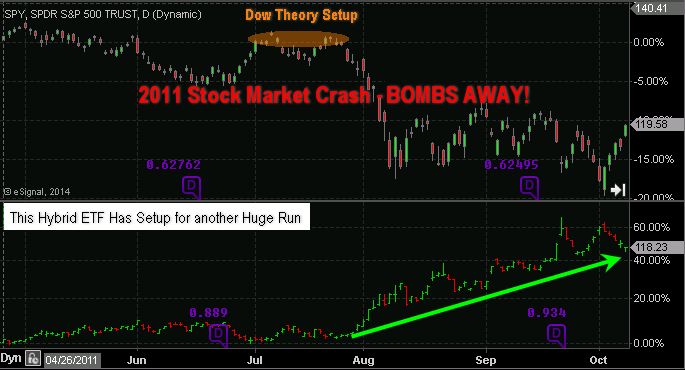
Take a look at the 2011 Stock Market Crash

Model ETF Portfolio Trading

The chart above shows how fearful traders have a delayed reaction to moving money from stocks to a mix of risk-off assets.

The choppy market condition during August and September clearly helped in frustrating investors and created more uncertainty. This helped prices of this ETF portfolio fund rally long after the initial selloff took place. This is something I feel will take place again in the near future and subscribers of my ETF newsletter will benefit from this move.

Because we have a Dow Theory setup, our risk levels are clearly defined as to when to exit the trade if it does not play out in our favor. But with the potential to make 40% and the downside risk only being 4%, it’s the perfect setup for a large portion of our ETF portfolio. And just so you know this is not a precious metals trade as we are already long that sector and up 10% in that position already.

Get My Daily Video Forecasts & ETF Trades Today


Chris Vermeulen
The Gold & Oil Guy.com


Friday, February 28, 2014

This Might be our Most Important Post EVER!

This has been a big week around here. Our trading partner John Carter has been sharing some game changing videos that have culminated into his wildly popular webinars, "Being the Architect of the Big Trade".

If you haven't seen the videos or the webinar please do that asap after finishing reading this entire article.

Here is John's video from two weeks ago.

And Here is the Replay of John's Webinar, which will only be up until midnight Friday evening February 28th

John sent us this message this morning and I want you to read it, because it could be our most important post ever.


John Carter here......

This may be the most important email I’ve ever sent to you. (Print Now)

In 1984 I read a book about Arnold Schwarzenegger and ever since then he has been one of my idols. Arnold’s dream was to come to America to become rich and famous. He had no idea how he would do this.

Arnold said, “I was a 15 year old farm kid growing up in Austria when I was first inspired by a bodybuilding magazine with a picture of Reg Park on the cover from one of his Hercules movies. My life was never the same. Reg Park became my idol and I could not have picked a better hero to inspire me. Reg went from bodybuilding to the movies. He became a smart and successful businessman, and he was the first person who gave me a glimpse of what my life could someday become if I dreamed big and worked hard.”

The biggest thing he said that stuck with me is, “I read this magazine and there was the whole plan laid out. I had my blueprint to accomplish my dreams.”

When I was 18 and decided that I wanted to become a trader I knew I only needed to find a blueprint for success. Since then I’ve developed and implemented several blueprints for successful trading.

My most important blueprint is for building wealth

Every trader would love to start with a million dollar trading account, but this rarely happens. Today I trade a few seven figure accounts, but 25 years ago I funded my first account with $1,000 (equivalent to about $5,000 today). What I needed and I what I discovered was a blueprint for building wealth.

LAST CHANCE LINK

Did you know most trading strategies taught out there are designed for accounts larger than $25,000 yet they are taught to traders with a $5,000 account as if they will have the same edge as someone with a larger account? This is simply not true.

Most traders start with under $25,000 in their account and those accounts need to utilize specific strategies to build wealth.

How does a trader go about building wealth?

1) You have to start with a goal. I think a reasonable goal with the strategies I’m going to share is to double an account and do it in a year.

2) You need to develop the right money management and trading mindset

3) You have to control your risk through appropriate position sizing

4) You need to have a written trading plan with the strategies you’re going to use and when

5) You need to know where your targets are so you don’t leave money on the table

LAST CHANCE LINK

For the first (and last) time I’m going to share my exact blueprint for wealth building.

The blueprint will include:

1) Step by step, A and B happens you do C blueprint. There will be nothing left to interpretation.

2) How to manage your risk – when to go big, and when not to “piss away your chips.”

3) How to structure your wealth building trades so that even when they don’t work out you still make money

4) The 3 “how to crush it” strategies that were most profitable in 2013

5) Identify the exact levels when a stock will “rip the market makers heads off”

And much more…

My goal with this course is to leave with you the exact blueprint for building wealth like Reg Park gave to Arnold.

Here is what you'll get when you join the Ultimate Options Trading Blueprint and 3 day mentorship:

1) Access to the Saturday course and 3 full days of live trading, analysis, and follow up sessions

2) You Get to Keep Everything - All audio and video will be recorded and you will get the on demand links and DVD. You will be able to download all my notes, the action plan, and PDFs I share with you during the course.

3) Fast Answers to Your Relevant Questions Answered by Henry, Darrell, Brian, Jeff, and myself throughout the course.

4) Homework: Special Bonus - Beginners Guide to Option on demand link

5) Homework: Options 101 Class on demand link

6) How to prepare your mind for the class and success

LAST CHANCE LINK

Here are the answers to some of the biggest questions we've been getting:

Q: I’m new to options should I go to this class?

A: Every journey starts with a single step. As part of the class we have included a few homework assignments that will quickly get you up to speed. I can teach anyone options in 1 hour and that exactly what I do in your options 101 homework assignment.

Q: When is this class?

A: The strategies class will be held Saturday March 1st from 2:00PM – 6:00PM New York time or 1-5 central. The 3 day live trading mentorship is Tuesday, Thursday, and Friday March 4th, 6th, and 7th during market hours with a lunch break midday.

Q: Will the course be RECORDED?

A: YES. Every single second of the 4 day course will be recorded. You will have online access to the recording PLUS you will get a DVD of the entire course in the mail.

Q: I am in the live trading room and I’ve taken most of your other courses will I learn anything new in this course?

A: Yes this course will be chock full of brand-spanking-new, never-before-revealed strategies and setups. If you’re in the live trading room and participated in every course there may be a few things in the class that will overlap, for example, you will already know what a squeeze is. However, the overwhelming majority of this course is material I have never presented on before.

Q: Do I need to be there live to get the most out of the course?

A: No, the course will be recorded and you will get all the information regardless if you attend live or not. The strategies I will teach can be universally applied at any time. As I go through live trading examples, although you will not be able to follow along live, I will be describing in detail what I am looking for in these live trades so when you watch the recording you will have the exact blue print I used determine which trades I got into and why.

Q: What if I have a full time job and I can’t trade intraday?

A: All of the strategies will work on any time frame. This means if you can only do end of day trading you can use daily and weekly charts. I find that people who are able to watch the markets all day end up over trading which is a death sentence for your trading account.

Q: Is there a Members Discount?

A: For a limited time we are making this class available for everyone at the member price because this class is so crucial. After the class is over the price will be raised for non-members.

LAST CHANCE LINK

I believe this will be the best course I've ever done and I’m really excited about presenting this material to you and hearing about your success.

Good Trading,

John

Visit John Carters "Simpler Options and Trading"


Doug Casey: “There’s Going to be a Bubble in Gold Stocks”

By Doug Casey


The following video is an excerpt from "Upturn Millionaires—How to Play the Turning Tides in the Precious Metals Market." In it, natural resource legends Doug Casey and Rick Rule discuss the deeply undervalued junior mining sector and the rare opportunity for spectacular returns it offers investors right now.


Loading the player .......


Discover for yourself how to make life changing gains in the new bull run in junior mining stocks. They still trade at deep discounts, but not for much longer.


To learn more, watch the full "Upturn Millionaires" video here.


This may be your last time to catch the replay...."Being the Architect of the Big Trade"


Monday, January 20, 2014

A Glimpse into the Coming Collapse

By Jeff Thomas, International Man

Beginning in 1999, we predicted a systemic economic collapse that would take place in the First World and would impact all other economies. We began to list some of the "dominoes" that would fall as the collapse evolved and described that the "Great Unravelling," as we termed it, would take roughly ten years. At that time, we guesstimated that the first two of the dominoes, a real estate crash and subsequent stock market crash in the US, would begin in about 2005.


We were premature in this prediction, as the first of the crashes did not occur until 2007. And, truth be told, we have frequently been incorrect in the timing of the other dominoes. Whilst the actual events have been predicted correctly, our timing has often been incorrect. In every such case, the prediction has been premature.

Sadly, however, the prediction of the events of the collapse have been almost entirely correct.

We also predicted that, just as a ball of string speeds up its rotation as it rolls along unravelling, so, too, the events of the Great Unravelling would occur more quickly as the situation worsened. Additionally, the severity of the events would increase concurrently with the increase in velocity.

However, none of the above was the result of gypsy fortune telling, nor did it require the brightest of minds to work out. It is mostly based on the simple assumption that history repeats itself—that the world's leaders make the same mistakes in every era, because human nature never changes. Anyone who is willing to expend the effort to study history diligently and to be prepared to think in contrarian terms, may develop a meaningful insight into the events of the future.

Back in 1999, of course, the very idea that the world was headed for serious economic calamity was considered ridiculous by most. The unfortunate fact is, most people do truly deal in the present, rarely questioning the future beyond what they consider to be the very next event. The truth of this statement is borne out by the fact that the great majority of people, who have already seen the first half of the Great Unravelling come to pass, still somehow cannot imagine the second half—the more disastrous half—as being in any way possible. Surely, somehow, the governments of the world will fix things.

However, the number of people whose eyes have been opened seems to be growing, and many of them are asking what the collapse will look like as it unfolds. What will the symptoms be?

Well, the primary events are fairly predictable: they would include major collapses in the bond and stock markets and possible sudden deflation (primarily of assets), followed by dramatic inflation, if not hyperinflation (primarily of commodities), followed by a crash of several major currencies, particularly the euro and the US dollar.

The secondary events will be less certain, but likely: increased unemployment, currency controls, protective tariffs, severe depression, etc.

But, along the way, there will be numerous surprises—actions taken by governments that may be as unprecedented as they would be unlawful. Why? Because, again, such actions are the norm when a government finds itself losing its grip over the people it perceives as its minions. Here are a few:
  • Travel Restrictions. This will begin with restrictions on foreign travel, including suspension/removal of passports. (This has begun in a small way in both the EU and US.) Later, travel restrictions will be extended within the boundaries of countries (highway checkpoints, etc.)
  • Confiscation of wealth. The EU has instituted the confiscation of bank accounts, which can be expected to become an international form of governmental theft. This does not automatically mean that other assets, such as precious metals and real estate will also be confiscated, but it does mean that the barrier for confiscation has been eliminated. There is therefore no reason to assume that any asset is safe from any government that approves theft through bail-ins.
  • Food Shortages. The food industry operates on very small profit margins and survives only as a result of quick payment of invoices. With dramatic inflation, marginal businesses (suppliers, wholesalers, and retailers) will fall by the wayside. The percentage of failing businesses will be dependent upon the duration and severity of the inflationary trend.
  • Squatters Rebellions. A dramatic increase in the number of home and business foreclosures will result in homelessness for anyone whose debt exceeds his ability to pay—even those who presently appear to be well-off. As numbers rise significantly, a new homeless class will be created amongst the former middle class. As they become more numerous, large scale ownership of property may give way to large scale "possession" of property.
  • Riots. These will likely happen spontaneously due to the above conditions, but if not, governments will create them to justify their desire for greater control of the masses.
  • Martial Law. The US has already prepared for this, with the passing of the 2012 National Defense Authorization Act (NDAA), which many interpret as declaring the US to be a "battlefield." The NDAA allows the suspension of habeas corpus, indefinite detention, and the assumption that any resident may be considered an enemy combatant. Similar legislation may be expected in other countries that perceive martial law as a solution to civil unrest.
The above list is purposely brief—a sampling of eventualities that, should they occur, will almost definitely come unannounced. As the decline unfolds, they will surely happen with greater frequency.

But the value in projecting what the collapsing governments may do to their citizens is not merely an exercise in speculation. By anticipating the likelihood of any of the above, the individual may find that it would be prudent to turn off the game on television tonight and spend his time musing on the possibility of what he would do if any of the above events were to take place. (And, again, these projections are not mere fancy; they are actions typically taken by governments as their declines play out.)

Most importantly, if the reader concludes that there is a significant percentage of likelihood that any of the above are coming his way, he would be well-advised to assess whether they are developments that he feels he could live with. If not, he might wish to assess how much time he has before these events become a reality and what he may do to sidestep their impact on him.

Whilst, throughout the First World, the comment, "The whole world is going to Hell," is becoming common, in fact, this is not the case. Although some countries are in decline, others are on the rise. It is left to the reader to decide whether he will fall victim to coming events, or will use them as an opportunity to internationalise himself.

Editor’s Note: You can find Casey Research’s A-Z guide on internationalization here.


Still a few seats left for next weeks Free Trading webinar. Sign up here and now!


Wednesday, January 15, 2014

Using 3X ETF's....Maybe this is now Possible

For years we have resisted using the 3X ETF's for our near term and day trading. These can potentially cut your head off over night. The main reason we have not been willing to use these tickers is that our traditional research including the resistance, support and pivot numbers just don't work.

But our friend and trading partner Chris Vermeulen is trying to convince us that he has it figured out. He has been telling us this for years but now he has created a program that....well, in all honesty looks like he was right.

Check out Chris new AlgoTrades Program

Here is his most recent trade using the ES Mini futures contract.....

On Jan 13th 2014 our algorithmic trading system took a long position in the SP500 futures trading contact. In less than 24 hours our algorithm system was able to identify resistance in the market the following session. This invisible overbought market condition which only our algorithmic trading system identified automatically sold 1/3rd of our long position for a quick $1100 profit and adjusted the protective stop to breakeven on the balance of the position.

Quick note: While this trade was executed on the ES mini futures contract using our futures trading system, we do have a 3x automated trading system for ETFs. We know the most of our followers and the general public prefer ETF trading because they understand them more and have less risk. So we built this 3x automated trading system using the 3 times leveraged exchange traded funds.

As of today (Jan 15th) we are sitting with a risk free trade, $1100 in realized gains, and another $2400 in gains on the remainder of our position. This type of trade setup has happened twice in the past 10 days. The first trade took $500 in profit and was stopped out the next day and now this trade.

Click here to read Chris' entire article and check out his chart work on this trade.


Don't miss Chris' 7 Steps to win with Logic


Monday, November 11, 2013

Crisis Investing in Action

By Nick Giambruno, Senior Editor, International Man

Stocks in Cyprus Are Down 98%—Time to Start Edging In?

Readers who have been with us for a while know that I've been hinting at the project Doug Casey and I have been working on in Cyprus for a while now. It's a project that dovetails perfectly with Doug's unique expertise. Now is the time to reveal what we have been up to.
Nick Giambruno: Doug, you are one of the foremost authorities in the world on the topic of crisis investing. Tell us about your background on this topic and the potential for life-changing gains it offers for those who have the intestinal fortitude to speculate in crisis markets.

Doug Casey: After my second book, Crisis Investing, [buy it here on Amazon.com] came out in 1979, I started publishing a newsletter. I used the Chinese symbol for crisis as the logo.

It is actually a combination of two symbols: the symbol for danger and the symbol for opportunity. The danger is what everybody sees; the opportunity is never quite so obvious as the danger, but it's always there.


Speculating in crisis markets is the ultimate way to be a contrarian, which means buying when nobody else wants to buy.

It is true, as a general rule, that you want to "make the trend your friend." But there always comes an inflection point when trends change because a market becomes either greatly overvalued or greatly undervalued. And when any market is down by 90% or more, you've got to reflexively look at it, no matter how bad the news is, and see if it's a place where you want to put some speculative capital.

Nick: Massive fortunes have been made throughout history with crisis investing. Was Baron Rothschild right when he said the time to buy is when blood is in the streets?

Doug: That's a very famous aphorism, of course. It was supposedly occasioned by the Battle of Waterloo, when he was buying British securities while the issue was in doubt. He was able to pull off that coup because he made sure that he got the information as to whether Wellington beat Napoleon a day before anybody else did. He recognized that Europe was in a period of tremendous crisis; Napoleon, after all, was actually kind of a proto-Hitler.

But a key point here is that a successful speculator capitalizes on politically caused distortions in the market.
If we lived in a completely free-market world—one without government interventions like taxes, regulations, inflation, war, persecutions, and the like—it would be impossible to speculate, in the sense I'm using the word.

But we don't live in a free-market world, so there are lots of good, speculative opportunities that, in effect, let you turn a lemon into lemonade.

And a good speculative opportunity is both high potential and low risk—not high potential and high risk. Most people don't understand that.

Nick: That brings to mind the Russian oligarchs, who became oligarchs in the first place because they did some crisis investing, i.e., they bought when the blood was in the streets and picked up some of the crown jewels of the Russian economy for literally pennies on the dollar. Are similar opportunities a possibility today in other countries?

Doug: It's interesting with the oligarchs because in the Soviet Union, everybody got certificates, which were traded for shares in businesses that were being privatized. The average person had no idea what they were or how to value them. The people who became oligarchs were able to buy them up for a couple of pennies on the dollar, taking advantage of the negative public hysteria following the collapse of the Soviet Union.
So this is a recurring theme—buying when the blood is in the streets. It's what speculation is all about: namely, taking advantage of politically caused distortions in the marketplace, or taking advantage of the aberrations of mass psychology.

Nick: Exactly—and that was the main reason why you and I were recently in Cyprus. We were there to see if that recent crisis presented a contrarian opportunity.

We all know what happened with the bank deposit confiscations and the capital controls, and most people would think you'd have to be crazy to put money into such an environment. Tell us how Cyprus fits into the theme of crisis investing.

Doug: What drew my attention to it was the fact that the Cyprus stock market is down 98% from its all-time high in October 2007. That's like a bell ringing at the bottom of the market. So I thought it was critical to go and get boots on the ground to see what the story really was.

It's down about as much as any market index has been in history, which makes it a unique opportunity. In any case, it was worth seeing whether or not it's really only worth 2% of what it was at its peak.

I'm not saying that we are absolutely at the bottom. I'm just saying that now is the time to pay close attention because when any market is down 90%, you're obligated to go and investigate.

Whether you buy when it is down 98% or you wait for it to be down 99%—which amounts to another 50% drop—is perhaps like looking a gift horse in the mouth.

Nick: Let's talk about the intrinsic value of Cyprus throughout history that comes from its geography—being at the crossroads of Asia, the Middle East, Africa, and Europe. Does the collapse in the paper Ponzi scheme banking system diminish Cyprus's natural value, or do you think it creates some interesting speculative opportunities?

Doug: Cyprus not only presents a tremendous speculative opportunity, but it is also quite instructive.
The banking sector there got quite out of control; it's similar to what has happened to the banking sector in other countries, like Iceland and Ireland in the recent past. But it's also predictive of what's very likely going to happen to larger banking systems in the near future.

Essentially, Cyprus became a favorite place for people of many nationalities—particularly, Russians—to put money that they wanted to diversify offshore.

The banks became overwhelmed with large amounts of money that dwarfed their capital. When a bank takes money in, it's got to find something to do with that money, and when the local economy couldn't absorb much of it, they became quite reckless.

Since most Cypriots are Greek-speakers, they naturally looked to Athens and wound up buying a lot of Greek government bonds, partly for patriotic reasons and partly because the yields were higher than elsewhere.

Once the Greek government bonds went south, it wiped out the capital base of the Cypriot banks that had purchased them. The Cypriot government was not in a financial position to bail them out, so instead they had what is called a bail-in, where large depositors took a haircut.

Nick: So, what kinds of speculative opportunities have been created from this crisis?

Doug: In all chaotic situations, in all true crisis situations, the baby gets thrown out with the bathwater. Everybody has decided that they don't want to have anything to do with a stock market whose index is down 98%.

But the fact of the matter is that there are sound, productive, and well-run businesses that are listed on the Cyprus Stock Exchange that got caught up in the maelstrom. There are businesses that will continue to produce earnings and pay dividends.

As Damon Runyon famously said, "The race is not always to the swift, nor the battle to the strong, but that's the way to bet."

The country has some unique advantages going for it. Cyprus is a place where Warren Buffett would be looking if the market weren't so tiny. It's also quite illiquid now because most people who needed to sell have already done so, but almost everybody is still too afraid to buy.

That said, I think it's time to start edging in.

We also looked at opportunities the crisis has created in the real estate market.

Nick: We should be clear that we are not necessarily talking about investing here. This is a long-term speculation. Can you elaborate on the differences?

Doug: I think it is critical to use words accurately and precisely, so that we know exactly what we are talking about. "Investing" is about allocating capital so that it can be used productively and produce more capital. "Speculating" is different. As I said before, speculating is about capitalizing on politically caused distortions in the marketplace.

One way this is pertinent to Cyprus is the fact that this is the first time the bail-in model was used and a government didn't step in to make depositors whole. That wiped out billions of euros and depressed the prices of financial assets.

People often confuse speculators with traders, who try to scalp a couple of basis points over a short period of time. What we are doing with Cyprus is not a trade. This is a speculation, and a good speculation can take a considerable amount of time to work itself out.

Nick: In order to take advantage of these opportunities and speculate on this market, one realistically needs to have a Cypriot brokerage account.

It's a testament to the chilling effects of FATCA and other US regulations that the vast majority of financial institutions in Cyprus, which are extremely desperate for cash, won't even consider dealing with American citizens.

And if Cypriot financial institutions won't deal with American clients, who will? Do you think the chilling effects of FATCA really amount to de facto capital controls for Americans?

Doug: Yes. US citizens have had draconian reporting requirements on what they do with their money abroad for years. But the new FATCA law has taken it to a new level.

Essentially, what it does is impose severe compliance burdens on foreign financial institutions that take an American client. It really makes the foreign banks, brokers, and other financial institutions unpaid employees of the US government.

This is expensive, legally onerous, and actually ethically questionable as far as their relationship with their clients. So, for this reason, there are very few non-US financial institutions anywhere that are still willing to take US customers. It's increasingly hard, and in some cases impossible, for an American now to get money out of the country, simply because nobody is going to take it.

I think as the global economic crisis that started in 2007 gets worse—and there is every reason to believe it's going to get worse, since we're just in the eye of the storm at the moment—these regulations will become even more onerous, and are likely to spread from the US to other countries.

So the takeaway from this is that your most important form of diversification in the world today is not diversification across investment classes—although that's very important. It's political diversification, so that all of your assets aren't under the control of one political entity, one government.

Here's how you can get in…

The opportunity for contrarians in Cyprus is great, but it's hugely important to analyze and evaluate all of the options. Doug and Nick's recent trip gave them great insights into the real economic situation in Cyprus and the companies located there. After getting their boots on the ground, Doug and Nick found quite a few pigs with copious amounts of lipstick applied… and a few shining gems, too—quality Cypriot stocks trading for tremendous crisis-driven bargains.

You don't need to take a trip to Cyprus yourself to get the lay of the land. Doug and Nick have written a special report titled Crisis Investing in Cyprus detailing their trip and offering the top investment picks they found on the Cyprus Stock Exchange. In it, you'll find detailed information of the best way to access these amazing opportunities from your living room, the real story on the ground, and much more.

The two of them also found a solution to the brokerage dilemma—they investigated every single brokerage on the island and found one willing to open accounts for American citizens remotely and without the need to visit the country.

All the details and on-the-ground contacts are in their report, which shows you exactly how to access the opportunities on the Cyprus Stock Exchange from your computer.

Crisis Investing in Cyprus is a crucial tool for taking the destructive actions of a desperate government and turning them on their head… and to your advantage.

For a limited time, you can get the report with a savings of 50% off the retail price of $199. That's just $99 for a huge speculative opportunity, penned by Doug Casey—the man who literally wrote the book on crisis investing. To get in on these opportunities, act now before the price discount is no longer offered.

Click here for more details.


Sign up for our latest Free Trading Webinars


Thursday, November 7, 2013

Who is Picking Stocks for These Fund Managers?

When successful fund managers make it a daily practice to sit down and review the trades and trading techniques of this staff of traders.....you have to wonder why.

But I’ve gotta say, after watching this presentation on how to select the highest probability stocks for the strongest expansion moves – now I know why these guys have been the “go to” people behind several Wall Street pros and million dollar market makers. So why would you try this alone...they don't! But, you want to know the best part? They’ve just created a free video giving away their entire stock selection strategy.

Trust me, this is really good stuff!

Unfortunately, this video [2nd in a three part series] will only be up for a couple of days.

So stop everything you’re doing and watch it before you miss out.

Good trading!
Ray's Stock World

P.S. Inside this rare presentation, you not only get their proprietary stock selection strategy for narrowing down over 7,000 candidates to just under a dozen in 15 seconds – they’re also blowing the whistle on a dirty Wall Street secret that’s intentionally designed to keep you in the dark.

Click Here....to watch this presentation right away!


Tuesday, July 16, 2013

Why Great Stocks Drop Hard and Reverse

Institutional sell programs and bots cause disruptions with David Banister, Chief Strategist at the Active Trading Partners......

One thing that will always over rule charts and technical analysis is fundamentals in the long run. To be sure, I love technical analysis but I always combine my work there with fundamental research. I rarely if ever buy a stock just because the chart looks nice, that is almost always a recipe for disaster.

With that said, how many times have you seen a good company with strong fundamentals and a seemingly great looking chart break down over 1-2 weeks and take everyone out of the trade? Then for sure, the stock reverses right back up all the way back to where the decline began? To make matters worse, this happens without any real news or any bad news as it were. What is it that causes these crazy down the mountain and up the mountain moves anyways?

Insitutional Sell Programs— sometimes referred to as “Bots” or “Algo” program trading

How does it work?

In an apparently strong fundamental growth stock with no apparent issues, an institution will have a pre-defined price at which point instructions are triggered to liquidate the entire position almost at any price once that price point is hit. They protect themselves ahead of time with Puts, which give them profits if the targeted stock drops hard while they are selling out of the position, thereby locking in their targeted sell price.

Lets take several examples, here's the 3 month charts to show you exactly how they look on paper.


Free Webinar with Carolyn "The Fibonacci Queen" Boroden "How to Use Fibonacci Analysis in Your Trading" this Wednesday, July 17th at 8:00PM est