Showing posts with label sectors. Show all posts

Monday, September 7, 2015

Buy the Dip? Hell No.....Sell the Rip Instead

By Tony Sagami

Are you worried about the stock market? You should be; at least according to your local Starbucks barista.
Starbucks CEO Howard Schultz told his 190,000 employees in his daily “Message from Howard” email communication: “Today’s financial market volatility, combined with great political uncertainty both at home and abroad, will undoubtedly have an effect on consumer confidence and … our customers are likely to experience an increased level of anxiety and concern. Let’s be very sensitive to the pressures our customers may be feeling.”

You can’t make this stuff up!

Hey, maybe I shouldn’t be too harsh on Mr. Schultz, because the stock market is in a lot of trouble… and not for the reasons the mass media and Wall Street experts are telling you. The know it alls on CNBC are pointing their fingers at the Chinese stock market meltdown as the reason for our stock market turmoil, but that is just the catalyst… not the root problem.

The source of the meltdown is deeper, more problematic, and more painful. What I’m talking about is that the Federal Reserve—from Greenspan to Bernanke, to Yellen—thought they possessed Wizard of Oz powers to fix whatever ails the economy with their menu of monetary tools.

In 2000, the Fed thought it could solve the bursting of the dot-com bubble with massive interest rate cuts and repeated that playbook again for the 2008-09 Financial Crisis. And when they ran out of room by cutting interest rates to zero, they trotted out Operation Twist and QE 1, 2, and 3.


Those three rounds of QE added about $3.7 trillion to the Federal Reserve’s balance sheet since 2008, which now totals a mind boggling $4.5 trillion. The problem is not China; the problem is Janet Yellen and her Federal Reserve buddies.


The Fed—beginning with the original monetary Mr. Magoo of Alan Greenspan—created a bubble, then rolled out more of the same to deal with the bursting of the bubble, and like the shampoo bottle says: Rinse, Lather, Repeat. Zero interest rates plus QE1, QE2, and QE3 created a massive misallocation of capital that has affected everything from home supply, ocean-going freighters, the US dollar, and wages, and pushed stock prices to a bigger than ever bubble.


The recent weakness is the painful process of deflating that bubble, but the Federal Reserve refuses to learn from its mistakes. It won’t be long until we hear about QE4 and/or a delay to the overpromised interest rate liftoff. Former US Treasury Secretary Larry Summers had this to say yesterday: “A reasonable assessment of current conditions suggests that raising rates in the near future would be a serious error that would threaten all three of the Fed’s major objectives; price stability, full employment and financial stability.”

Honestly, I don’t know what the Federal Reserve will do next. Heck, I bet they don’t know what to do either… but they will do something. Central bankers are arrogant know-it-alls who think they can fix the world’s financial problems with a couple of pulls of a monetary lever.

So pull they will.

And so the stock market damage will continue, albeit with some powerful up moves along the way.
Bulls, whether in a Spanish bull-fighting arena or roaming the floor of the NYSE, are a tough animal to kill. They won’t surrender until they make a few more desperate attempts to push the market higher.
Look at what happened last Tuesday after the 588-point Monday meltdown. The Dow Jones Industrial Average shot up by as much as 441 points before ending the day with a 204-point loss.


My point is that you’re going to see a lot of powerful up moves in the coming months… but I’m telling you, these are nothing more than bear market traps to lure you into buying at the wrong time. The stock market is falling into a bear market, and that means big swings both up and down, similar to 2000–2003.


The Federal Reserve, along with the rest of the world’s central bankers, has puffed stock valuations into an epic bubble, and the stock market has a long, long ways yet to fall…..just not in a straight line. That’s heart attack material for both buy-hold-and-pray and buy the dip investors, but it is a goldmine if you adapt your strategy.


Instead of buying the dip, the right strategy going forward is SELL THE RIP.

When the stock market gives you a big rally, the right move will be to sell into strength.

And if you have some risk capital, that will be the time to load up on inverse ETFs and put options, like my Rational Bear subscribers did in July.

The biggest short-selling opportunity of our lifetimes is knocking on your door.
Tony Sagami
Tony Sagami

30 year market expert Tony Sagami leads the Yield Shark and Rational Bear advisories at Mauldin Economics. To learn more about Yield Shark and how it helps you maximize dividend income, click here.

To learn more about Rational Bear and how you can use it to benefit from falling stocks and sectors, click here.


Get our latest FREE eBook "Understanding Options"....Just Click Here!


Monday, January 26, 2015

The Single Most Important Economic Statistic that the White House Never Talks About

By Tony Sagami


For the first time in 35 years, American business deaths now outnumber business births. —Jim Clifton, CEO, Gallup Polls

I’ve been self employed since 1998, and let me tell you, the life of a business owner isn’t easy. It’s filled with long hours, a relentless amount of paperwork, and uncertainty of where your next paycheck will come from.

If you’ve ever owned a business, you know exactly what I’m talking about.

Difficult or not, self employment is extremely rewarding, and I wouldn’t have it any other way. Nor would the other 6 million business owners in the United States. Of those 6 million businesses, the vast majority are small “Mom and Pop” businesses. Here are more statistics on businesses in the U.S. :
  • 3.8 million have four or fewer employees. That’s me!
     
  • 1 million with 5-9 employees;
     
  • 600,000 with 10-19 employees;
     
  • 500,000 with 20-99 employees;
     
  • 90,000 with 100-499 employees;
     
  • 18,000 with 500 employees or more; and
     
  • 1,000 companies with 10,000 employees or more.
Those small businesses are the backbone of our economy and responsible for employing roughly half of all Americans. Moreover, while estimates vary, small business create roughly two thirds of all new jobs in our country.

Get our latest FREE eBook "Understanding Options"....Just Click Here!

For those reasons, the health (or lack thereof) of small business is the single most important long term indicator of America’s economic health. Warning: new data suggest that small businesses are in deep trouble.
For the first time in 35 years, the number of business deaths outnumbers the number of business births.


The US Census Bureau reported that the birth and death rates of American businesses crossed for the first time ever! 400,000 new businesses were born last year, but 470,000 died.

Yup, business deaths now outnumber business births.


Pay attention, because this part is important.

The problem isn’t so much that businesses are failing, but that American entrepreneurs are simply not starting as many new businesses as they used to. We like to think of America has the hotbed of capitalism, but the US actually is number 12 among developed nations for new business startups.

Number 12!

You know what countries are ahead of us? Hungary, Denmark, Finland, New Zealand, Sweden, Israel, and even financially troubled Italy are creating new businesses faster than us!


The reasons for the capitalist pessimism are many, but my guess is that the root of the problem comes down to three issues: (1) difficulty of accessing capital (loans); (2) excessive and burdensome government regulations; and (3) an overall malaise about our economic future.

Business owners are permanently smitten with an entrepreneurial bug, and the only thing that prevents them from seeking business success is the expectation that they’ll lose money.

Sadly, the lack of new business start ups is confirmation that American’s free enterprise system is broken.

"There is nobody in this country who got rich on their own. Nobody. You built a factory out there—good for you. But I want to be clear. You moved your goods to market on roads the rest of us paid for. You hired workers the rest of us paid to educate. You were safe in your factory because of police forces and fire forces that the rest of us paid for. You didn't have to worry that marauding bands would come and seize everything at your factory... Now look. You built a factory and it turned into something terrific or a great idea—God bless! Keep a hunk of it. But part of the underlying social contract is you take a hunk of that and pay forward for the next kid who comes along."

Elizabeth Warren

“When small and medium-sized businesses are dying faster than they’re being born, so is free enterprise. And when free enterprise dies, America dies with it,” warns Gallup CEO Jim Clifton.

I don’t believe for a second that America’s free-enterprise system is permanently broken. The pendulum will eventually swing the other way, but our economy will not enjoy boom times until the birth/death trends are reversed.

That won’t happen next week or next month. It will take serious, fundamental changes in tax, regulatory, and judicial rules, and I sadly fear that it will take several years for that to happen. Until then, our economy is going to struggle and will pull our high flying stock market down with it. Are you prepared?

If you’re not familiar with inverse ETFs, you’re ignoring one of your best defenses against tough times. An inverse ETF is an exchange traded fund that’s designed to perform as the inverse of whatever index or benchmark it’s designed to track.

By providing performance opposite to their benchmark, inverse ETFs prosper when stock prices are falling. An inverse S&P 500 ETF, for example, seeks a daily percentage movement opposite that of the S&P. If the S&P 500 rises by 1%, the inverse ETF is designed to fall by 1%; and if the S&P falls by 1%, the inverse ETF should rise by 1%.

There are inverse ETFs for most major indices and even sectors and commodities (like oil and gold), as well as specialty ETFs for things like the VIX Volatility Index.

I’m not suggesting that you rush out and buy a bunch of inverse ETFs tomorrow morning. As always, timing is critical, so I recommend that you wait for my buy signals in my Rational Bear service.

But make no mistake, the birth/death ratio is signaling serious trouble ahead. Any investor who doesn’t prepare for it is going to get run over and flattened like a pancake.

Tony Sagami
Tony Sagami

30 year market expert Tony Sagami leads the Yield Shark and Rational Bear advisories at Mauldin Economics. To learn more about Yield Shark and how it helps you maximize dividend income, click here.

To learn more about Rational Bear and how you can use it to benefit from falling stocks and sectors, click here.


New Video: 6 Simple Criteria that Guarantee Trading Success.....Just Click Here!


Saturday, March 15, 2014

Is this Gold's "Best of the Breed" a Golden Rocket!

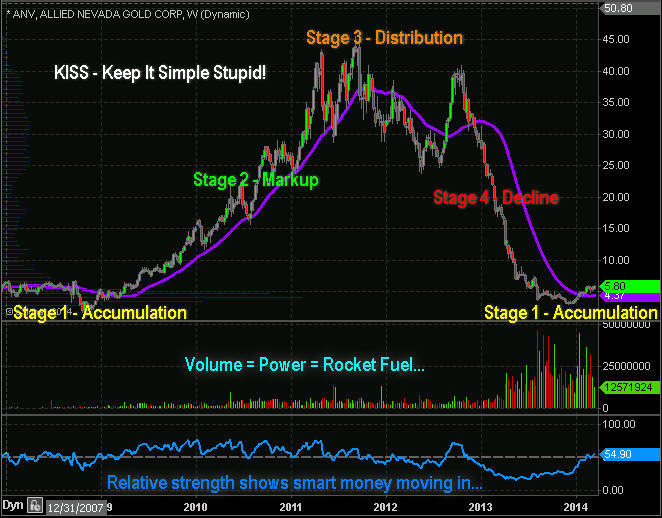
Gold and gold stocks have be stabilizing for months and have been quietly rising. Many gold stocks are up 30% even 50% in the past three months. The $HUI AMEX Gold Bugs Index is up over 30% from the lows.

If you think you have missed most of the move already you are wrong. The truth is most of the biggest rallies in stocks take place after a basing pattern with 30 -50% or more has formed. This is signaling massive accumulation in gold stocks and its happening right now by the institutions.

So in this exclusive report I want to share one golden rocket stock pick which I feel has huge upside potential “IF” the precious metals market and miners can breakout of this stage 1 pattern it has formed.

One thing that excites me is about precious metals and gold stocks is the fact that we have heard nothing about gold, silver or mining stocks in the media for months… almost like the big institutions have told the media to avoid putting the spot light on it until they accumulate all they can in terms of physical bullion and stock shares.

This is the same for a few other sectors I have been watching build massive stage 1 bases in over the past few months and will be investing and actively trading them also once they break out of the basing stage.


Gold Stock Trading & Investing Success Formula

1. KISS – Keep It Simple Stupid! – Non one likes or follows complicated trading strategies

2. Understand and know how to identify the four market stages – Read My Book: Click Here

3. Know why and how stages must be traded for timing your entry, profit taking and exits.

4. Scan the market for the top performing sectors and focus on stocks/ETFs within those sectors.

5. Review all stocks and funds to meet setup criteria and trade only the best looking charts primed to start a new bull market (low overhead resistance nearby, strong relative strength, strong volume on breakout, 30 week SMA moving up etc..) Get this done for you: Click Here

6. Sit back, watch and monitor position for possible change in the stage, to adjust stops and identify profit taking levels.


Golden Rock Stock Pick

The chart below is top quality gold stock which has all the characteristics of a big winner. Just to be clear, I normally do not mention individual stocks within public reports. I am not compensated in any way to post this report. This is nothing more than my technical outlook on a stock and not investment advice. I do plan on buying some shares of this company this week or next.

Gold Forecast - Gold Stock Picks


Golden Rocket Conclusion:

While it still my be a little early for precious metals to bottom, it looks as though the stage (pardon the pun) has been set for a precious metals bull market to start. As they say, there is always a bull market somewhere… the key is finding it and taking the proper action.

If you want simple, hassle free trading and investing join my newsletter today.

  Just visit The Gold & Oil Guy

Sincerely,

Chris Vermeulen
Founder of Technical Traders Ltd. - Partnership Program

Check out our other "Gold and Crude Oil Trading Ideas"


Sunday, February 2, 2014

What are Business Development Companies?

By Andrey Dashkov

Business Development Companies (BDCs) are publicly traded private debt and equity funds. I know that description isn’t terribly sexy, but keep reading and you’ll find there’s a lot to be excited about.


BDCs provide financing to firms too small to seek traditional bank financing or to do an IPO, but at the same time are too advanced to interest the earliest-stage venture capitalist. These companies are often near or at profitability and just need extra cash to reach the next milestone. Filling this void, BDCs provide funds to target companies in exchange for interest payments and/or an equity stake.

BDCs earn their living by lending at interest rates higher than those at which they borrow. Conceptually, they act like banks or bond funds, but with access to yields unlike any you’ll see from a traditional bond fund. The interest rate spread—meaning the difference between their capital costs and interest they charge their clients—is a major component of their business.

Oftentimes, a BDC will increase its dividend when market interest rates have not changed. Like a bank, the more loans it has in force, the more it profits. Increasing its dividend payout will generally have a very positive effect on its share price.

Unlike banks or many other traditional financial institutions, however, BDCs are structured to pay out more than 90% of their net profits to the shareholders. In return, BDCs don’t pay any income tax. In essence, their profits flow through to the owners. Many investors like to own BDCs in an IRA to create tax deferred or tax free income. The opportunity to use them for tax planning purposes, access to diversified early stage financing, and the impressive dividend yields they deliver make them a perfect fit for the Bulletproof Income strategy we employ at Miller's Money Forever.

The Clients


As a business model, BDCs emerged in response to a particular need: early-stage companies needed funding but couldn’t do it publicly due to their small size. At the same time, these companies didn’t match the investment criteria of so-called angel investors or venture capital providers. Enter the Business Development Company.

BDC teams, through expertise and connections, select the most promising companies in their fields and provide funds in return for a debt or equity stake, expecting gains from a potential acquisition scenario and a flow of interest payments in the meantime. The ability to selectively lend money to the right startup companies is paramount. It makes little difference how much interest they charge if the client defaults on the loan.

With limited financing options, BDCs’ clients may incur strict terms regarding their debt arrangements. The debt often comes with a high interest rate, has senior level status, and is often accompanied by deal sweeteners like warrants which add to the upside potential for those with a stake in the borrowing company.

In return for these stringent terms, the borrower can use the funds to:

•  Increase its cash reserve for added security;

•  Accelerate product development;

•  Hire staff and purchase licenses necessary to advance R&D, etc.

•  Invest in property, plant, and equipment to produce its product and bring it to market.

Turning to a BDC for funds allows a company to finance its development and minimize dilution of equity investors while reaching key value adding milestones in the process.

What’s in It for Investors?


In addition to the unique opportunity to access early-stage financing, we like BDCs for their dividend policy and high yield. The Investment Act of 1940 requires vehicles such as BDCs to pay out a minimum of 90% of their earnings. In practice, they tend to pay out more than that, plus their short term capital gains.

This often results in a high yield. Yields of 7-12% are common, which makes this vehicle unique in today’s low yield environment. The risk is minimized by diversification—like a good bond fund, they spread their assets over many sectors. This rational approach and the resulting income make the right BDC(s) a great addition to our Bulletproof Income strategy.

BDCs and the Bulletproof Income Strategy


In short, BDCs serve our strategy by:
  • Providing inflation protection in the form of high yields and dividend growth;
  • Limiting our exposure to interest rate risk, thereby adding a level of security (some BDCs borrow funds at variable rates, but not the ones we like);
  • Maintaining low leverage, which BDCs are legally required to do;
  • Distributing the vast majority of their income to shareholders, thereby creating an immediate link between the company’s operating success and the shareholders’ wellbeing… in other words, to keep their shareholders happy, BDCs have to perform well.

How Should You Pick a BDC?


Not every BDC out there qualifies as a sound investment. Here’s a list of qualities that make a BDC attractive.
  • Dividend distributions come from earnings. This may sound like common sense, but it’s worth reiterating. A successful BDC should generate enough quarterly income to pay off its dividend obligations. If it doesn’t, it will have to go to the market for funds and either issue equity or borrow, or deplete cash reserves it would otherwise use to fund future investments. An equity issuance would result in share dilution; debt would increase leverage with no imminent potential to generate gains; and a lower cash reserve is no good either. We prefer stocks that balance their commitments to the shareholders with a long term growth strategy.
  • The dividends are growing. This is another characteristic of a solid income pick, BDC or otherwise. Ideally, the dividend growth would outpace inflation, in addition to the yield itself being higher than the official CPI numbers. This growth can come from increasing the interest rate spread and also having more loans on the books.
  • Yields should be realistic. We’d be cautious about a BDC that pays more than 12% of its income in dividends. Remember, gains come from the interest it receives from the borrowers. Higher interest indicates higher risk debt on a BDC’s balance sheet, which should be monitored regularly.
  • Fixed-rate liabilities are preferred. We need our BDC to be able to cover its obligations if interest rates rise. Fixed rates are more predictable than floating rates; we like the more conservative approach.
  • Their betas should be (way) below 1. We don’t want our investment to move together with the broad market or be too interest-rate sensitive. Keeping our betas as low as possible provides additional opportunities to reduce risk, which is a critical part of our strategy.
  • They are diversified across many sectors. A BDC that has 100 tech companies in its portfolio is not as well diversified as a one with 50 firms scattered across a dozen sectors, including aerospace, defense, packaging, pharmaceuticals, and others. Review a company’s SEC filings to see how many baskets its eggs are in.

Wrap up......


Right now, BDCs look very interesting to income-seeking investors. They provide excellent yields, diversification opportunities, and access to early-stage companies that previously only institutions enjoyed. They also fit in with Miller Money Forever's Bulletproof Income strategy, the purpose of which is to provide seniors and savers with real returns, while offering maximum safety and diversification.

Catching a peek our Bulletproof portfolio is risk-free if you try today. Access it now by subscribing to Miller's Money Forever, with a 90-day money-back guarantee. If you don't like it, simply return the subscription within those first three months and we'll refund your payment, no questions asked. And the knowledge you gain in those months will be yours to keep forever.


Posted courtesy of our trading partners at Casey Research


Saturday, October 8, 2011

Is The SP 500 About to Stage a Multi Month Rally?


J.W. Jones of Options Trading Signals tells us where he sees this market headed...... 

The S&P 500 must have taken notice of the multitude of headlines coming at market participants and proceeded on a path of pure chaos. Since October 4th, the S&P 500 Index (SPX) managed to trade in a range that spanned from 1,074 to as high as 1,171 in 4 days. To put the past 4 days price action into perspective, the S&P 500 Index rallied 97 points or 9% in less than 96 hours.

Since late July, market participants have been dealing with a whipsaw that has been wrought with headline risk coming from Europe and huge swings in the price action of the volatility index. A few short days ago I was calling for a bounce higher in the SPX as every time frame was oversold. After the jobs number came out Friday morning domestic equities rallied sharply higher and in the short term prices were excessively overbought prompting some profit taking.

Around lunch time the news wires broke that Spain and Italy had their sovereign debt downgraded by Fitch Ratings. The downgrade put U.S. banks under pressure quickly and the price action started to rollover. By the end of the day price action was starting to work higher but a sharp selloff played out in the final 30 minutes of the session putting the major indices back into the red at the closing bell. So the real question that lies ahead is where do we go from here?

There is no easy answer to that question as the headline risk coming out of Europe over the weekend could have a dramatic impact on prices on Monday. Just as a reminder, U.S. bond markets will be closed on Monday for Columbus Day, but equities markets will be open as usual. At this point in time my short term bias is to the downside.

It would be healthy to see the S&P 500 roll over here and find a key support level where buyers step in and support prices. A higher low would be constructive and could lead to a more prolonged intermediate term rally which could last into the holiday season. However, before we can see any sort of rally we need to see a bottom form. While I do believe we have initiated that process, until I see a higher low carved out on the daily chart I will consider the current price structure to remain bearish.

In order to break to new lows, the SPX would have to push through several layers of support. I am of the opinion that we are unlikely to see the recent lows broken, but the chart below illustrates the key support levels going forward. A test of the 1,040 – 1,050 price range remains possible, but the price action the past week makes it seem less likely. Within the context of a hyper volatile period of time, just about any possible outcome remains feasible. The daily chart of the SPX below illustrates key support levels for the index:


In addition to the weak price action into the close on Friday, several other clues are pointing to potentially lower prices in the near future. Members of my service know that I focus daily on several underlying ETF’s which help me get a grasp of the overall market conditions. On Friday, the financials (XLF), the Dow Jones Transportation Index (IYT), and the Russell 2000 Index (IWM) all showed relative weakness against the S&P 500. The chart below illustrates the relative performance on Friday:


The financials and the Dow Jones Transportation Index are excellent sectors to monitor when trying to determine the future price action of the S&P 500. Most of the trading session on Friday the financials (XLF) were exhibiting relative weakness versus the S&P 500 Index. Later in the session, the Dow Jones Transportation Index (IYT) started to roll over as well and once both ETF’s were under pressure it was not long before the S&P 500 Index flipped the switch to the downside.

The financials (XLF), the Russell 2000 (IWM), and the Dow Jones Transports (IYT) all put in large reversal candlesticks on the daily chart by the close of business on Friday. This is an ominous signal that lower prices for domestic equities may be forthcoming. The fact that key sectors are showing signs of weakness is a negative omen for the S&P 500 and the early part of next week. However, there is a bright side to this scenario.

If support levels can hold up prices next week and we see a higher low on the daily chart form, the bottoming process could be underway which could lead to a strong rally into year end. Obviously a probe to new lows is possible, but I believe that we are in the beginning stages of forming a bottom and a base for a rally to take shape.

If support levels hold up prices, a bottoming formation will likely get carved out on the daily chart of the SPX. The chart below illustrates two potential outcomes that could cause prices to rally sharply. In one case, a higher low is formed and we see prices take off to the upside. The other scenario involves an intraday selloff down to the 1,040 – 1,050 price level that gets snapped back up and a huge reversal candlestick would be formed. These scenarios are common during bottoming processes. The daily chart of the S&P 500 Index is shown below with the two scenarios highlighted:


The other scenarios would involve prices blowing through support and possibly knifing down to test the S&P 500 1,000 – 1,008 support area. While I find this scenario to be less likely at this time, anything could happen in this trading environment.


The key in the short run is the utilization of defined risk through the use of stop orders. In addition, a trading plan with stop orders and profit taking levels planned ahead will help remove emotion in a volatile tape. The price action is wild, but from my perch the likely scenarios all involve some short term selling pressure. If my analysis is right, this could be a huge turning point for price action the rest of the year.
The next few weeks are going to provide us with clues about the rest of 2011. 

The question traders should really be asking is whether support will hold, or will we break below the recent lows? Right now, the upside looks limited, but in this trading environment the best thought out plans can turn out to be useless if price action does not cooperate. Be nimble and define your risk, as volatility is not likely to subside anytime soon.

Subscribers of OTS have pocketed more than 150% return in the past two months. If you’d like to stay ahead of the market using My Low Risk Option Strategies and Trades check out OTS at Options Trading Signals.com and take advantage of our free occasional trade ideas or a 66% coupon to sign up for daily market analysis, videos and Option Trades each week.


The Latest Options Trading Signals Articles