Showing posts with label capital. Show all posts

Tuesday, August 29, 2017

VIX Spikes Showing Massive Volatility Increase

Today, we are going to revisit some of our earlier analysis regarding the VIX and our beloved VIX Spikes.  Over the past 3+ months, we’ve been predicting a number of VIX Spikes based on our research and cycle analysis.  Our original analysis of the VIX Spike patterns has been accurate 3 out of 4 instances (75%).  Our analysis has predicted these spikes within 2 to 4 days of the exact spike date.  The most recent VIX Spike shot up 57% from the VIX lows.  What should we expect in the future?

Well, this is where we should warn you that our analysis is subjective and may not be 100% accurate as we can’t accurately predict what will happen in the future. Our research team at Active Trading Partners.com attempt to find highly correlative trading signals that allow our members to develop trading strategies and allow us to deliver detailed and important analysis of the US and global markets.

The research team at ATP is concerned that massive volatility is creeping back into the global markets. The most recent VIX spike was nearly DOUBLE the size of the previous spike. Even though the US markets are clearly range bound and rotating, we expect them to stay within ranges that would allow for the VIX to gradually increase through a succession of VIX spike patterns in the future.

Let’s review some of our earlier analysis before we attempt to make a case for the future. Our original VIX Spike article indicated we believed a massive VIX spike would happen near June 29th. We warned of this pattern nearly 3 weeks ahead of the spike date. Below, you will see the chart of the VIX and spikes we shared with our members. This forecast was originally created on June 7th and predicted potential spikes on June 9th or 12th and June 29th.


What would you do if you knew these spikes were happening?

Currently, we need to keep in mind the next VIX Spike Dates
Sept 11th or 12th and finally Sept 28th or 29th.

Our continued research has shown that the US markets are setting up for a potential massive Head-n-Shoulders pattern (clearly indicated in this NQ Chart). The basis of this analysis is that the US markets are reacting to Political and Geo-Economic headwinds by stalling/retracing. The rally after the US Presidential election was “elation” regarding possibilities for increased global economic activities. And, as such, we have seen an increase in manufacturing and GDP output over the past 6+ months. Yet, the US and global markets may have jumped the gun a bit and rallied into “hype” setting up a potential corrective move.


Currently, the NQ would have to fall an additional 4.5% to reach the Neck Line of the Head-n-Shoulders formation. One interesting facet of the current NQ chart is that is setting up in a FLAG FORMATION that would indicate a massive breakout/breakdown is imminent. The cycle dates that correspond to this move are the September 11th or 12th move.


Please understand that we are attempting to keep you informed as to the potential for a massive volatility spike in the US and Global markets related to what we believe are eminent Political and Geo-Economic factors. Central Banks have just met in Jackson Hole, WY and have been discussing their next moves as well as the US Fed reducing their balance sheets. Overall, the US economy appears to show some strength, yet as we have shown, delinquencies have started to rise and this is not a positive sign for a mature economic cycle. Expectations are that the US Fed will attempt another one or two rate raises before the end of 2017. Our analysis shows that Janet Yellen should be moving at a snail’s pace at this critical juncture.


The last, most recent, VIX Spike was nearly DOUBLE the size of the previous Spike. This is an anomaly in the sense that the VIX has, with only a few exceptions, continued to contract as the global central banks continued to support the world’s economies. In other words, smooth sailing ahead as long as the global banks were supplying capital for the recovery.

Now that we are at a point where the central banks are attempting to remove capital from their balance sheets while raising rates and dealing with debt issues, the markets are looking at this with a fresh perspective and the VIX is showing us early warning signs that massive volatility may be reentering the global markets. Any future VIX Spike cycles that continue to increase in range would be a clear indication that FEAR is entering the markets again and that debt, contraction and decreased consumer participation are at play.

I don’t expect you to fully understand the chart and analysis below, but the take away is this. Pay attention to these dates: September 11, September 28 and October 16. These are the dates that will likely see increased price volatility associated with them and could prompt some very big moves.


This analysis brings us to an attempt at creating a conclusion for our readers. First, our current analysis of the Head-n-Shoulders pattern in the NQ is still valid. We do not have any indication of a change in trend or analysis at this moment. Thus, we are still operating under the presumption that this pattern will continue to form. Secondly, the current VIX spike aligns perfectly with our analysis that the markets are becoming more volatile as the VIX WEDGE tightens and as the potential for the Head-n-Shoulders pattern extends. Lastly, FEAR and CONCERN has begun to enter the market as we are seeing moves in the Metals and Equities that portend a general weakness by investors.

We will add the following that you won’t likely see from other researchers – the time to act is NOT NOW. Want to know why this is the case and why we believe our analysis will tell us exactly when to act to develop maximum profits from these moves?

Join the Active Trading Partners to learn why and to stay on top of these patterns as they unfold. We’ve been accurate with our VIX Spike predictions and we will soon see how our Head and Shoulders predictions play out. We’ve already alerted you to the new VIX Spike dates (these alone are extremely valuable). We are actively advising our ATP members regarding opportunities and trading signals that we believe will deliver superior profits. Isn’t it time you invested in your future and prepared for these moves?


Join the Active Trading Partners HERE today and Join a team dedicated to your success.


Stock & ETF Trading Signals

Friday, March 6, 2015

What Top Hedge Fund Managers Really Think About Gold

By Jeff Clark, Senior Precious Metals Analyst

In the January BIG GOLD, I interviewed a plethora of experts on their views about gold for this year. The issue was so popular that we decided to republish a portion of the edition here.

Given their level of success, these fund managers are worth listening to: James Rickards, Chris Martenson, Steve Henningsen, Grant Williams, and Brent Johnson. Some questions are the same, while others were tailored to their particular expertise.

I hope you find their comments as insightful and useful as I did…...

James Rickards is chief global strategist at the West Shore Funds, editor of Strategic Intelligence, a monthly newsletter, and director of the James Rickards Project, an inquiry into the complex dynamics of geopolitics and global capital. He is the author of the New York Times best  seller The Death of Money and the national best seller Currency Wars.

He’s a portfolio manager, lawyer, and economist, and has held senior positions at Citibank, Long Term Capital Management (LTCM), and Caxton Associates. In 1998, he was the principal negotiator of the rescue of LTCM sponsored by the Federal Reserve. He’s an op-ed contributor to the Financial Times, Evening Standard, New York Times, and Washington Post, and has been interviewed by the BBC, CNN, NPR, C-SPAN, CNBC, Bloomberg, Fox, and the Wall Street Journal.

Jeff: Your book The Death of Money does not paint an optimistic economic picture. What will the average citizen experience if events play out as you expect?

James: The end result of current developments in the international monetary system will almost certainly be high inflation or borderline hyperinflation in US dollars, but this process will take a few years to play out, and we may experience mild deflation first. Right now, global markets want to deflate, yet central banks must achieve inflation in order to make sovereign debt loads sustainable. The result is an unstable balance between natural deflation and policy inflation. The more deflation persists in the form of lower prices for oil and other commodities, the more central banks must persist in monetary easing. Eventually inflation will prevail, but it will be through a volatile and unstable process.

Jeff: The gold price has been in a downtrend for three years. Is the case for gold over? If not, what do you think kick-starts a new bull market?

James: The case for gold is not over—in fact, things are just getting interesting. I seldom think about the “price” of gold. I think of gold as money and everything else as a price measured in gold units. When the dollar price of gold is said to be “down,” I think of gold as a constant store of value and that the dollar is simply “up” in the sense that it takes more units of gold to buy one dollar. This perspective is helpful, because gold can be “down” in dollars but “up” in yen at the same time, and often is when the yen is collapsing against the dollar.

The reason gold is thought to be “down” is because the dollar is strong. However, a strong dollar is deflationary at a time when the Fed’s declared policy is to get inflation. Therefore, I expect the Fed will not raise interest rates in 2015 due to US economic weakness and because they do not want a stronger dollar. When that realization sinks in, the dollar should move lower and gold higher when measured in dollar terms.

The looming global shortage of physical gold relative to demand also presages a short squeeze on the paper gold edifice of futures, options, unallocated forward sales, and ETFs. The new bull market will be kick started when markets realize the Fed cannot raise rates in 2015 and when the Fed finds it necessary to do more quantitative easing, probably in early 2016.

Jeff: Given what you see coming, how should the average retail investor position his or her portfolio?

James: Since risks are balanced between deflation and inflation in the short run, a sound portfolio should be prepared for both. Investors should have gold, silver, land, fine art, and other hard assets as an inflation hedge. They should have cash and US Treasury 10-year notes as a deflation hedge. They should also include some carefully selected alternatives, including global macro hedge funds and venture capital investments for alpha. Investors should avoid emerging markets, junk bonds, and tech stocks.

Steve Henningsen is chief investment strategist and partner at The Wealth Conservancy in Boulder, CO, a firm that specializes in wealth coaching, planning, and investment management for inheritors focused on preservation of capital. He is a lifetime student, traveler, fiduciary, and skeptic.

Jeff: The Fed and other central banks have kept the economy and markets propped up longer than some thought they could. How much longer do you envision them being able to do so? Or has the Fed really staved off crisis?

Steve: I do not believe we are under a new economic paradigm whereupon a nation can resolve its solvency problem via increasing debt. As to how long the central banks’ plate spinning can defer the consequences of the past 30-plus years of excess credit growth, I hesitate to answer, as I never thought they would get this far without breaking a plate. However incorrect my timing has been over the past two years, though, I am beginning to doubt that they can last another 12 months. Twice in the last few months the stock market plates began to wobble, only to have Fed performers step in to steady the display.

With the end of QE, a slowing global economy, a strengthening dollar, and the recent sharp drop in oil prices, deflationary winds are picking up going into 2015, making their balancing act yet more difficult. (Not to mention increasing tension from poking a stick at the Russian bear.)

Jeff: Gold has been in decline for over three years now. What changes that? Should we expect gold to remain weak for several more years?

Steve: I cannot remember an asset more maligned than gold is currently, as to even admit one owns it receives a reflexive look of pity. While most have left our shiny friend bloodied, lying in the ditch by the side of the road, there are signs of resurrection. While I’m doubtful gold will do much in the first half of 2015 due to deflationary winds and could even get dragged down with stocks should global liquidity once again dissipate, I am confident that our central banks would again step in (QE4?) and gold should regain its luster as investors finally realize the Fed is out of bullets.

The wildcard I’m watching is the massive accumulation of gold (and silver) bullion by Russia, China, and India, and the speculation behind it. Should gold be announced as part of a new monetary system via global currency or gold-backed sovereign bond issuance, then gold’s renaissance begins.

Jeff: Given what you see coming, how should the average investor position her or his portfolio?

Steve: Obviously I am holding on to our gold bullion positions, as painful as this has been. I would also maintain equity exposure via investment managers with the flexibility to go long and short. I believe this strategy will finally show its merits vs. long-only passive investments in the years ahead. I believe that for the next 6-12 months, long-term Treasuries will help balance out deflationary risks, but they are definitely not a long-term hold. Maintaining an above average level of cash will allow investors to take advantage of any equity downturns, and I would stay away from industrial commodities until the deflationary winds subside.
Precious metals equities could not be hated more and therefore represent the best value if an investor can stomach their volatility.

Grant Williams is the author of the financial newsletter Things That Make You Go Hmmm and cofounder of Real Vision Television. He has spent the last 30 years in financial markets in London, Tokyo, Hong Kong, New York, Sydney, and Singapore, and is the portfolio and strategy advisor to Vulpes Investment Management in Singapore.

Jeff: The Fed and other central banks have kept the economy and markets propped up longer than some thought possible. How much longer do you envision them being able to do so? Or has the Fed really staved off crisis?

Grant: I have repeatedly referred to a singular phenomenon over the past several years and it bears repeating as we head into 2015: for a long time, things can seem to matter to nobody until the one day when they suddenly matter to everybody. It feels as though we have never been closer to a series of such moments, any one of which has the potential to derail the narrative that central bankers and politicians have been working so hard to drive.

Whether it be Russia, Greece, the plummeting crude oil price, or a loss of control in Japan, there are a seemingly never-ending series of situations, any one (or more) of which could suddenly erupt and matter to a lot of people at the same time. Throw in the possibility that a Black Swan comes out of nowhere that nobody has thought about (even something as seemingly trivial as the recent hack of Sony Pictures by the North Koreans could set in motion events which can cascade very quickly in a geopolitical world which has so many fissures running through it), and you have the possibility that fear will replace greed overnight in the market’s collective psyche. When that happens, people will want gold.

The issue then becomes where they are going to get it from. Physical gold has been moving steadily from West to East despite the weak paper prices we have seen for the last couple of years, and this can continue until there is a sudden wider need for gold as insurance or as a currency. When that day comes, the price will move sharply from being set in the paper market—where there is essentially infinite supply—to being set in the physical markets where there is very inelastic supply and the existing stock has been moving into strong hands for several years. Materially higher prices will be the only way to resolve the imbalance.

Jeff: You’ve written a lot about the gold market over the past few years. In your view, what are the most important factors gold investors should keep in mind right now?

Grant: I think the key focus should be on two things: first, the difference between paper and physical gold; and second, on the continuing drive by national banks to repatriate gold supplies. The former is something many people who are keen followers of the gold markets understand, but it is the latter which could potentially spark what would, in effect, be a run on the gold “bank.” Because of the mass leasing and rehypothecation programs by central banks, there are multiple claims on thousands of bars of gold. The movement to repatriate gold supplies runs the risk of causing a panic by central banks.

We have already seen the beginnings of monetary policy divergence as each central bank begins to realize it is every man for himself, but if that sentiment spreads further into the gold markets, it could cause mayhem.
Keep a close eye on stories of further central bank repatriation—there is a tipping point somewhere that, once reached, will light a fire under the physical gold market the likes of which we haven’t seen before, and that tipping point could well come in 2015.

Jeff: Given what you see coming, how should the average investor position his or her portfolio?

Grant: Right now I think there are two essentials in any portfolio: cash and gold. The risk/reward skew of being in equity markets in most places around the world is just not attractive at these levels. With such anemic growth everywhere we turn, and while it looks for all the world that bond yields are set to continue falling, I think the chances of equities continuing their stellar run are remote enough to make me want out of equity markets altogether.

There are pockets of value, but they are in countries where the average investor is either disadvantaged due to a lack of local knowledge and a lack of liquidity, or there is a requirement for deep due diligence of the kind not always available to the average investor.

The other problem is the ETF phenomenon. The thirst for ETFs in order to simplify complex investing decisions, as well as to throw a blanket over an idea in order to be sure to get the “winner” within a specific theme or sector, is not a problem in a rising market (though it does tend to cause severe value dislocations amongst stocks that are included in ETFs versus those that are not). In a falling market, however, when liquidity is paramount, any sudden upsurge of selling in the ETF space will require the underlying equities be sold into what may very well be a very thin market.

In a rising market, there is always an offer. In a falling market, bids can be hard to come by and in many cases, nonexistent, so anybody expecting to divest themselves of ETF positions in a 2008 like market could well find themselves with their own personal Flash Crash on their hands.

Unlevered physical gold has no counterparty risk and has sustained a bid for 6,000 straight years (and counting). Though sometimes, in the wee small hours, those bids can be both a little sparse and yet strangely attractive to certain sellers of size.

Meanwhile, a healthy allocation to cash offers a supply of dry powder that can be used to gain entry points which will hugely amplify both the chances of outperformance and the level of that performance in the coming years.

Remember, you make your money when you buy an asset, not when you sell it.

Caveat emptor.

Chris Martenson, PhD (Duke), MBA (Cornell), is an economic researcher and futurist who specializes in energy and resource depletion, and is cofounder of Peak Prosperity. As one of the early econobloggers who forecasted the housing market collapse and stock market correction years in advance, Chris rose to prominence with the launch of his seminal video seminar, The Crash Course, which has also been published in book form.

Jeff: The Fed and other central banks have kept the economy and markets propped up longer than some thought possible. How much longer do you envision them being able to do so? Or has the Fed really staved off crisis?

Chris: Well, if people were being rational, all of this would have stopped a very long time ago. There’s no possibility of paying off current debts, let alone liabilities, and yet “investors” are snapping up Italian 10 year debt at 2.0%! Or Japanese government bonds at nearly 0% when the total debt load in Japan is already around $1 million per rapidly aging person and growing. I cannot say how much longer so called investors are willing to remain irrational, but if pressed I would be very surprised if we make it past 2016 without a major financial crisis happening.

Of course, this bubble is really a bubble of faith, and its main derivative is faith based currency. And it’s global. Bubbles take time to burst roughly proportional to their size, and these nested bubbles the Fed and other central banks have engineered are by far the largest ever in human history.

As always, bubbles are always in search of a pin, and we cannot know exactly when that will be or what will finally be blamed. All we can do is be prepared.

Jeff: If deflationary forces pick up, how do you expect gold to perform?

Chris: Badly at first, and then spectacularly well. It’s like why the dollar is rising right now. Not because it’s a vastly superior currency, but because it’s the mathematical outcome of trillions of dollars’ worth of US dollar carry trades being unwound. So the first act in a global deflation is for the dollar to rise. Similarly, the first act is for gold to get sold by all of the speculators that are long and need to raise cash to unwind other parts of their trade books.

But the second act is for people to realize that the institutions and even whole nation states involved in the deflationary mess are not to be trusted. With opaque accounting and massive derivative positions, nobody will really know who is solvent and who isn’t. This is when gold gets “rediscovered” by everyone as the monetary asset that is free of counterparty risk—assuming you own and possess physical bullion, of course, not paper claims that purport to be the same thing but are not.

Jeff: Given what you see coming, how should the average investor position her or his portfolio?

Chris: Away from paper and toward real things. If the outstanding claims are too large, or too pricey, or both, then history is clear; the perceived value of those paper claims will fall.

My preferences are for land, precious metals, select real estate, and solid enterprises that produce real things. Our view at Peak Prosperity is that deflation is now winning the game, despite everything the central banks have attempted, and that the very last place you want to be is simply long a bunch of paper claims.

However, before the destruction of the currency systems involved, there will be a final act of desperation by the central banks that will involve printing money that goes directly to consumers. Perhaps it will be tax breaks or even rebates for prior years, or even the direct deposit of money into bank accounts.

When this last act of desperation arrives, you’ll want to be out of anything that looks or smells like currency and into anything you can get your hot little hands on. This may include equities and other forms of paper wealth—just not the currency itself. You’ll want to run, not walk, with a well-curated list of things to buy and spend all your currency on before the next guy does.

We’re not there yet, but we’re on our way. Expect the big deflation to happen first and then be alert for the inevitable central bank print a thon response.

Because of this view, we believe that having a very well balanced portfolio is key, with the idea that now is the time to either begin navigating toward real things, or to at least have that plan in place so that after the deflationary impulse works its destructive magic, you are ready to pounce.

Brent Johnson is CEO of Santiago Capital, a gold fund for accredited investors to gain exposure to gold and silver bullion stored outside the United States and outside of the banking system, in addition to precious metals mining equities. Brent is also a managing director at Baker Avenue Asset Management, where he specializes in creating comprehensive wealth management strategies for the individual portfolios of high-net-worth clients. He’s also worked at Credit Suisse as vice president in its private client group, and at Donaldson, Lufkin & Jenrette (DLJ) in New York City.

Jeff: The Fed and other central banks have kept the economy and markets propped up longer than some thought possible. How much longer do you envision them being able to do so? Or has the Fed really staved off crisis?

Brent: As much as I dislike the central planners, from a Machiavellian perspective you really have to give them credit for extending their influence for as long as they have. I wasn’t surprised they could engineer a short-term recovery, and that’s why, even though I manage a precious metals fund, I don’t recommend clients put all their money in gold. But I must admit that I have been surprised by the duration of the bull market in equities and the bear market in gold. And while I probably shouldn’t be, I’m continually surprised by the willingness of the investing public to just accept as fact everything the central planners tell them. The recovery is by no means permanent and is ultimately going to end very, very badly.

But I don’t have a crystal ball that tells me how much longer this movie will last. My guess is that we are much closer to the end than the beginning. So while they could potentially draw this out another year, it wouldn’t surprise me at all to see it all blow up tomorrow, because this is all very much contrived. That’s why I continue to hold gold. It is the ultimate form of payment and cannot be destroyed by either inflation, deflation, central bank arrogance, or whatever other shock exerts itself into the markets.

Jeff: As a gold fund manager, you’ve watched gold decline for over three years now. What changes that? And when? Should we expect gold to remain weak for several more years?

Gold has been in one of its longest bear markets in history. Many of us in the gold world must face up to this. We have been wrong on the direction of gold for three years now. Is this due to bullion banks trying to maximize their quarterly bonuses by fleecing the retail investor? Is it due to coordination at the central bank level to prolong the life of fiat currency? Is it due to the Western world not truly understanding the power of gold and surrendering our bullion to the East? I don’t know… maybe it’s a combination of all three. Or maybe it’s something else altogether.

What I do know is that gold is still down. Now the good news is… that’s okay. It’s okay because it isn’t going to stay down. The whole point of investing is to arbitrage the difference between price and value. And right now there remains a huge arbitrage to exploit. As Jim Grant said, “Investing is about having people agree with you… later.”

Now all that said, I realize it hasn’t been a fun three years. This isn’t a game for little boys, and I’ve felt as much pain as anyone. I think the trend is likely to change when the public’s belief in the central banks starts coming into question. We are starting to see the cracks in their omnipotence. For the most part, however, investors still believe that not only will the central banks try to bail out the markets if it comes to that, but they also still believe the central banks will be successful when they try. In my opinion, they are wrong.

And there are several catalysts that could spark this change—oil, Russia, other emerging markets, or the ECB and Japan monetizing the debt. This “recovery” has gone on for a long time. But from a mathematical perspective, it simply can’t go on forever. So as I’ve said before, if you believe in math, buy gold.

Jeff: Given what you see coming, how should the average investor position her or his portfolio?

Brent: The answer to this depends on several factors. It depends on the investor’s age, asset level, income level, goals, tolerance for volatility, etc. But in general, I’m a big believer in the idea of the “permanent portfolio.” If you held equal parts fixed income, equities, real estate, and gold over the last 40 years, your return is equal to that of the S&P 500 with substantially less volatility. And this portfolio will perform through inflation, deflation, hyperinflation, collapse, etc.

So if you are someone who is looking to protect your wealth without a lot of volatility, this is a very strong solution. If you are younger, are trying to create wealth, and have some years to ride out potential volatility, I would skew this more toward a higher allocation to gold and gold shares and less on fixed income, for example.

Because while I generally view gold as insurance, this space also has the ability to generate phenomenal returns and not just protect wealth, but create it. But whatever the case, regardless of your age, level of wealth, or world view, the correct allocation to gold in your portfolio is absolutely not zero. Gold will do phenomenally well in the years ahead, and those investors who are willing to take a contrarian stance stand to benefit not only from gold’s safety, but also its ability to generate wealth.

One other thing to remember about gold is that while it may be volatile, it’s not risky. Volatility is the fluctuation in an asset’s daily/weekly price. Risk is the likelihood of a permanent loss of capital. And with gold (in bullion form), there is essentially no chance of a permanent loss of capital. It is the one asset that has held its value not just over the years, but over the centuries. I for one do not hold myself out as being smarter than thousands of years of collective global wisdom. If you do, I wish you the best of luck!

Of course, bullish signs for gold have been mounting, which begs the question: could the breakthrough for the gold market be near?

Well, no one knows for sure. But what we do know is that when the market recovers, the handful of superb mining stocks that have survived the slaughter won’t just go up—they’ll go vertical.

Which is why we're hosting a free online event called, GOING VERTICAL, headlined by a panel of eight top players in the precious metals sector, names you'll no doubt recognize. Each of our guests give their assessment on where the gold market is right now, how long it will take to recovery, and what practical steps you need to take to prepare including - which stocks you should own now.

This free video event will air March 10th, 2pm Eastern time. To make sure you don't miss it, click here to register now.


Get our latest FREE eBook "Understanding Options"....Just Click Here!

Thursday, February 19, 2015

Simple Strategy Alert: Premium Decay

We all think we know what premium decay is right? Well, I thought I knew how it worked until I watched this new video from our trading partner John Carter of Simpler Options. I never knew just how powerful and simple it was to apply knowledge of the decay principal to trading options.

Basically it's a way to insure the health of your portfolio even in an unhealthy market.

In this free video John shows us a simple and effective strategy for using premium decay, but he also shows you his strategy to make money on a stock whether it's going up or down.


Here's a sample of what John will share with us.....

  *  How to “control” stocks for a fraction of the price so you don’t risk all your capital - How you can
      generate consistent returns being dead wrong

  *  What “premium decay” is and how you can use to it to give yourself an edge in trading

  *  How you can set up occasional home run trades while generating consistent returns

  *  A handful of the key stocks I look at every day so you don’t go bug eyed looking for stocks to trade


Don't miss the game changing video "Simple Strategy Alert: Premium Decay"....Watch Video Now


John Carter has become well known for his wildly popular free options trading webinars and his free options trading eBook that changed the way traders looked at options trading in 2014.

Download the free eBook HereWhile you still can!

Thursday, January 29, 2015

How to Find the Best Offshore Banks

By Nick Giambruno

It’s hard to think of a topic where following the conventional wisdom can be more dangerous. And that topic is banking. It’s generally accepted as an absolute truth by the public and most financial experts that putting your money in a domestic bank is a safe and responsible thing to do. After all, if anything were to go wrong, your deposits are insured by the government.

As a result, most people put more thought into which shoes they should purchase than which bank should be entrusted with their life savings.

It’s a classic moral hazard—a situation in which a person is more likely to take risks because the costs won’t be borne by that person. In the case of banking, that’s how a lot of people think, but it isn’t necessarily true that individuals bear no costs of their banking decisions. The prudent thing to do is ignore the conventional wisdom and look at the facts to form your opinions. Choosing the right custodian for your life savings makes a difference—and it deserves some serious thought.

A False Sense of Security


In the US, the Federal Deposit Insurance Corporation (FDIC) insures bank deposits. In the case of a bank failure, the FDIC pays depositors up to $250,000. The FDIC has a reserve of around $30 billion for this purpose.

Now, $30 billion might sound like a lot of money. But considering that the FDIC insures around $9 trillion in deposits, the $30 billion in reserve amounts to just a drop in the bucket. It’s actually less than half a penny for every dollar it supposedly insures.

In fact, there are over 36 banks in the US that have deposits larger than the FDIC’s reserve. It wouldn’t take much for the FDIC itself to go bust. One large bank failure is all it would take. And with many of the big banks leveraged to the hilt, that isn’t as remote a possibility as many would believe.

Oddly, this doesn’t shake the confidence the public and most financial experts place in the US banking system.

Also, it’s already an established precedent that whenever a government deems it necessary, deposit guarantees can be disregarded on whim. We saw this in the early days of the financial crisis in Cyprus. The Cypriot government initially sought (but was ultimately rebuffed) to dip its hands into bank accounts under the guaranteed amount. Similarly, Spain has imposed a blanket taxation on all bank deposits. I’d bet this is only the beginning. We haven’t even made it through the coming attractions.

Taken together, this shows that the confidence in the banking system—merely because of the existence of a bankrupt government promise—is dangerously misplaced.

Follow conventional wisdom at your own peril.

See what our traders are trading everyday, and it's FREE....Just Click Here!

Fortunately, in this day and age the decision on where to bank doesn’t have to be constrained by geography. Banking outside of your home country—where much sounder governments, banking systems, and banks can be found—is in most ways just as easy as banking with Bank of America.

The Solution


Obtaining a bank account outside of your home country is a key component of any international diversification strategy.

It protects you from capital controls, lightning government seizures, bail ins, other forms of confiscation, and any number of other dirty tricks a bankrupt government might try.

Offshore banks offer another benefit: they are usually much safer and more conservatively run than banks in your home country… at least if you live in the US and many parts of Europe. It’s hard to see how you’d be worse off for placing some of your cash where it’s treated best. In the event that your home government does something desperate or your domestic bank makes a losing bet, it could turn out to be a very prudent move.

When Doug Casey and I were in Cyprus, we met with a number of astute Cypriots who saw the writing on the wall. They got their money outside of the country before the bail in and capital controls, and they were spared. It would be wise to learn from their example.

But you shouldn’t just blindly move your savings to any foreign bank. You want to consider only the best.
For me, being able to find the safest and best offshore banks comes naturally. In the past, I worked as a banking analyst for an investment bank in Beirut, Lebanon. While there, I rigorously assessed countless banks around the world. This experience and the analytical tools I developed have been very helpful in evaluating the best offshore banks worthy of holding deposits.

A basic rundown (but not inclusive) of factors I look for when analyzing an offshore bank include:
  • The economic fundamentals and political risk of the jurisdictions the bank operates in.
  • The quality of the bank’s assets—namely its loan book and investments. This helps you determine what the bank is doing with your money. I look for banks that are conservatively run and don’t gamble with your deposits. Banks that make leveraged bets with things like mortgage-backed securities or Greek government bonds are obviously to be avoided. Having a sound loan book with a low nonperforming ratio is crucial.
  • Liquidity—a relatively safer bank will keep more cash on hand rather than invest it in risky assets or loan it out, all else equal. That way it can meet customer withdrawals without having to potentially sell off assets for a loss—which could affect its ability to give you back your deposits.
  • Capitalization—this is a measure of its financial strength of the bank. It also shows you if the bank is using excessive leverage, which can increase the risk of insolvency. A bank’s capitalization is like its margin of error: the higher the better.
Another important factor is whether an offshore bank has a presence in your home jurisdiction. To obtain more political diversification benefits, it’s better that it does not.

For example, assume you are a Chinese citizen and want to diversify. It wouldn’t make much sense to open an account with the New York City branch of the Bank of China. It would be much better from a diversification standpoint for the Chinese citizen to open an account with a sound regional or local bank that doesn’t have a presence or connection to mainland China—and thus cannot have its arm easily twisted by the Chinese government.

The Best Offshore Banks


Each year, a prominent financial magazine publishes a study on the world’s safest banks. Below are its top 10 safest banks in the world (notice that none of them is in the US).

Naturally, things can change quickly though. New options emerge, while others disappear. This is why it’s so important to have the most up-to-date and accurate information possible. That’s where International Man comes in. Be sure to get the free IM Communiqué to keep up with the latest on the best offshore banking options.


Now, as an American citizen, it’s very unlikely that you could just show up to one of these banks and open an account as a nonresident of that country. That is, unless you plan on making a seven figure or high six figure deposit. Then you might have a chance, but even then it’s not guaranteed.

This dynamic is thanks to FATCA and all the red tape that the US government imposes on foreign banks who have US clients. For foreign banks, the logical business decision is to show Americans the unwelcome mat. The costs simply do not justify the benefits.

This is unfortunately true for many banks the world over. The net effect is to drastically reduce the number of choices that Americans have when banking offshore. It’s a sort of de facto capital control.

There are of course exceptions. Some solid offshore banks still accept Americans, and some even open accounts remotely. This means you could obtain huge diversification benefits without having to leave your living room.

In our comprehensive Going Global publication, we discuss our favorite banks and jurisdictions for offshore banking, crucially including those that still accept Americans as clients. It’s a list that is constantly dwindling, which highlights the need to act sooner rather than later.

The article was originally published at internationalman.com.


Get our latest FREE eBook "Understanding Options"....Just Click Here!

Tuesday, October 21, 2014

The 10th Man....What a Correction Feels Like

By Jared Dillian


Back in the summer of 2007, when I was working for Lehman Brothers, I had a vacation to the Bahamas planned. This was unusual for me. Up until that point, in six years of working for Lehman, I had taken about five vacation days—total. But my wife and I were going to a semi primitive resort on Cat Island, the most desolate island in the Bahamas. Interesting place for a vacation. Suffice to say that it’s plenty hot in the Bahamas in August.

The market had been acting funny for a while, and I had a hunch that there was going to be trouble while I was gone, so I bought the 30 strike calls in the CBOE Market Volatility Index (VIX). I was betting that volatility was going to go up a lot in a short period of time. In fact, these options—which I spent a little over $100,000 on—would be worthless unless there was outright panic. I gave instructions to my colleagues to sell the call options if the VIX went over 35. (Note: my memory on the details of the trade, like the strike of the options and the level of the VIX, is a little hazy. The specifics might have been different, but you get the general idea.)

So there I was, sunning myself at this primitive resort on Cat Island and the world was melting down, and I was completely oblivious to what was going on back on Wall Street. Coincidentally, the local Bahamas newspaper had a picture of black swans on the cover one day. I staged a photo of me in a hammock reading the newspaper with the black swans on it. I still have that photo.

I got back to civilization and checked the markets. I saw the chart of the VIX. I could hardly contain myself. If my colleagues had executed the trades properly, I would have had a profit of over $800,000. But when I got back to work and opened my spreadsheet, I found that I’d made less than $100,000. What I had failed to consider was that if the world actually was blowing up, the guys would have been too busy to execute my trade.

So there is this whole idea of state dependence that we have to consider when we’re talking about the market. Like, you might have a plan to buy stocks when the index gets below a certain level, but when the market gets to that point, you: a) may not have the capital; and b) might be panicking into your shorts. It’s nice to have a plan, but, paraphrasing Mike Tyson, everyone has a plan until they get punched in the face.

I remember reading Russell Napier’s book about bear markets, called Anatomy of the Bear. It talked about all the big bear markets in the US, including the granddaddy of them all, the stock market crash of 1929 and the Great Depression. One of the things that I learned from this book was that if you can time the bottom exactly right, you can make a hell of a lot of money in very short order. For example, if you had bought the lows in 1932, you could have doubled your money in a matter of months.

I wanted to do that. I prayed for a bear market, so I would get my chance.

Little did I know that I would get my chance just two years later—and blow it.

When the market is down 60%, it’s scary as hell to buy stocks. Hindsight being 20/20, you can say, “What, did you think it was going to zero?” Actually, yes—in March of 2009, people thought it was going to zero.
But for those people who: a) had capital; and b) weren’t terrified, it was a once in a lifetime opportunity.

A Thousand Days with No Correction


So let’s talk about a). Does everybody have capital? Remember, the hard part of this is not picking bottoms. Many people can do this quite capably. Panic/liquidation is very easy to spot. But few people have the ability to take advantage of it, because they’re fully invested.

As for b), you tend not to be terrified if you have capital.

Everyone knows by now that the stock market is correcting. The price action is pretty terrible. Will it get worse? I think so. We’re seeing excesses (corporate credit, growth stocks, IPOs) that we haven’t seen in many, many years. It’s been over 1,000 days since we’ve had a correction of any magnitude. With the market down about 5%, nobody is particularly worried, because every other time the market was down 5%, it ended up going higher.

Back to state dependence. What is it going to feel like if the market goes down further? How will people behave if the S&P 500 gets to, say, 1,700?

I can tell you what it will be like if the S&P gets to 1,700. It’s going to be like it was in August of 2007 when my coworkers forgot to sell my VIX calls because they were buried under an avalanche of panicked sell orders from institutional money managers. Pre-algorithmic trading, the trading floor used to get pretty noisy. I used to be able to tell you what the market was doing just from listening to the floor. At SPX 1,700, trading floors will be very noisy.

It’s been so long since we’ve had a correction, I’m guessing that most people have forgotten what a correction feels like. When you go that long in between corrections, people are sitting on a mountain of capital gains. And unless the capital gains really start to disappear, there is little pressure to sell. But if you’re the owner of, say, airline stocks, and you’ve watched them evaporate to the tune of 30%, that tends to focus the mind a little bit.

As with any steep correction, there will be fantastic opportunities, but they will only be available to those who have capital. Remember, bear markets don’t just destroy the bulls’ capital, they destroy the bears’ capital, too.

Bear markets destroy everyone’s capital.
Jared Dillian
Jared Dillian

The article The 10th Man: What a Correction Feels Like was originally published at mauldin economics


Get our latest FREE eBook "Understanding Options"....Just Click Here!

Tuesday, October 7, 2014

War, Peace, and Financial Fireworks

By Casey Research

Politics has long been a driver of international markets and fickle financial systems alike. Everything is connected. Here are some voices from the just concluded Casey Research Fall Summit talking about cause, effect, and war.

James Rickards, senior managing director with Tangent Capital Partners and an audience favorite at investment conferences, says the Middle East, Russia, and China are all working against the U.S. dollar and for gold.

America’s recently improved relationship with Iran is actually bad for the petrodollar, he claims, because the Saudis and the Iranians are bitter enemies. The Russians, for their part, aren’t sitting idly by while the US imposes sanctions on them—aside from Putin being able to freeze US assets in Russia, Rickards believes that Russian hackers may already have the ability to shut down the New York Stock Exchange.

China does want a strong dollar because it still holds over $1 trillion in dollar-denominated assets. But Beijing is aware that eventually the dollar will depreciate, so it’s buying gold to hedge against a decline in the value of the US currency. Current gold reserves are estimated to be between 3,000 and 4,000 tonnes of gold; the ultimate target may be 8,000 tonnes.

Rickards thinks that we are approaching a period of extreme volatility in the U.S. markets and recommends allocating 10% of one’s portfolio to physical gold.

Bud Conrad, chief economist at Casey Research, also is a petrodollar bear. For the past 40 years, he says, the petrodollar has bestowed extraordinary privileges on Americans, but that era is now coming to an end.
Dozens of countries have already set up bilateral trade agreements that circumvent the US dollar. Dollars as a percentage of foreign reserves have declined from 55% in 1999 to 32% today—and could reach 18% by 2019, says Conrad. Ultimately, the petrodollar will fail, which will lead to a rise in sought-after commodities, especially gold.

Conrad thinks the greatest danger we face may be a combined financial and political collapse. Current geopolitical problems are even worse than economic problems, he says, and the trend is toward more, not less, war. Wars, on the other hand, often precipitate financial collapse.

Grant Williams, portfolio and strategy advisor for Vulpes Investment Management in Singapore and editor of the hugely popular newsletter Things That Make You Go Hmmm…, wholeheartedly agrees.

War and financial turmoil have always been inextricably linked, says Williams. Both occur in natural cycles, and one often causes the other. He believes that we’re in an extended period of economic peace because the Federal Reserve has used monetary policy “to abolish the bottom half of the business cycle.”

Although that may sound like a good thing, it is not. The business cycle, argues Williams, is inevitable and natural; we need it to cleanse the economy. But the Fed has leveraged to such unsustainable levels to “keep the peace” that the inevitable fallout will be that much worse.

He foresees serious wars to accompany the coming financial turmoil. Today’s geopolitical setup, he says, is similar to 1914’s. In 1914, France was a fading former giant (that’s Japan today); Britain was a waning superpower, no longer able to guarantee global security (that’s the US now); and Germany was an emerging industrial power huffing and puffing and making territorial claims (today, that’s China).

Rather than all out war, Marin Katusa, Casey’s chief energy investment strategist, believes the new “Colder War” will be fought by economic means, specifically through domination of the energy markets.
While Europe is using less oil than it did over a decade ago, says Katusa, it’s depending more on Russia for its energy. North Sea oil and gas production is in decline, and Norway’s production has reached a plateau and is dropping. Russia, on the other hand, owns 40% of the world’s conventional oil and gas reserves.

The solution, Katusa says, is the “European Energy Renaissance.” As Putin tightens the thumbscrews on his energy trading partners, more and more EU countries are waking up to the fact that they will have to produce their own energy to gain independence from Russia. As the best ways to play this new paradigm, Katusa recommends three undervalued North American companies that are in the thick of the action.

To get Marin Katusa’s timely stock picks (and those of the other speakers), as well as every single presentation of the Summit and all bonus files the speakers used, order your 26+-hour Summit Audio Collection now. They’re available in CD and/or MP3 format. Learn more here.


The article War, Peace, and Financial Fireworks was originally published at casey research


Get our latest FREE eBook "Understanding Options"....Just Click Here!

Friday, September 26, 2014

Are you a "Future Bull"?

By John Mauldin

In a conversation this morning, I remarked how rapidly things change. It was less than 20 years ago that cutting edge tech for listening to music was the cassette tape. We blew right past CDs, and now we all consume music from the cloud on our phones. Boom. Almost overnight.

A lot has changed about the global economy and politics, too. Things that were unthinkable only 10 years ago now seem to be reality. What changes, I wonder, will we be writing about a few years from now that will seem obvious with the advantage of hindsight?

In today’s Outside the Box, my good friend David Hay of Evergreen Capital sends us a letter written from the perspective of a few years in the future. I find myself wishing that some of the more hopeful events he foresees will come true, and my optimistic self actually sees a way through to such an outcome. In that future, I will join David as a bull. But the path that he proposes to take to that more optimistic future is not one that most investors will enjoy, so on the whole it’s a very sobering letter and one that should make all of us think.

Take a break to download our new FREE eBook "Understanding Options".....Just Click Here

I’m back from San Antonio, where I spent four enjoyable days with my friends and participants at the Casey Research Summit. I tried to attend as many of the conference sessions as I could, and I intend to get the “tapes” for some of the ones I missed.

I did a lot of video interviews while in San Antonio, too. And finished up a major documentary. Mauldin Economics will be making all of these available very soon. It’s hard to recommend one interview over another, but Lacy Hunt is just so smart.

And with no further remarks let’s turn it over to David Hay and think about how the next few years will play out. Have a great week.

Your wishing his crystal ball was clearer analyst,
John Mauldin, Editor

Stay Ahead of the Latest Tech News and Investing Trends...
Each day, you get the three tech news stories with the biggest potential impact.

Future Bull

By David Hay
Twitter: @EvergreenGK

“Money amplifies our tendency to overreact, to swing from exuberance when things are going well to deep depression when they go wrong.”
– Economist and historian Niall Ferguson

Future bull.  Let me admit up front that this EVA has been rolling around in my mind for quite awhile. Its genesis may be directly related to the fact that I’ve been desperately yearning to write a bullish EVA – besides on Canadian REITs or income securities that get trounced by the Fed’s utterances. In other words, I want to return to my normal posture of being bullish on the US stock market.

It wasn’t long ago, like in 2011, that clients were chastising me for believing in what I formerly referred to as “the coiled spring effect.” By this I meant that corporate earnings had been rising for over a decade, and yet, stock prices were much lower than they there were in 1999. Consequently, price/earnings ratios were compressed down to low levels, though certainly not to true bear market troughs. My belief was that stocks were poised for an upside explosion once the inhibiting factors, primarily extreme pessimism on the direction of the country, were removed. I even remember one long-time client dismissing my “Buy America” argument on the grounds that in my profession I had to be bullish (regular EVA readers know that is definitely not the case!).

Well, a funny thing happened to my “coiled spring effect” – namely, it became a reality. Additionally, the upward reaction was much stronger than I envisioned. But what really caught me by surprise was that it played out with virtually no improvement on the “extreme pessimism on the direction of the country” front. Perhaps I’m wrong, but I don’t think there has ever been a rally that has taken stocks to such high valuations (time for my usual qualifier – based on mid-cycle profit margins, not the Fed-inflated ones we have today) concurrent with such pervasive fears America is on the wrong track.

Undoubtedly, the pros among you who just read that last sentence are thinking: “That’s great news! All that pessimism will keep this market running. We’re not even close to the peak.” Not so fast, mon amis (and amies)! We’re not talking market pessimism here. As numerous EVAs have documented, US investors are as heavily exposed to stocks as they have ever been, other than during the late 1990s, when stocks bubbled up to valuations that made 1929 look restrained.

Further, please check out the chart below from still-bullish Ned Davis regarding investment advisor sentiment.  The bearish reading is the lowest since the fateful year of 1987, while bulled-up views are in the excessively optimistic zone.  (See Figure 1.)


It is my contention that there are currently millions of fully-invested skeptics. They aren’t bullish long-term – in fact, they believe the underlying fundamentals are alarming (with the usual perma-bull exceptions) – but they feel compelled by the lack of competitive alternatives to remain at their full equity allocation.

Disturbingly, professional investors are increasingly doing so even with money belonging to retired investors who need both cash flow and stability.

Okay, with all that history out of the way, let’s go the other direction  – into the future, to a time several years from now, when conditions are nearly the polar opposite of where they are today.

The Evergreen Virtual Advisor (EVA)

November, 201???

At long last, reforms! Do you remember back in 2014 when the stock market was as hot as napalm? When it just never went down? When millions believed the Fed could control stock prices by whipping up a trillion here and a trillion there?

Looking back from the vantage of today, it all seems so obvious. We should have known better than to believe that the S&P 500 had years more of appreciation left in it after having already tripled by the fall of 2014 from the 2009 nadir. The warning signs were there. But, before we rehash what went wrong, let’s focus on the upside of what some are calling “The Great Unwind” – the hangover after years and years of the Fed recklessly driving asset prices to unsustainable heights.

First of all, let me start with what I think is the biggest positive of all:  the end of the central banks’ era of omnipotence. While that might sound like a major negative, you may have noticed that with the crutch of binge-printing taken away, our nation’s leaders are finally getting around to implementing reforms that should have been enacted years ago. The history of our country is that we are energized by crises, and the latest is no exception. Our most recent financial convulsions have galvanized a bipartisan coalition to attack an array of long-festering problems that have hobbled our country since the start of the millennium.

Arguably, the most important was the recently enacted tax reform legislation. Skeptics believed the US could never move toward the type of simple tax system that has long been used in countries like Singapore, Hong Kong, and even Estonia. It took the realization by both parties that lower tax rates with almost no deductions would actually produce more revenue. Moreover, the elimination of incalculable and massive “friction costs” for millions of businesses and individuals, trying to adhere to and/or game that beastly labyrinth known as the tax code, is quickly catalyzing real economic growth. This is in contrast to the 2010 to 2014 counterfeit version that rolled off the Fed’s printing press.

By 2014, the US was ranked a lowly 32nd out of 34 countries in terms of tax fairness and efficiency. Yet, now, thanks to last year’s drastic tax reform, US corporations are no longer fleeing in droves to other countries, using such tax dodges as inversions (buying out foreign companies and assuming their country of corporate citizenship to access lower tax rates). They have even begun to repatriate their trillion or so of offshore profits since the formerly onerous tax rate of 35%, the highest in the developed world, has been reduced. And, thanks to the eradication of the aforementioned legalized tax dodges, corporate tax receipts are actually beginning to rise sharply, despite the fact that our economy is in the early stages of recovering from the latest recession.

As we all know, the rationalization of our national business model involves much more than even the essential aspect of tax code simplification. At long last, meaningful tort reform has been enacted. No longer will the rule of lawyers be allowed to dominate the rule of law. The enormous, but insidiously hidden, costs of a subsector of the legal system whose chief mission is to squeeze unjustifiable sums from the private sector is finally being reined in.

Similarly, regulatory overkill is also being addressed by the very entity that created this monster in the first place: the government itself. Absurd, overlapping, and often conflicting directives that hobbled the most essential element of the private sector – small businesses – have been abolished, replaced by a much simpler and unified set of rules.

Even America’s dysfunctional and wasteful healthcare system is being revamped using rational economic solutions, rather than by piling on more incomprehensible rules, requirements, and panels. Consumers can now easily compare prices among service providers thanks to technology as instituted by for-profit providers. Along with significantly improved visibility, they also now have far greater control over how their healthcare dollars are spent.  Medical outlays are now in a decided downtrend.

Incredibly, Congress is actually beginning to behave like a representative of the people rather than an ATM dispensing taxpayer money to the most politically connected. The intense implosions of the multiple bubbles the Fed intentionally inflated triggered a backlash of voter ire toward its legislative enablers. Since then, we’ve seen a dramatic House – and Senate – cleaning. This new “coalition of the thinking” is now following the proven path to recovery that numerous countries – such as Germany, Sweden, and Canada – blazed when their economic and financial systems hit previous roadblocks. As in those nations, moving away from excessive socialism, while simultaneously supporting the business community, rather than vilifying and hindering it, is already beginning to elevate America out of its long stagnation.

Collectively, these sweeping reforms are as dramatic as those seen in the 1980s and promise to unleash a growth boom equally as powerful as the ones that followed those overhauls. Yet, despite these dramatic and highly promising changes, investors remain hunkered down in their bomb shelters.

Fool me once, fool me twice, fool me thrice!  After the third devastating bear market since 1999, investor hostility toward stocks has reached a level unseen since the 1970s. Far too many were lured in by the last up-leg of the great bull market that started in the depths of pessimism in March of 2009. As the market resolutely climbed higher and higher, even beyond the five-year length of most bull cycles, millions of investors succumbed to either greed or complacency.


Indicative of the feverish conditions prevailing then—despite the widely disseminated myth that it was the most hated bull market of all time—headlines like those shown below, and graphics such as the one above, began to dominate the financial press.


Remarkably, at least to me, investors once again ignored warnings from the savviest savants, almost all of whom had waxed cautious about the tech and housing manias: Bob Shiller, Jeremy Grantham, Rob Arnott, John Mauldin, Seth Klarman, and John Hussman. As the esteemed Mohamed El-Erian had prophetically written in June of 2014, “In their efforts to promote growth and jobs, central banks are trading the possibility of immediate economic gains for a growing risk of financial instability later.”

Conversely, Janet Yellen didn’t do her legacy any favors by uttering these words in July, 2014: “Because a resilient financial system can withstand unexpected developments, identification of bubbles is less critical.” At the time, I was pretty sure she would come to regret that statement as much as Ben Bernanke did his equally ill-advised assurances back in 2007 that the problems in sub-prime mortgages were contained. Based on how fragile the “resilient financial system” turned out to be, I’ll say no more.

It did surprise me that despite having called out those previous bubbles, as well as several others including the 2008 blow-offs in commodities and Chinese stocks, I received such intense resistance from other professionals and even clients. After awhile, I was getting so much push back I started to feel like the nose of a commercial airliner being readied for take-off.

Ignorance wasn’t bliss. Another aspect of the late stages of the last bull market was how many investment professionals – who should have known better – dismissed Robert Shiller’s namesake P/E. To clarify, Shiller believes (as did Warren Buffett’s mentor, Ben Graham) that the stock market needs to be valued based on normalized earnings, not bottom- or top-of-the cycle profits. Despite the unassailable logic of this approach, a legion of perma-bulls repeatedly sought to discredit Shiller and his valuation methodology. Some even went so far as to deride his process as “Shiller Snake Oil,” notwithstanding Dr. Shiller’s Nobel Prize and, more meaningfully in my view, the fact that he had forewarned of both the tech and housing bubbles – unlike almost all of those throwing stones at him back in 2014.

The main criticism from those who were “hatin’ on” Shiller in 2014 was that his P/E had produced only two buy signals over a 25-year period. This was a valid critique but it missed an essential point: Despite the reality that the stock market from 1990 to 2014 traded at valuations far higher than it had in any previous quarter-century timeframe, the Shiller P/E accurately predicted future returns. In other words, when the Shiller P/E was very elevated – like in the late 1990s, 2007, and 2014 (so far) – stocks went on to generate extremely disappointing future returns (it also did so in decades going all the way back to the 1920s but this was not the era that the Shiller debunkers were criticizing). The graphic on the next page vividly illustrates this fact, even though it was created before the most recent bear market further underscored the danger of ignoring high Shiller P/Es. (See Figure 2.)


It also shocked and dismayed me at the time how many contortions Wall Street strategists, and even money managers, performed in order to dismiss concerns about the extreme variability of earnings. Somehow charts like the one below from Capital Economics were blown-off despite (or, perhaps, because) it so clearly highlighted the tendency of corporate profits to return back down to the long-term trend-line of nominal GDP growth, with stocks closely following. As we all now know, this time wasn’t different. (See Figure 3.)


The legions of market cheerleaders also ignored the heavy reliance on profits from the financial sector, a notoriously unstable source of earnings. This proved to be a disaster in 2007 and, unsurprisingly, was again once the Fed’s “Great Levitation” fell victim to gravitational forces. (See Figure 4.)


Even David Rosenberg, one of the few economists who saw the housing debacle coming, but who briefly flirted with drinking the Fed-spiked bubble-aid in 2014, noted that 60% of earnings growth from 2010 through 2013 came from share buy-backs. He calculated that the market’s “organic” P/E, backing out the influence from share repurchases, was over 20, even prior to normalizing for peak profit margins. Additionally, the reality that corporations buy the most stock at high prices, and the least at low prices, was forgotten – another costly oversight. (See Figure 5, above.)

It was also overlooked during this era of Fed-induced euphoria, that low interest rates – so often cited by bulls as a justification for lofty P/Es – historically coincided with lower earnings multiples. (See Figure 6.)


As Japan and Europe have repeatedly shown over the last two decades, when low interest rates are a function of chronic economic stagnation, P/Es actually contract, not expand. The fact that the latest recession has reduced America’s anemic 1.8% annual growth rate since 2000 to even lower levels is a key reason why stocks have been thrashed over the last couple of years, despite interest rates on the 10-year treasury note falling to 1%.

Another massive mistake was to overlook the strident warning from Evergreen’s favorite valuation metric, the price-to-sales (P/S) ratio. By the summer of 2014, the median stock in the S&P 500 was trading at its highest P/S ratio on record. Sadly, this attracted little attention. (See Figure 7.)


But perhaps the most egregious oversight of all was to forget the theorem from the late, great economist Hyman Minsky who long ago warned that stability breeds instability. As was the case from 2002 through 2007, the exceptionally low volatility of the years leading up to the latest crisis numbed market participants to the steadily rising risks. Even professional investors convinced themselves they could get out in time once conditions became unstable, an arrogance that has been severely punished, as well it should. Alas, we’ve had to learn Dr. Minsky’s lesson the hard way, once again.

But let’s close this EVA by focusing on the stunning opportunity for investors created by the Fed’s latest misadventure…...

Investors, start your engines! It is certainly understandable that US investors are thoroughly disenchanted with the stock market. The fact that the powers-that-be, or at least used-to-be, allowed securities trading to become so heavily dominated by computers was, like the tolerance of the Fed’s asset inflation, inexcusable. The influence of computerized, black box trading was unquestionably a huge factor in the speed-of-light-in-a-vacuum drop in stock prices. Also as feared, many ETFs poured kerosene on the fire as investors became terrified by the nearly overnight erosion in these prices, causing them to sell en masse. The plethora of ETFs holding illiquid underlying securities were particularly crushed, with many simply halting trading for long stretches. Now, instead of rapturous paeans about the wonders of ETF liquidity and low costs, the financial press is full of horror stories about their fundamental flaws (fortunately, higher quality and more liquid ETFs, performed as expected during the worst of the panic).

Further, based on the failure of the Fed’s desperate maneuver to stabilize stocks after their first big break, by launching another $1 trillion QE, this time directly buying US shares, investors have rationally lost faith in the Fed’s ability to make stocks dance to its tune. While QE 4 did cause a sharp counter-trend rally after it was initially launched, the supportive effects soon waned, as we all are now painfully aware. The resumption of the bear market after the Fed’s frantic triage effort was reminiscent of Dorothy, the Tinman, the Lion, and Toto discovering that behind the green curtain was a scared old man instead of The Wizard of Oz.

The extreme negativity by investors toward the stock market today is reflected in the high level of outflows being seen from equity mutual funds, including ETFs. Cash levels are high everywhere as institutional and retail investors, as well as corporations, have become excessively risk averse. This provides the rocket fuel for the next bull market which might just be much closer than almost everyone believes.

Rampant investor pessimism is also being manifested in the drop in the Shiller P/E to the mid-teens from 26 at the peak of the last bull romp.  As a direct result, future returns on stocks are now projected by the aforementioned Jeremy Grantham and John Hussman to be in the low double digits over the next seven to ten years.  Yet, no one seems interested. Even Warren Buffett’s ragingly bullish comments, which were considerably premature, are being attributed to the ramblings of a soon-to-be nonagenarian.

Naturally, I have considerable empathy for Mr. Buffett because, as usual, Evergreen was early to shift into bullish mode. We waited much longer than most people and actually did a fairly commendable job of cutting back into the Fed’s QE4 driven rally, after raising our equity exposure during the initial steep sell-off. But once stocks fell hard after that sugar-high wore off, we were guilty of our typical “premature accumulation syndrome.”

However, we did the same thing way back in October of 2008 when we published our client newsletter, “A Bull is Born” (and wrote a series of “buy the panic” EVAs), only to watch the market slide another 30%.  Yet, buying when almost the entire world was in liquidation mode, much of it forced, in the fall of 2008 proved to be extremely lucrative over the next two years. We are convinced the same will be true following this latest episode of market mayhem.

From a longer-term standpoint, a perspective most investors seem unwilling to take given their still-fresh pain and suffering, conditions look highly encouraging. In addition to the previously described remedies our policy makers are belatedly adopting, many of the key positive trends the bulls used to justify over-the-top valuations for stocks back in 2014 are still in place. Admittedly, the enthusiasm got ahead of reality but the energy renaissance continues apace in the US, despite the well-publicized fracking problems. Re-shoring of manufacturing, which has been slower than the uber-optimists forecast, appears to be now accelerating. Relatedly, robotic adoption is rapidly spreading through the US industrial base, supporting Evergreen’s belief that re-shoring is a reality, not a fantasy. Yet, there’s even more to like.

Nanotechnology and solar power innovators continue to provide breathtaking breakthroughs. Today, nanotech is becoming as ubiquitous as the microprocessor was a decade ago. Meanwhile, solar power, thanks to miniaturization advances similar to Moore’s Law, has achieved “grid parity,” or even lower, in over a dozen US states. Power is becoming increasingly cheap and abundant and that’s terrific news for humanity.

Finally, and perhaps most significantly, we are far closer to achieving that wondrous, if slightly scary, state known as “singularity.” As most us now know, this means that humans are becoming one with computers.

The proliferation of wearables has essentially elevated the intelligence of anyone who can afford to spend $150 for an iWatch or Google Glass, to the level of a supercomputer. We now take for granted being able to whisper a few instructions into our watches, like Dick Tracy, and have all the information of the Cloud at our disposal. (It may soon be feasible to actually have a computer implanted into our brains, possibly even curing Alzheimer’s.) Clearly, the implications for productivity are nearly limitless. Already, we are beginning to see this in the data and we believe we are in the very early innings of a true revolution – with no apologies to gloomsters like Northwestern University’s Robert Gordon who believed, and still do, that the era of radical innovation ended long ago.

One of the biggest challenges a professional investor faces is the tyranny of current prices. When they are relentlessly rising, as they were back in 2013 and 2014, clients extrapolate those indefinitely, and, for a long time, they are right to do so. The same thing happens on the downside in periods such as we are in right now.  But rising markets always turn down and falling ones always turn up. Those are unquestionable facts. We are getting closer to the point where this bear goes back into its cave for a nice long nap while a powerful young bull is ready to bust out of the pen it’s been cooped up in for what seems like an eternity. Get out your checkbook – it’s time to bet on the bull!

Back to the here and now. A wise man once said that if you are going to predict that something will happen, don’t be so foolish as to say when it will happen. You may have noticed, I’ve followed that advice, perhaps to an irritating degree, mainly because I truly have no clue when our current bull market, already so long in the horns, will succumb.

It also goes without saying, but I will anyway, that the sequence and details of future financial events are almost certain to be dramatically different than what I’ve suggested in this EVA edition. However, I believe the broad outline is likely to be roughly along these lines, including my exceedingly optimistic long-term outlook for America.

It dawned on me as I wrote the section about tax, tort, healthcare, and regulatory reforms that many readers were probably thinking: “Not in my lifetime – and I’m only 50!” First, of all, let me say that I’m jealous you’re just 50. Second, it is highly unlikely stocks will remain in a long-term bull market, or even continue to hover at such generous valuations, unless our country makes some truly dramatic changes. It can’t remain business as usual, persistently avoiding essential reforms, relying almost totally on the Fed.

Believe me, I will be a bull again, and likely a very lonely one at that. But it’s going to take a combination of lower valuations and a serious makeover of how this country operates. We can do it and I’m convinced we will do it. Hopefully, I’ll be able to convince some of you the next time fear is on the rampage.


Like Outside the Box?
Sign up today and get each new issue delivered free to your inbox.


It's your opportunity to get the news John Mauldin thinks matters most to your finances.

Important Disclosures

The article Outside the Box: Future Bull was originally published at mauldineconomics.com.


Make sure to get our FREE eBook "Understanding Options"....Just Click Here!

Saturday, June 21, 2014

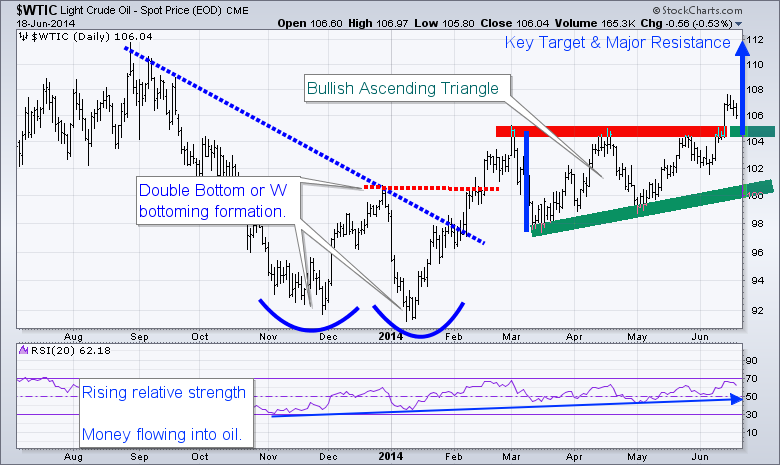
WTI Crude Oil on the Move $112 Next Stop

The energy sector has surged during the last two months which can be seen by looking at the XLE Energy Select Sector Fund. If crude oil continues to climb to the $112 level, XLE will likely continue to rally for another few days or possibly week as energy stocks are considered a leveraged way to play energy price movements.

Another way to look at this info is through the USO United States Oil Fund. This tracks much closer to the price of oil. The only issue is that many ETFs that “try to track” an underlying commodity is in how the funds are built. They own multiple contracts further into the future which does not exactly provide us with the short term news/event driven price movements in the current front month contract as they should.

What does this mumbo jumbo mean? Well, it means funds like USO and the highly respected UNG, and VIX ETFs… (just joking about the highly respected part), fail to track the underlying commodity or index very well when it comes to short term price movements. This means, you can nail the timing of a trade, and the commodity or index will move in your favor, yet your fund loses money, or goes nowhere...

Let’s Focus on the Technicals Now….


WTI crude oil has formed a bullish ascending triangle pattern from March to May of this year. The breakout to the upside is bullish and should be traded that way until the chart says otherwise. This breakout and first pullback must hold, or I will consider it a failed breakout. So if price dips and closes 2 days below the breakout level, it will be a major negative for oil in my opinion.

The range of the ascending triangle provides us with a measured move to the upside which is $112. Typically the first pullback after a breakout can be bought. The first short term target to scalp some gains would be $109, and at that point moving your stop to breakeven is a wise decision. Trading is all about managing capital and risk, if you don’t, then the market will take advantage of your lack in discipline.

Looking further back on the chart, you can see the double bottom formation also known as a “W” formation. Once the high of the “W” formation is broken the trend should be considered neural or up.

Also note that the RSI (relative strength) has been trending higher for some time now. This means money is rotating into this commodity. This is in line with my interview this week with Kerry Lutz and my recent article talking about the next bull market in commodities and the TSX (Toronto Stock Exchange).

clfutures


WTI Crude Oil Trading Conclusion:


In short, oil has some extra risk around it. The recent move has been partly fueled by news overseas. So at any time oil could get a lift or take a hit by news that hits the wires. I tent to trade news related events with much less capital than I normally do because of this risk.

Happy Trading,
Chris Vermeulen

WANT MORE TRADE IDEAS? GET THEM HERE: THE GOLD & OIL GUY.COM